
This article first appeared in Kannada in ಕ್ಷ ಕಿರಣ, Dr Shashikiran Umakanth’s column in the Vishwavani daily. The Inside Story is its English edition. ಈ ಲೇಖನವನ್ನು ಕನ್ನಡದಲ್ಲಿ ಓದಿ
You get up in the morning, and your whole body feels held in a grip. Your hands, your feet, everything.
Have you heard an old wooden door whose hinges have rusted? Keech… keech… It creaks, and it will not swing smoothly. Do the joints of your hands and feet feel like that when you wake up?
If they do, do not brush it off as the usual winter body ache, or as “gastric”. It may be rheumatoid arthritis, a disease that goes after the joints. In Kannada, many people call it sandhivata.
Last time we spoke about autoimmune diseases, where the body’s own defence force turns on us like a mad dog. Now imagine that guard dog taking aim at our joints. That is rheumatoid arthritis.
In some people, an autoimmune disease makes the body’s defence system attack its own body. Rheumatoid arthritis is one such problem.
Fire Inside, Smoke Outside
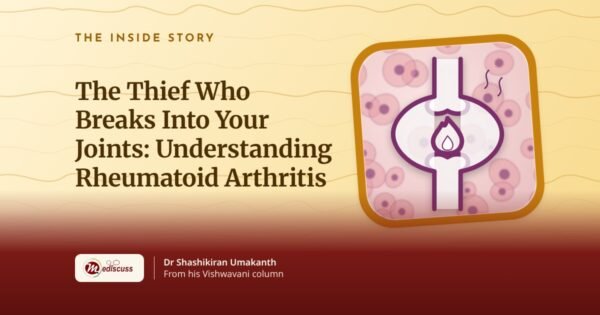
Think of the place where two bones meet. That is a joint. Inside it there is a soft lining and an oily fluid, so that the bones can glide over each other without a fuss.
Sometimes our immune system, the defence force, gets confused. It attacks this very lining. And a great battle begins right there!
When the battle rages inside, you see its smoke outside: swelling, redness and severe pain.
How Do You Recognise It?
Many of us know the joint pain of old age, called osteoarthritis, where the bone wears down with the years. Rheumatoid arthritis is very different. Two things set it apart.
- It strikes both sides, evenly. If the right wrist swells up, the left wrist usually begins to hurt as well.
- Morning stiffness that lasts. When you wake up, your fingers are so stiff that you cannot bend them. It stays that way for at least half an hour. Put your hands in warm water, or walk about for a while, and the pain eases.
A Guest, or a Thief?
Many people get severe joint pain after dengue, chikungunya or even an ordinary viral fever. Think of a wedding at home. The guests have gone, but the noise and the mess hang about in the house for a while. Joint pain after a viral fever is like that. It troubles you for a month or two at the most, and then it leaves by itself.
That is why a doctor will not say “this is rheumatoid arthritis” the moment your joints start to hurt. The doctor waits and watches for at least six weeks.
If the pain and swelling are still there after six weeks, the doctor thinks: aha! This is no passing guest. This one has come to camp in your house for good. It may be a thief like sandhivata, and the doctor goes on to the next tests.
Our people have a habit of pinning a label on every pain… “It’s nothing, never mind. It was the potato I ate last night. It turned to gas and has caught my joint!” Or: “I’ll get a massage”, and out comes a great deal of oil, rubbed in hard.
But when the immune system has set the house on fire from inside, what is the use of smearing oil on the outside?
Ignore it like this, and in time the joints are destroyed. The fingers turn crooked, and the damage stays for life.
The Golden Time
There is a golden time for this. If the disease is recognised in the first few months and the right medicines are started, damage to the joints can be stopped.
Do not lie down because of the pain, either. The joints only get stiffer. A little gentle exercise of the right kind, as your doctor advises, matters a great deal.
And when joint pain starts suddenly, please do not treat yourself.
Get the treatment that calms the anger of the defence system at the right time, and your joints will not rust. They can keep moving smoothly to the very end of your life!