
Glucocorticoid Equivalence Calculator
Equivalent doses between steroids, and where the mineralocorticoid cover will not match · v1.2- Enter the current glucocorticoid, its total daily dose and the drug you intend to change to.
- Enter the total daily dose, not the dose per administration: 10 mg three times a day goes in as 30.
- You get the equivalent anti-inflammatory dose, rounded to a prescribable figure.
- Read the two flags beside it: the change in duration of action, which decides the dosing frequency, and any mineralocorticoid cover lost on the way.
- Inhaled, topical, intranasal, ophthalmic and intra-articular preparations. It converts systemic doses.
- A tapering schedule, or stress and sick-day cover.
- The fludrocortisone dose where a switch removes mineralocorticoid cover. It flags the loss and does not size the replacement.
- A weight-based dose for a child. The only input is a total daily dose in milligrams, with no age and no weight beside it.
1. Current Regimen
2. Target Regimen
Clinical Context & Pearls
The equivalence tables give you a baseline, not a promise. Receptor affinity, protein binding and organ dysfunction all move the response, so two patients on equivalent doses will not always look equivalent. Convert, then watch the patient.
1. The 100-25-4 Equivalence Mnemonic
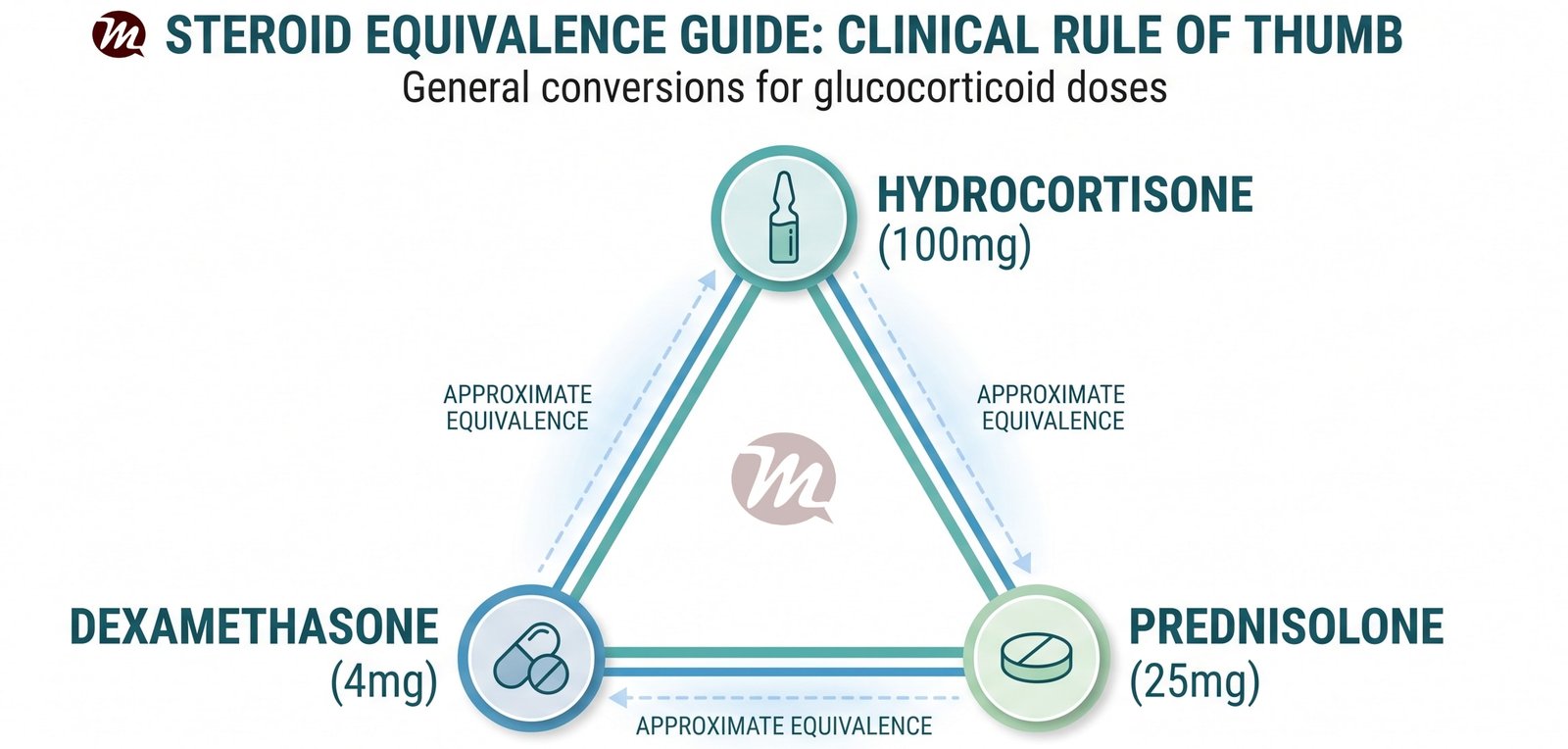
The bedside mnemonic for the standard potency ratios is 100 = 25 x 4. It is the one worth carrying into a resuscitation, where nobody is going to open a table:
- 100 mg of Hydrocortisone is the physiological baseline.
- 25 mg of Prednisolone is roughly the same anti-inflammatory dose.
- 4 mg of Dexamethasone is roughly the same again. (Strict pharmacological arithmetic puts it nearer 3.75 mg. The rule is taught with 4 mg, and 4 mg is what a ward uses.)
2. Mineralocorticoid Activity (Sodium Retention)
An equivalence table converts the glucocorticoid effect and says nothing at all about the mineralocorticoid one. In septic shock or an Addisonian crisis, that silence is the error that costs the patient.
- Hydrocortisone has a 1:1 ratio of glucocorticoid to mineralocorticoid effect. It is the drug of choice for primary adrenal insufficiency.
- Dexamethasone, Betamethasone and Triamcinolone have practically zero mineralocorticoid activity. Methylprednisolone has about half that of hydrocortisone, which is less than prednisolone and is not zero: the comparison table in the result carries the figure for each agent.
- Switching a patient with primary adrenal insufficiency from Hydrocortisone to Dexamethasone removes the mineralocorticoid cover, and the blood pressure can fall from sodium wasting unless Fludrocortisone is added. In secondary or glucocorticoid-induced adrenal insufficiency the zona glomerulosa still works, and the 2024 ESE and Endocrine Society joint guideline recommends against fludrocortisone. Which kind of adrenal insufficiency this is decides the answer.
3. Biological Half-Life & Dosing Frequency
You cannot convert a long-acting steroid to a short-acting steroid and maintain the same dosing frequency.
- Short-acting (8-12 hours): Hydrocortisone, Cortisone. Must be dosed BID to QID.
- Intermediate-acting (12-36 hours): Prednisolone, Methylprednisolone, Deflazacort. Can be dosed OD or BID.
- Long-acting (36-72 hours): Dexamethasone, Betamethasone. Dosed OD.
4. HPA Axis Suppression & Tapering
Any patient on a dose greater than the physiological equivalent of 5 mg Prednisolone per day for more than 3 weeks must be assumed to have Hypothalamic-Pituitary-Adrenal (HPA) axis suppression.
- Abrupt cessation will cause acute secondary adrenal insufficiency.
- Above 7.5 mg of Prednisolone equivalent, the disease activity sets the pace of the taper. Below it, the adrenal glands do: slow the reduction to something like a 1 mg drop every 1-2 weeks, and give the axis the time it needs to restart its own cortisol.
5. Hepatic Impairment Note
Prednisone and Cortisone are inactive prodrugs that must be converted by the liver (via 11-beta-hydroxysteroid dehydrogenase) into active Prednisolone and Hydrocortisone. In patients with severe hepatic impairment, bypass the liver and prescribe Prednisolone or Hydrocortisone directly.
Abbreviations
BID (Twice Daily) · GC (Glucocorticoid) · HPA (Hypothalamic-Pituitary-Adrenal) · MC (Mineralocorticoid) · OD (Once Daily) · TDS/QID (Three/Four Times Daily)References
- Liu D, Ahmet A, Ward L, et al. A practical guide to the monitoring and management of the complications of systemic corticosteroid therapy. Allergy Asthma Clin Immunol. 2013;9(1):30. PMID 23947590.
- Beuschlein F, Else T, Bancos I, et al. European Society of Endocrinology and Endocrine Society Joint Clinical Guideline: Diagnosis and Therapy of Glucocorticoid-induced Adrenal Insufficiency. J Clin Endocrinol Metab. 2024;109(7):1657-1683. PMID 38724043.
- Czock D, Keller F, Rasche FM, Haussler U. Pharmacokinetics and pharmacodynamics of systemically administered glucocorticoids. Clin Pharmacokinet. 2005;44(1):61-98. PMID 15634032.
- Bornstein SR, Allolio B, Arlt W, et al. Diagnosis and treatment of primary adrenal insufficiency: an Endocrine Society clinical practice guideline. J Clin Endocrinol Metab. 2016;101(2):364-389. PMID 26760044.
- Griggs RC, Miller JP, Greenberg CR, et al. Efficacy and safety of deflazacort vs prednisone and placebo for Duchenne muscular dystrophy. Neurology. 2016;87(20):2123-2131. PMID 27566742.
- Mulavelil R, Finny P, David A, Samuel PS, Armstrong LJ. Glucocorticoid use and misuse in a rural community of Kerala, India. Indian J Endocrinol Metab. 2022;26(3):234-238. PMID 36248048.
- Dineen R, Thompson CJ, Sherlock M. Adrenal crisis: prevention and management in adult patients. Ther Adv Endocrinol Metab. 2019;10:2042018819848218. PMID 31223468.
- Broersen LHA, Pereira AM, Jorgensen JOL, Dekkers OM. Adrenal insufficiency in corticosteroids use: systematic review and meta-analysis. J Clin Endocrinol Metab. 2015;100(6):2171-2180. PMID 25844620.
How to Cite This Tool
DOIhttps://doi.org/10.5281/zenodo.22401647
AMA Style:Umakanth S. Glucocorticoid Equivalence Calculator. Version 1.2. MEDiscuss Clinical Decision Support System. Published 2026. Accessed . https://mediscuss.org/cdss/steroid-converter. doi:10.5281/zenodo.22401647
Vancouver Style:Umakanth S. Glucocorticoid Equivalence Calculator [Internet]. Version 1.2. MEDiscuss.org; 2026 [cited ]. Available from: https://mediscuss.org/cdss/steroid-converter. doi:10.5281/zenodo.22401647
Save this calculation
Whatever you type here stays on this device and is not sent anywhere. The server receives only a scrambled code made from it, so nobody with access to the server can tell which patient a saved calculation belongs to. Enter the same nickname the next time to see that patient's earlier values. What is stored