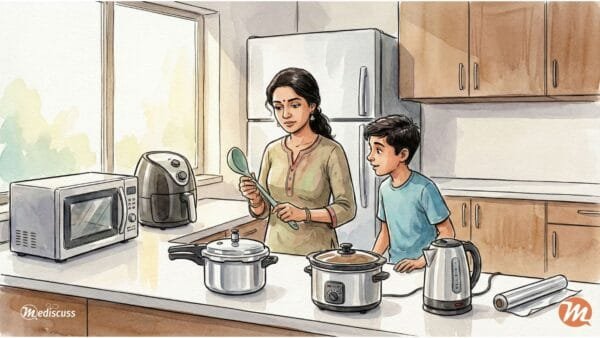
The Healthy Kitchen: A Physician's Guide to Health & Safety
This six-part series explores what we can learn from traditional kitchen wisdom about creating a truly healthy kitchen, separating marketing myths from reality, and understanding that health begins long before food reaches your mouth.
As a physician practicing in Udupi, I've witnessed a curious pattern in my OPD consultations. Patients following perfect diets and active lifestyle also often present with unexplained evidence of inflammation and chronic fatigue.
The pattern emerged slowly. A software engineer microwaving lunch in plastic containers. A young mother using the same cooking oil for many days of deep frying. A family relying entirely on packet masalas, unaware of the sodium load accumulating meal after meal.
I started asking different questions:
How are you preparing this food? What oil are you cooking it in?
When did you last replace your non-stick pans?
How do you store and reheat leftovers?
What do you do with your cooking oil after frying?
The answers revealed something I hadn't realized earlier: the environment where food is prepared matters as much as the food itself.
This series bridges two worlds: (1) Evidence-based clinical medicine and (2) Time-tested culinary wisdom.
It's written for (1) families wanting to create genuinely healthy kitchens, (2) patients dealing with unexplained symptoms despite "clean" diets, and (3) anyone willing to question whether kitchen convenience might come with hidden costs.
The Healthy Kitchen: A Physician's Guide to Health & Safety
This six-part series explores what we can learn from traditional kitchen wisdom about creating a truly healthy kitchen, separating marketing myths from reality, and understanding that health begins long before food reaches your mouth.
As a physician practicing in Udupi, I've witnessed a curious pattern in my OPD consultations. Patients following perfect diets and active lifestyle also often present with unexplained evidence of inflammation and chronic fatigue.
The pattern emerged slowly. A software engineer microwaving lunch in plastic containers. A young mother using the same cooking oil for many days of deep frying. A family relying entirely on packet masalas, unaware of the sodium load accumulating meal after meal.
I started asking different questions:
How are you preparing this food? What oil are you cooking it in?
When did you last replace your non-stick pans?
How do you store and reheat leftovers?
What do you do with your cooking oil after frying?
The answers revealed something I hadn't realized earlier: the environment where food is prepared matters as much as the food itself.
This series bridges two worlds: (1) Evidence-based clinical medicine and (2) Time-tested culinary wisdom.
It's written for (1) families wanting to create genuinely healthy kitchens, (2) patients dealing with unexplained symptoms despite "clean" diets, and (3) anyone willing to question whether kitchen convenience might come with hidden costs.
To provide the best experiences, we use technologies like cookies to store and/or access device information. Consenting to these technologies will allow us to process data such as browsing behavior or unique IDs on this site. Not consenting or withdrawing consent, may adversely affect certain features and functions.
Functional
Always active
The technical storage or access is strictly necessary for the legitimate purpose of enabling the use of a specific service explicitly requested by the subscriber or user, or for the sole purpose of carrying out the transmission of a communication over an electronic communications network.
Preferences
The technical storage or access is necessary for the legitimate purpose of storing preferences that are not requested by the subscriber or user.
Statistics
The technical storage or access that is used exclusively for statistical purposes.The technical storage or access that is used exclusively for anonymous statistical purposes. Without a subpoena, voluntary compliance on the part of your Internet Service Provider, or additional records from a third party, information stored or retrieved for this purpose alone cannot usually be used to identify you.
Marketing
The technical storage or access is required to create user profiles to send advertising, or to track the user on a website or across several websites for similar marketing purposes.