
God’s Mother Tongue
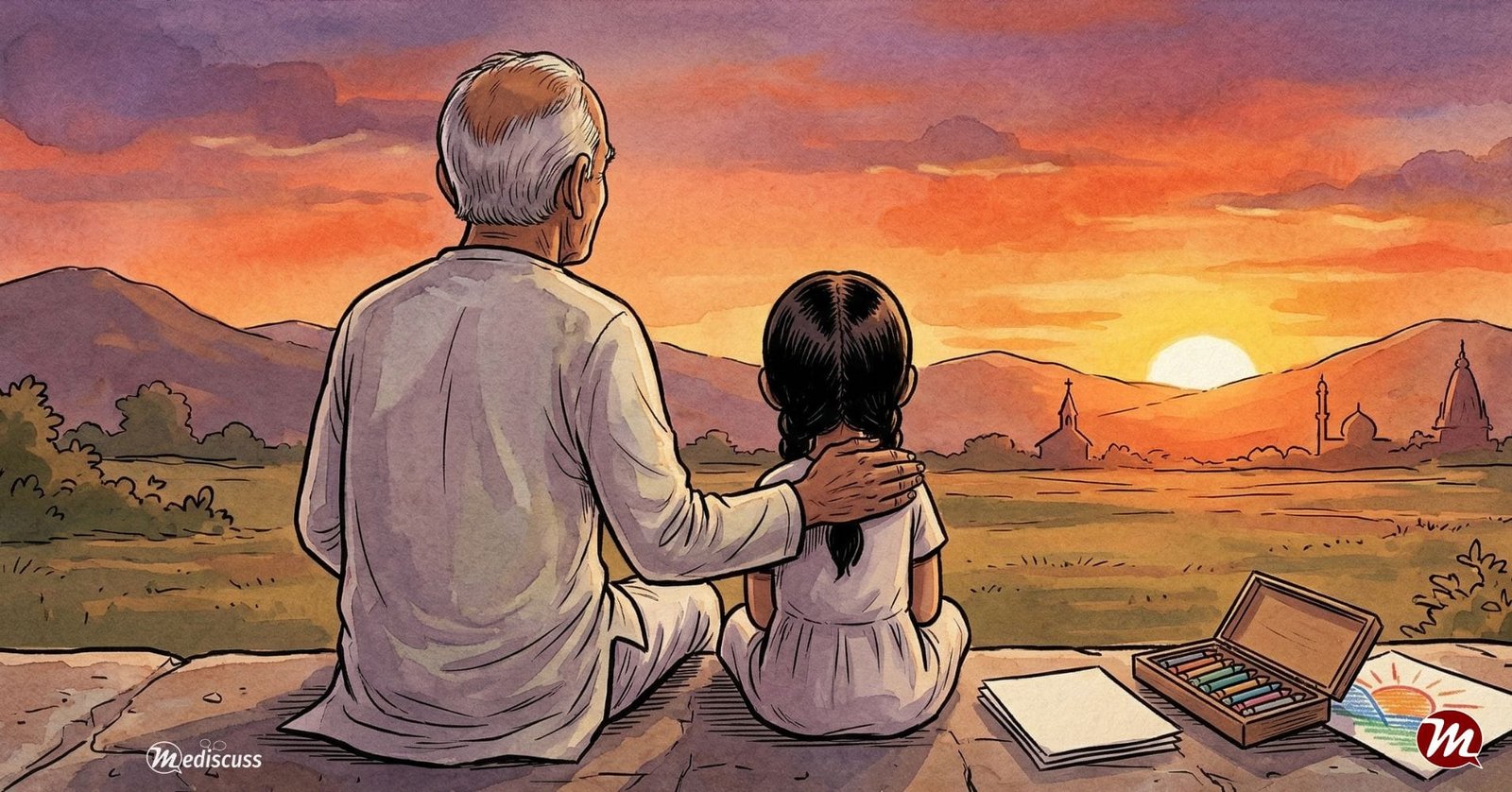
“Ajja,” Maya said.
She was eight years old, and she had her grandfather’s habit of staring at the sky when something was bothering her. The evening sun was setting in a magnificent fiery orange.
“Does God have a favourite language?”
Her grandfather did not answer immediately.
“Why do you ask, Chinnu?”
“John prays in English. We pray in Sanskrit. Zara, from my class, prays in Arabic.” She stared at the horizon. “So are there different Gods? One for each of us?”
He placed a hand on her shoulder. Warm. Steady.
“Look at that sun, Maya. What is it doing right now?”
“Setting.”
“And is it setting only for us?”
She thought about this. “No. It’s setting for all of us here… For Zara. And for John.”
“Yes,” he said quietly. “The very same sun.” He paused. “Ekam sat, vipra bahudha vadanti.“
Maya looked up at him. “What does that mean, Ajja?”
“It’s from the Rigveda, Chinnu. Very old. Very wise. It means…” He tilted his head, the way he always did when he was choosing words carefully. “Truth is one. But wise people describe it in many different ways.”
“So, does Truth mean God?”
“Yes. And God is one. And all of us, each in our own language, are just trying to describe the same one.”
She turned this over in her mind. Then she nodded, once, as though filing it away for later.
But only for a moment.
“But Ajja.” She was frowning again. “If God is one, then why do we have so many gods? We have Ganesha, and Vishnu, and Shiva, and Saraswati…”
“Yes,” he said, smiling now.
“That’s not one. That’s many.”
He laughed softly. “You’re right. It looks like hundreds.”
…
He was quiet for a moment, watching the edge of the sun hide behind the hills. “Tell me something. Your principal at school, what do you call her?”
“Madam.”
“And at home, what do they call her?”
“She’s Mrs. Kumari. And I think her husband calls her Sunita.”
“And her children?”
Maya thought. “Amma, probably.”
“So.” He raised an eyebrow. “Is she four different people?”
The frown dissolved slowly. “No. She’s the same person. Just… different people call her differently.”
“Exactly. Now, God is far more vast than any person. Far more vast than anything we can ever imagine in our minds. So our ancestors did something very human. They looked at all the things God does, all the qualities God has, and they gave each quality its own name. Its own face. Its own story.” He paused. “Ganesha for wisdom and new beginnings. Saraswati for learning. Lakshmi for abundance. Vishnu for Sustenance. Shiva for the great cycle of creation and dissolution.”
“Like… different departments?” Maya offered.
Her grandfather burst out laughing.
“Yes, chinnu. Exactly like different departments. But all in the same office.”
She giggled. Then went quiet again, thinking hard. “And Zara’s God?”
“The same office,” he said simply. “No departments. Just one. That is their way of describing the vastness. One name. Undivided. Indescribable.”
“And John’s God?”
“Also the same. They say God is three things at once, Father, Son, and Spirit, yet still one. A different way of describing something that is simply too big for any one to describe.”
Maya stared at the sky for a long time.
“So nobody’s wrong,” she said finally.
“They’re all just… drawing the same thing. But with different crayons.”
Her grandfather looked at her. Something shifted in his face.
He had just heard a child say something that would take a philosopher a full page to explain.
“Different crayons,” he repeated. “I’m going to remember that, Chinnu.“
…
Maya smiled, pleased. Then, almost immediately: “‘God’ is what John calls that truth. What do we call it, Ajja?”
He was quiet for just a moment. Not because he didn’t know. But because he wanted to find the right words for an eight-year-old.
“We call it Brahman, the original source” he said. 1
Maya’s eyebrow went up. “Like a Brahmin?”
“Sounds similar. Completely different thing.” He shook his head gently. “Brahmana is the name for a community of people. Brahman, this Brahman, comes from a Sanskrit root word that means to expand. To grow, without limit, in every direction, forever.” He opened his hands slowly, as if releasing something into the evening air. “It’s not a person. Not a king on a throne somewhere. It’s the very ground of everything that exists.”
“What does that mean?”
“It means it’s in the sun. It’s in the soil. It’s in you. It’s in your friends. It’s in the stars and even in the space between the stars.”
Maya looked at her own hands.
“So it’s not outside us?”
“It’s outside us. And inside us. Both at once.” He smiled at her expression. “I know. It’s a lot.”
“It’s very lot,” she said, seriously.
…
Before this Earth existed, before the first ocean formed or the first breath was taken, something set the whole thing in motion. That original spark, that first cause, that force which decided the universe would exist rather than not exist, that is what most human beings, across the entire history, have called God.
One source. Not many.
The same energy that cracks open a seed in dark soil is the same energy holding galaxies in their spinning orbits. This is not poetry. It is, in a way, the most logical thing in the world. You cannot have two original sources. If something is truly the beginning, there must only be one.
….
And yet. Look around.
Dozens of religions. Hundreds of holy texts. Thousands of different prayers rising into the same sky at the same time. And sometimes, sad to note, people arguing bitterly that their particular name for God is the only correct one.
How did we get here?
…
The answer is simpler than you might think.
Religion is like language.
Look at our sun.
Every human being who has ever lived has felt the heat of the same sun on their face. The same star. The same light. But because our ancestors lived in different corners of the world, because they spoke different languages and built different cultures, they each invented their own word for it.
Here are just 12 examples of the hundreds of languages and scripts that name our sun:
- English: Sun
- Sanskrit (Indian): आदित्य – Āditya
- Kannada (Indian): ಸೂರ್ಯ – Surya
- Tamil (Indian): சூரியன் – Suriyan
- Arabic (Middle Eastern): شمس – Shams
- Mandarin Chinese (Asian): 太阳 – Tàiyáng
- Japanese (Asian): 太陽 – Taiyō
- Spanish (European): Sol
- Greek (European): Ήλιος – Helios
- Swahili (African): Jua
- Quechua (South American): Inti
- Ancient Egyptian: 𓇳 – Ra
Twelve words. Twelve scripts. Twelve languages. One sun.
Nobody argues that the Spanish Sol is a different object from the Kannada Surya.
We all understand, without being told, that the word changes but the thing itself does not. The sun does not become something else just because you cross a border, or speak a different language.
…
And yet, when it comes to God, we forget this. Completely.
…
Thousands of years ago, human beings were trying hard to understand the universe. They looked at the stars, at the floods and the droughts, at the mystery of birth and the quiet finality of death.
So they built religions. Not to divide themselves. To explain what they were feeling. To give names to something that was, and still is, too vast for any single name to fully hold.
A child born in the Sahara will describe God differently than a child born in the Himalayas. Their food is different. Their music is different. Their sky looks different. Naturally, their prayers are different too.
But the feeling underneath? Identical.
The peace of mind that comes to a person during a temple aarti is the same peace that fills a church during prayers, the same peace in a mosque at Fajr, and the same peace that a person finds sitting alone under an old tree.
This is what the Upanishads understood, in that phrase that has survived thousands of years: Ekam sat, vipra bahudha vadanti. Truth is one. The wise speak of it in many ways.
…
I have sat beside many deathbeds.
A Hindu woman, her daughter reading the Vishnu Sahasranama in a voice that kept breaking. A Muslim grandmother, her family gathered close, prayers moving on their lips like breath. A Christian man, his daughter pressing a small crucifix into his palm.
I am the same doctor for all of them. I hold with the same hand. I watch the same vital signs slow and quiet. And I can tell you this with certainty, not as a philosopher, but as a physician who has stood in that particular silence.
In that last moment, the fear on every face looks identical. And so does the peace, when it finally comes.
Whatever they called it, they were all reaching for the same thing.
…
The light had gone from the sky, leaving only a shade of purple seen just after the sun disappears. Maya had her head leaning against her grandfather’s arm.
“So,” she said softly. She was still thinking. “When Zara prays in Arabic, John prays in English, and I pray in Sanskrit… God hears all of us?”
He pulled her close.
“Always, Chinnu.”
He looked up at the stars visible now. “God does not listen to the words. God listens to what is behind the words. And behind every prayer, in every language, the feeling is the same.”
Maya was quiet for a moment. Then, “Like the sun,” she said. “It doesn’t matter what you call it. It just feels warm.”
Her grandfather did not say anything for a while. He simply held her.
“Exactly,” he said at last. “It just feels warm.”
…
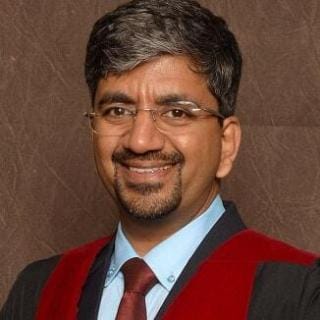
Dr. Shashikiran Umakanth (MBBS, MD, FRCP Edin.) is the Professor & Head of Internal Medicine at Dr. TMA Pai Hospital, Udupi, under the Manipal Academy of Higher Education (MAHE). While he has contributed to nearly 100 scientific publications in the academic world, he writes on MEDiscuss out of a passion to simplify complex medical science for public awareness.
References
- Brahman on Wikipedia: https://en.wikipedia.org/wiki/Brahman
 wpDiscuz