
AI vs. Doctors: Why the Knowledge Era is Dead
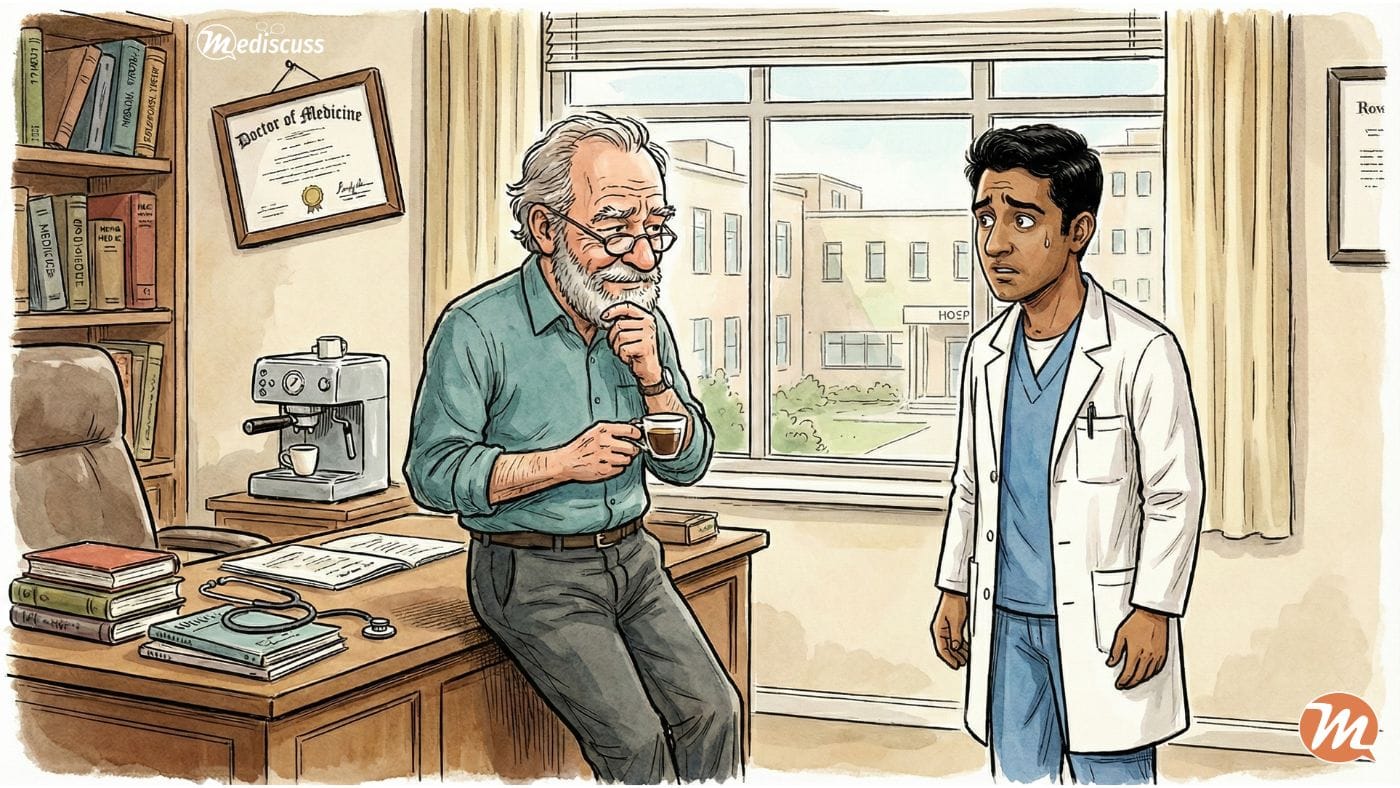
It’s 11 AM. The Professor’s office.
The espresso machine screams to life… that loud whirrrr that cuts through everything. The Professor’s tamping coffee grounds. Precise. Methodical.
Arjun: Sir, I’m quitting. I’m done.
Professor: Quitting? You’re a final-year resident. Three months from freedom. Sit down. Take this.
Arjun takes the cup. His hands are shaking.
Arjun: Thank you. But Sir, you saw the news. That tech giant dropped their clinical diagnostic plugin yesterday. It’s over. They’re saying it passed the USMLE with scores higher than 99% of humans. It diagnosed a rare autoimmune condition in seconds… a case three specialists missed for years. Seconds, Sir. So why am I memorizing the CHA2DS2-VASc score? Why am I calculating Child-Pugh or Well’s at 3 AM? Why am I learning physical signs a camera can see better? I’m obsolete. And the therapeutic plugin? That’s coming too.
Professor: Drink the coffee. Dark roast. Arabica with 20% Robusta for that extra caffeine kick. Very stimulating.
Arjun: You’re not listening! In two years, we won’t just have software. We’ll have humanoids. Hyper-realistic robots with warm skin. Perfect eye contact. They’ll hold a patient’s hand, scan retinas, listen to hearts without a stethoscope. They’ll know every drug interaction in history. They won’t get tired. They won’t complain about canteen food. Or about each other. Who’s going to hire me?
The Professor sips slowly. He’s actually enjoying this.
Professor: No hospital administrator will hire you. That’s certain.
Arjun: Exactly! So I should leave. I’ll go into… I don’t know. Agriculture?
Professor: Robots will do that too. And they won’t complain about the weather. Listen to me, Arjun. You’re panicking. You’re thinking like a machine thinks… you’re just calculating. Let’s look at the stakeholders. Who benefits from this?
Arjun: Patients win. Rural patients finally get world-class diagnostics. Insurance companies win because robots don’t order “just to be safe” MRIs.
Professor: Correct. Insurance companies will love this. They’ll pay only for the “Standard AI Protocol” because it’s programmable and cheap. They’ll refuse to pay for human doctor involvement unless it’s absolutely justified. Pharma giants? They’ll feed data directly to the programmed bots.
Arjun: And the doctors?
Professor: The average doctor is finished. The “fast-food” physician who sees a symptom, checks a chart, writes a prescription. The robot does it better. The robot doesn’t get irritable after a 24-hour shift. If your value is just your memory? You’re useless.
Arjun: That’s what I’m saying! That’s 90% of medicine!
Professor: It’s 90% of the business of medicine. It’s 0% of the art of medicine.
Arjun: Art? Sir, with respect, “art” doesn’t pay my future home loan EMI.
Professor: Let’s talk about your assumption.
He leans forward.
Professor: Imagine you’re the patient. Terminal illness. The robot comes in. Holds your hand. Its silicone skin is heated to exactly 37 degrees Celsius. Its voice is perfectly modulated—empathetic, based on analysis of thousands of grief counseling sessions. It tells you that you have three months to live. Cites the Kaplan-Meier survival curves. Offers you a pill to reduce anxiety.
Arjun: Okay.
Professor: Do you feel comforted?
Arjun: Maybe… if it’s convincing enough.
Professor: No. You know it’s simulated. Deep down, you feel it. The machine doesn’t care. It acts like it cares. But there’s no soul witnessing your pain. It’s just processing data points labeled “grief.” Just some “sattvic mode” running on a silicon chip.
Arjun: Does that matter? If the behavior’s identical?
Professor: It matters entirely. Humans crave connection. We don’t just crave solutions. We want to be seen. A robot sees your data.
He pauses.
Professor: It doesn’t see you.
Arjun: But for a simple fever…
Professor: For a fever, use the bot! I’ll use it too. Why should I waste my brain on viral fever? I’ve got things to do. Let the AI handle the monotony. That’s the “tamas” of medicine—the repetitive, dull work. Let the machines take it.
Arjun: So what’s left for us?
Professor: The complex. The messy. The grey areas. The spiritual.
Arjun: Spiritual? I thought we were scientists.
Professor: Medicine was never about fixing a machine. It was about healing a life. Sometimes, the correct evidence-based treatment isn’t what the patient needs. A robot follows the rule: “Prescribe statins.” A human doctor? They see the patient is depressed, recently widowed, won’t take the tablet anyway. The human doctor says, “Forget the statins for now. Go for a walk every day. Let’s talk in three months.”
The robot can’t break the rules. It can only optimize them.
Arjun: But the AI will learn that too, Sir. It’ll learn psychological patterns.
Professor: It can learn the pattern. It cannot feel the weight of the decision. Look, the future is split.
On one side: McDonald’s Medicine. Cheap, fast, AI-driven. Perfect for 80% of cases.
On the other side: Boutique Medicine. The “True Physician.” This doctor uses AI as a tool… just like they use a stethoscope. But the patient pays for the human. They pay for the judgment. They pay for someone who can look them in the eye and say, “I won’t let you suffer,” and mean it.
Arjun: So I have to be… a super-doctor?
Professor: You have to be a philosopher-doctor. You must understand the nature of suffering, not just the pathology of disease. Study the Gita as much as you study Guyton. Understand fear, hope, karma.
Arjun: That sounds harder than memorizing drug doses.
Professor: It is much harder. That’s why the robots can’t do it. The “knowledge era” is dead, Arjun. The AI already won that game. We’re entering the “wisdom era.”
Arjun: Wisdom.
Professor: Yes. The ability to know when to ignore the data. The ability to touch a patient and transfer confidence… not just analyze temperature. If you want to be a technician, quit now. The robot is better. But if you want to be a healer?
He looks at Arjun directly.
Professor: Stay.
Arjun stares into his dark coffee for a long moment.
Arjun: The robot can’t enjoy this coffee, right Sir?
Professor: It can analyze the chemical composition perfectly. Tell you the exact pH. But it’ll never know the joy of the first sip. That’s your edge. Never forget it. Now finish the coffee. Let’s go for rounds.
Arjun: Rounds? But Sir, the AI…
Professor: The AI is a tool. You’re the operator. Let’s go check if the machine missed anything. Let’s hold some hands.
A faint smile returns to Arjun’s face.
Arjun: Yes, Sir.
Professor: And Arjun?
Arjun: Sir?
Professor: If you ever build a website for your private practice, use WordPress. Don’t let the AI convince you to build one from scratch.
Arjun: Noted, Sir.
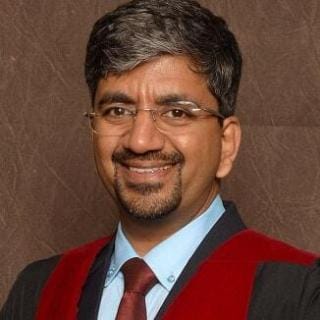
Dr. Shashikiran Umakanth (MBBS, MD, FRCP Edin.) is the Professor & Head of Internal Medicine at Dr. TMA Pai Hospital, Udupi, under the Manipal Academy of Higher Education (MAHE). While he has contributed to nearly 100 scientific publications in the academic world, he writes on MEDiscuss out of a passion to simplify complex medical science for public awareness.
 wpDiscuz