
What is ABPM? The Gold Standard for Blood Pressure Testing
We have all been there. You walk into a clinic, smell the antiseptic, see the white coat, and suddenly your heart races. By the time the cuff tightens around your arm, your blood pressure reads 150/90 mmHg. But at home, relaxed on your sofa, it is a perfect 120/80.
This is the limitation of the “snapshot” measurement. Your blood pressure is not a static number… it is a dynamic rhythm that fluctuates with every stress, meal, and hour of sleep. To truly understand your cardiovascular health, we cannot just look at a single photo; we need the full movie.
That movie is Ambulatory Blood Pressure Monitoring (ABPM).
What is ABPM?
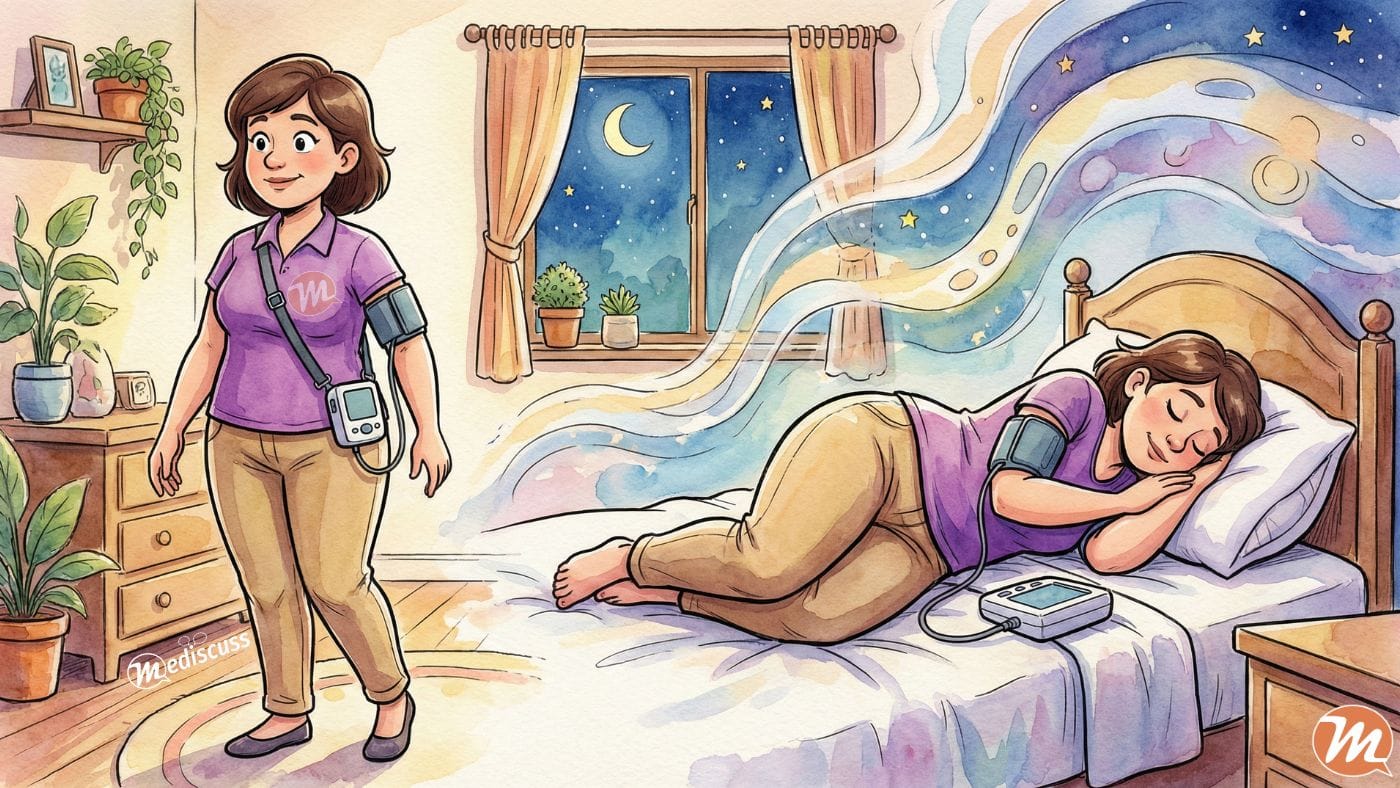
ABPM is the gold standard for diagnosing hypertension. Instead of a single reading in a clinic or hospital, you wear a small, portable device for 24 hours.
How it works:
- The Cuff: A cuff is wrapped around your upper arm, connected to a small recorder on your belt.
- The Day: It automatically inflates every 15–30 minutes during the day and every 30–60 minutes while you sleep.
- The Result: You go about your normal day, work, commute, eat, sleep, all while the device builds a complete profile of your vascular health.
The Triage: Who Needs ABPM?
We do not order this test for everyone. We use it to solve specific mysteries.
1. The “White Coat” Suspects
You have high readings in the clinic but normal readings at home. Is it real hypertension, or just anxiety?
- The Risk: Treating “White Coat Hypertension” with medication can lead to dangerous hypotension (low blood pressure) and fainting at home. ABPM tells us if you actually need pills or just reassurance.
2. The “Masked” Hypertensives
This is the dangerous opposite. Your clinic readings are normal (perhaps you feel safe there), but your work stress or home life spikes your pressure dangerously high.
- The Reality: Standard checkups miss this completely, leaving you at risk for heart attacks or strokes.
3. The Non-Dippers (The Night Watch)
Normally, your blood pressure should drop by 10–20% while you sleep. This is called “dipping”—a physiological rest period for your heart.
- The Concern: If your pressure stays high at night (“non-dipping”), your cardiovascular risk skyrockets. Only ABPM can detect this.
Clinical Pearls
- Cuff Hygiene: When the machine starts to inflate, stop moving. Relax your arm at your side. Walking or flexing your muscle during inflation will cause an error, forcing the machine to squeeze you again immediately (and tighter).
- Note: If you have Atrial Fibrillation (AFib), this test might not be for you. The irregular heart rhythm can confuse the sensor, leading to inaccurate data.
Hospital vs. Real Life
Why does a 24-hour test beat a 5-minute visit?
| Feature | Hospital Measurement (Snapshot) | ABPM (Movie) |
|---|---|---|
| Accuracy | Prone to “White Coat” highs. | Captures real-life data. |
| Data Points | 1 or 2 readings. | 50 to 70 readings. |
| Sleep Data | None. | Crucial. Assesses nocturnal dipping. |
| Prediction | Good predictor of risk. | Superior predictor of stroke & heart attack risk. |
Conclusion
ABPM changes how we treat you. It is the difference between guessing and knowing.
- If you have White Coat Hypertension: We might stop your meds.
- If you are a Non-Dipper: We might move your medication to bedtime.
- If you have Masked Hypertension: We treat you before damage occurs.
High blood pressure is a silent killer, but with ABPM, it has nowhere to hide.

Dr. Shashikiran Umakanth (MBBS, MD, FRCP Edin.) is the Professor & Head of Internal Medicine at Dr. TMA Pai Hospital, Udupi, under the Manipal Academy of Higher Education (MAHE). While he has contributed to nearly 100 scientific publications in the academic world, he writes on MEDiscuss out of a passion to simplify complex medical science for public awareness.