
The Sixth Walker: A Pilgrimage to Everest Base Camp
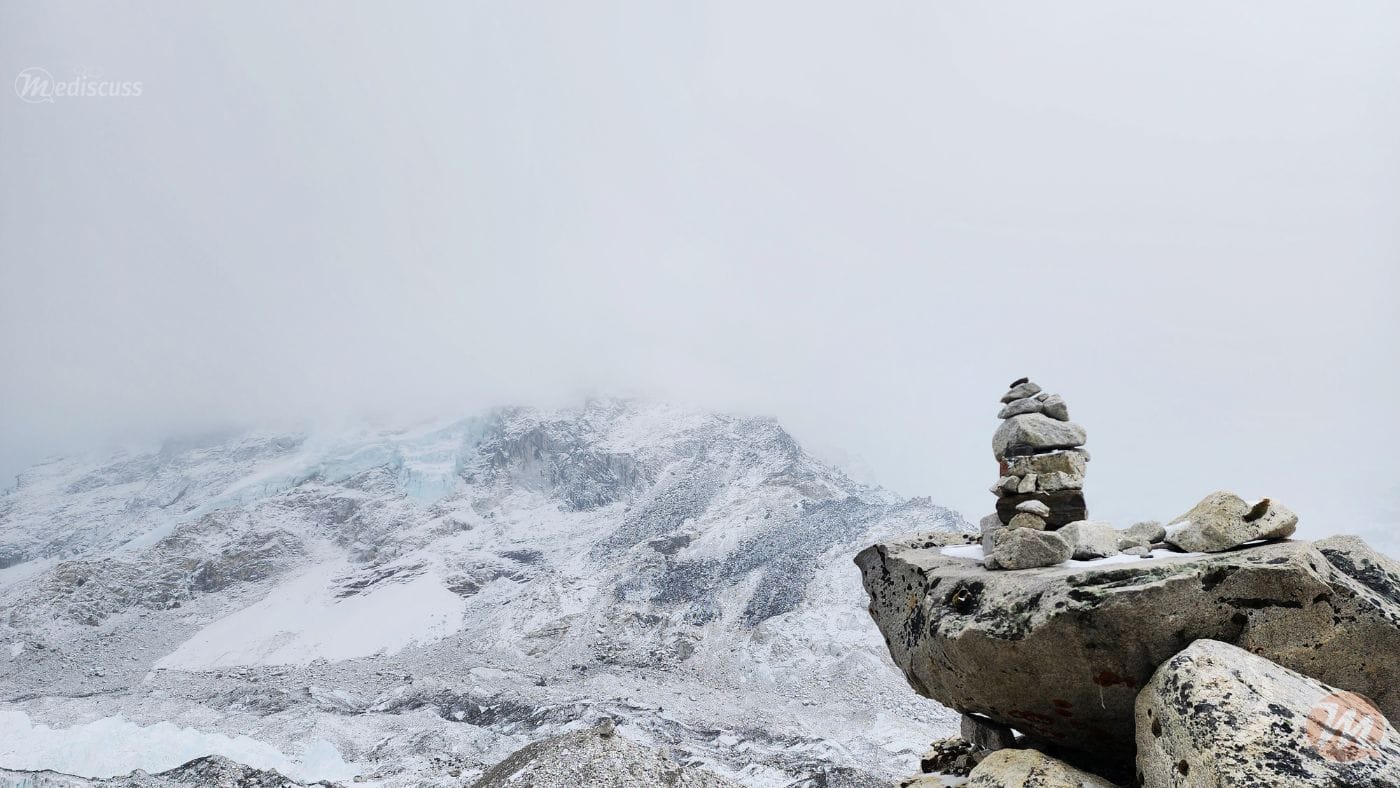
Medicine, Mortality and 5,364 Meters
In medicine, control is everything. We intervene. We stabilize. We measure life in clear, quantifiable vital signs. But the Himalayas? They don’t care about our training.
Up there, the illusion of control just evaporates. You don’t measure life in heart rates or blood pressure. You measure it in steps taken. In breaths rationed. Survival depends entirely on the permission granted by the mountains themselves.
On paper, our group was five: Dr. Dinesh, Rajesh, Prashanth, Vijay, and myself. We set out for Everest Base Camp (EBC) in April 2025. But in reality, we were a group of six. Guru – our friend, philosopher, and photographer – had passed away just months prior. His absence wasn’t just a void… it was a heavy silence walking right beside us. A constant reminder of the fragility we work so hard to preserve in the hospital.
Humility in the High Passes
Years ago, Guru gave me a piece of advice that defined this entire trip. We had trekked together to Gomukh in 2022, and he was adamant about one thing.
“Never think you are going to ‘scale’ or ‘conquer’ the Himalayas,” he told me. “That’s not possible unless the mountains allow it. You must kneel before them. Pray that they accept you.”
I took that to heart. Before leaving Kathmandu, we visited the Pashupatinath temple. Later, standing at the trailhead in Lukla, looking up at those massive peaks, I remembered his words. I knelt. Physically and mentally. This wasn’t a conquest. It was a request for safe passage.
Physiology and Perseverance
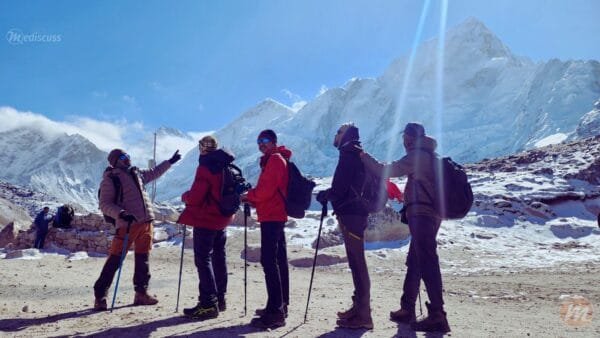
Watching our group move up the trail was like a live experiment in human physiology. Dr. Dinesh was the epitome of endurance, pacing his steps perfectly to his breath and heart rate. Rajesh had this high cardiovascular reserve… he would surge ahead, often reaching the destination before anyone else. Prashanth was our buffer, using self-deprecating humour to keep our morale oxygenated even when the air got thin. And Vijay? He was just pure humility, absorbing everything.
Then there was me.
I had stopped drinking coffee completely after my last trek. But just before Namche, something snapped. The cold bit hard. The ascent got steep. I ordered a cup of black coffee. The warmth, the caffeine, the ritual… it felt like a necessary concession at that altitude. The first sip was bitter, scalding, perfect. The warmth spread through my chest like a small fire. My fingers started to tingle back to life.
That’s when I knew. My coffee ban was over. Sometimes you need to break your own rules to survive. The caffeine romance restarted at 4,300 meters and hasn’t stopped since then.
The Convergence of Time
The trek didn’t just end at a physical destination. It ended in a rare, beautiful alignment of time.
We reached the vicinity of Base Camp on Vijay’s 50th birthday. A huge milestone in the Gregorian calendar. But by a stroke of cosmic coincidence, that same day marked my own birthday according to the Indian Panchanga (lunar) calendar.
There, at the foot of the world’s highest peak, two systems of time merged together. Solar and lunar. Western and Vedic. We cut a cake at the “World’s Highest Bakery,” celebrating life in two different dimensions simultaneously. It felt like an auspicious sign. Like we were exactly where we were meant to be.
The Shadow in the Snow
But the moment that really stuck with me happened near the Khumbu Glacier, right before the final push to EBC. We were exhausted. Grinding through the last mile.
Suddenly, a mountain dog appeared.
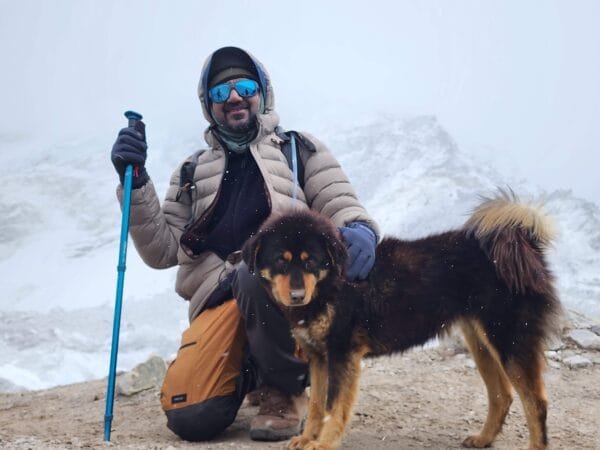
In the barren beauty of that region, logic often gives way to intuition. Mountain dogs usually keep their distance. But this one didn’t behave like a stray. It didn’t wag it’s tail. It just walked with us. Calm. Present. It even allowed me to pet it with my gloved hands. A quiet understanding passed through the group. Rajesh glanced at me, and we shared a knowing look.
Guru.
He would have been the one photographing this moment. In his own way, he was there to shepherd us through the final mile. Call it hypoxia or spirituality, but it defied medical explanation. It made perfect sense to us.
Guru was a man of nature. If his spirit was going to guide us anywhere, it would be through a creature that belonged to these mountains.
A Chant at -12°C
Reaching Everest Base Camp is often described by the number: 5,364 meters. But the subjective experience? That’s intense.
The air was thin. My pulse oximeter read a precarious 74% SpO2. Back home in Udupi, that number gets you a bed in the ICU. Here? I wasn’t in the ICU. I was just on ICE. The temperature was -12°C.
Amidst the “huff and puff” and physical exhaustion, I had one promise to keep. I had told my wife, Shashi, that my sankalpa (resolution) was to chant 21 specific shlokas from the Soundarya Lahari – a hymn to the Mother Goddess, taught by my sister Suma, at the base camp.
My breathing was heavy. The wind bit at my face. Snowflakes stuck to my lips and melted into salt. I started the first shloka.
The words came out as wheezes. Sanskrit syllables felt impossible in my oxygen-starved brain… each verse a battle between devotion and hypoxia.
I closed my eyes and heard Guru’s voice: “The mountains accept those who come with humility.”
I kept my promise. Twenty-one verses. One at a time.
The blizzard didn’t care about my devotion. The mountain didn’t pause to listen. But there, at 5,364 meters with 74% oxygen saturation, chanting ancient Sanskrit at the foot of Everest felt like bridging two worlds – the physical grandeur towering above me and something vast within.
It was a test of lung capacity, yes. But more than that, it was a test of will. I measured endurance not in distance, but in syllables spoken at the edge of what my body could do.
Departure and Closure
Our return was a decompression. Shifting from the physical challenge back to the spiritual. After the helicopter trip to Lukla and the return to Kathmandu, we went straight back to Pashupatinath for thanksgiving. Full circle.
Since our helicopter plan saved us time, we detoured to the Muktinath temple via Pokhara. We even spent quiet moments hunting for Shaligram shilas in the Gandaki river. We needed that space. To offer gratitude for our safety, and for the memory of the friend who walked it with us in spirit.
I returned to the hospital with dust on my boots and a renewed understanding. Medicine prolongs life. But friendship, memory, and meaning? That’s what sustains it.
Appendix: Expedition Logistics
For those interested in the technical planning, here is how we managed the movement.
| Phase | Route & Details |
|---|---|
| Start | Kathmandu to Lukla » Trek to Phakding. |
| Acclimatize | Two nights in Namche Bazaar (3,440m) and two nights in Dingboche (4,410m). These are non-negotiable for safety. |
| Push | Dingboche » Lobuche » Gorakshep » EBC. |
| Descend | To spare our knees and time, we trekked back only as far as Pheriche (4,240m) and took a helicopter back to Lukla. |
- Flexibility is Key: Heavy smog in Kathmandu grounded all flights to Lukla. We had to pivot immediately and charter a Manang Air helicopter to save the trip.
- The Helicopter: The chopper has a strict 500kg limit. Since I was the lightest (62kg), I sat in the co-pilot’s seat. Note: No phones allowed in the front seat. I missed the photos, but the view is burned into my memory.
Medical Tips for High-Altitude Trekking
I’ve seen the physiology of high altitude from both sides now… as a doctor and as a trekker. Here are the things you actually need to know. (For the deep dive, check out A Physician’s Guide to the High Mountains).
- Respect the Acclimatization Needs: “Climb high, sleep low” isn’t just a saying; it’s the golden rule. Even if you feel like Superman, do not skip the acclimatization days at Namche and Dingboche. Your body isn’t just resting; it’s working overtime to manufacture red blood cells and adjust enzyme systems. Give it time.
- Hydration is Essential: You lose a scary amount of water just by breathing that dry, thin air. Dehydration mimics AMS (Acute Mountain Sickness), which confuses the diagnosis. Aim for 3 to 4 liters daily. Locals swear by garlic soup for oxygenation. Placebo? Maybe. But it helps you get the fluids in, so take it.
- Monitor the Patient, Not the Number: Carrying a pulse oximeter is wise, but don’t obsess over it. Look at the bigger picture. My SpO2 dropped to 74% at EBC – ICU levels at sea level! – but I was asymptomatic aside from shortness of breath on exertion. Watch for the real red flags: headache, nausea, or dizziness. Treat the symptoms, not just the digital readout.
- Medications: Acetazolamide (Diamox) is the standard for a reason. It helps you metabolically acclimatize by inducing a mild acidosis, which stimulates your breathing. Talk to your doctor before you go. Some people are allergic and might need alternatives.
- The “Humble” Mindset: This is where medicine meets philosophy. Physiologically, stress triggers oxygen consumption. Anxiety spikes your heart rate and burns through your reserves. Guru’s advice to “kneel before the Himalayas” was actually medically sound. Approaching the trek with humility lowers your sympathetic drive. Calmness conserves energy.
So, take a breath. Kneel down. And let the mountain take you in.
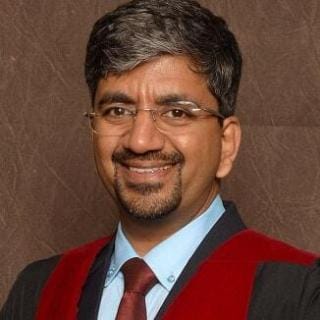
Dr. Shashikiran Umakanth (MBBS, MD, FRCP Edin.) is the Professor & Head of Internal Medicine at Dr. TMA Pai Hospital, Udupi, under the Manipal Academy of Higher Education (MAHE). While he has contributed to nearly 100 scientific publications in the academic world, he writes on MEDiscuss out of a passion to simplify complex medical science for public awareness.
 wpDiscuz