Night Owls & Heart Risk: A Physician’s Guide
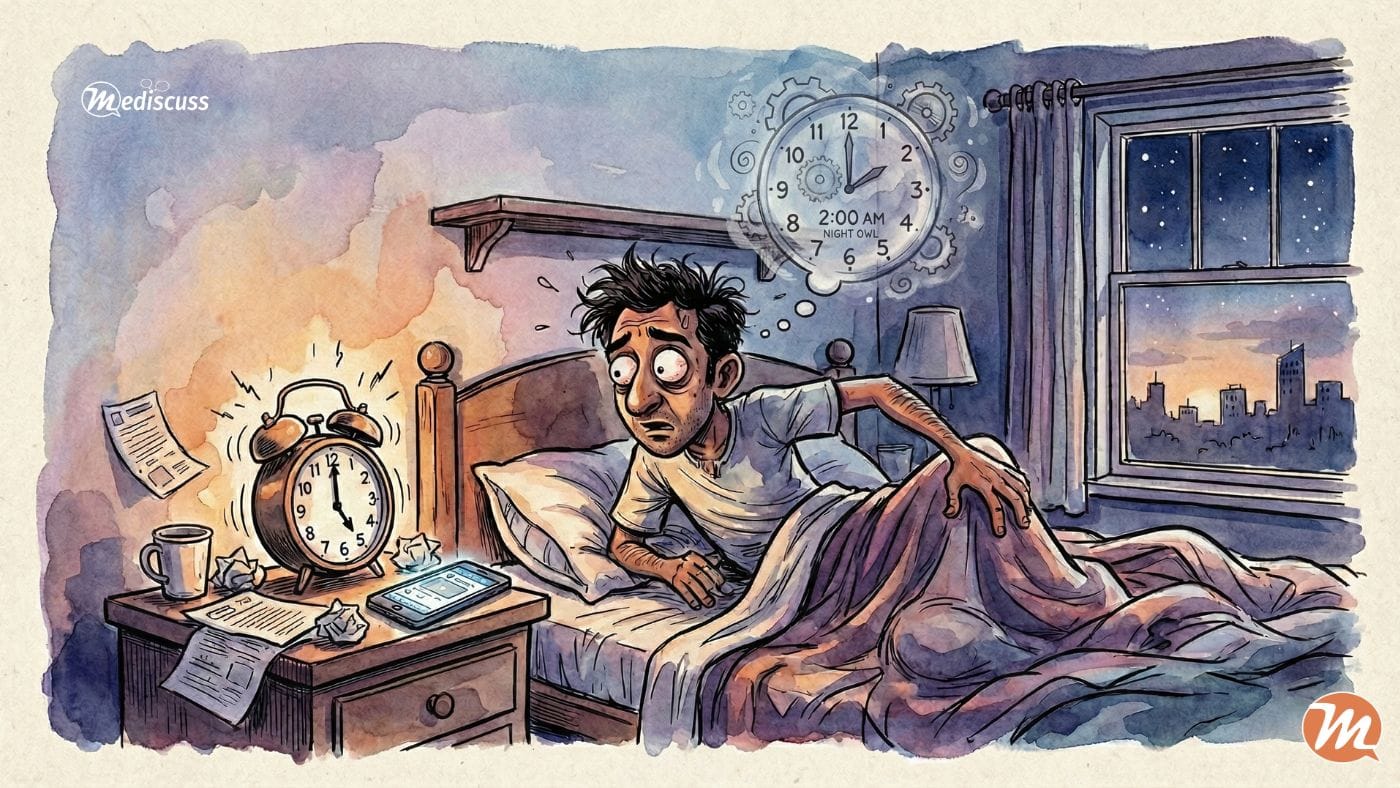
Our bodies operate on a strict 24-hour schedule known as the circadian rhythm. This internal master clock synchronizes our sleep, awake state, and metabolism with the natural cycle of day and night. When we ignore this synchronization, we fight our own physiology. The conflict between the alarm clock and the biological clock is not just annoyance… it is a medical hazard.
Before we get into the details of the medical hazard and the solutions, let’s clarify these terms and identify which type you are.
The Sleep Spectrum: What Are You?
We classify people into 3 biological categories known as “chronotypes.” This is not a habit you choose. It is a genetic setting controlled by your internal clock.
The Sleep Spectrum
- Morning Larks (Early chronotypes): These individuals wake up naturally before the sun. Their peak of alertness occurs before noon. They find it difficult to stay awake after 8:00 PM or 9:00 PM.
- Night Owls (Evening chronotypes): These individuals are most alert in the late hours. Their melatonin secretion begins much later than average. Waking early feels physically painful to them.
- Intermediate Types: Most of the population are of this type. They are between the two extremes. They typically wake around 7:00 AM and sleep by 11:00 PM. They possess the flexibility to adjust slightly in either direction.
The “Night Owl” Risk Profile
Recent research shows a worrying information for those who prefer the night. A large-scale analysis using data from the UK Biobank has highlighted a significant correlation between evening chronotypes (the night owls) and cardiovascular disease. The findings are stark. Individuals with a definitive evening preference faced a 79% higher risk of poor cardiovascular health compared to intermediate types… they also demonstrated a 16% higher risk of specific cardiovascular events like heart attack and stroke. 1
Social Jetlag
However, we must interpret these numbers with caution. Being a night owl is not inherently dangerous. The danger lies in the mismatch. Neuroscientist Matthew Walker describes this phenomenon as “Social Jetlag.” 2
Our society operates on a morning schedule. Schools start early, factories shift at dawn, corporate markets open a little after the sun. An evening person is biologically wired to sleep late… but social obligations force them to wake early. This leads to chronic sleep deprivation and circadian misalignment (disrupted sleep cycle).
The physiological cost of circadian misalignment is very high.
The cost of circadian misalignment
- Insulin Resistance: Disrupting the sleep cycle impairs glucose metabolism.
- Inflammation: C-reactive protein levels rise.
- Autonomic Stress: Waking during the “biological night” spikes cortisol and blood pressure.
It is likely that this misalignment increases the cardiovascular risk, not the chronotype itself.
Evolution and the “Lazy” Myth
We culturally celebrate the early risers. “The early bird catches the worm” implies that waking early is virtuous and productive. Conversely, we unfairly label the late sleeper as lazy or undisciplined. This is a social construct… not a biological truth.
Evolution required diversity. As historian Yuval Noah Harari notes, early human survival depended on cooperation and specialized roles. In our ancestral hunter-gatherer tribes, total synchronization would have been fatal. If everyone slept from 8:00 PM to 4:00 AM, the tribe would be at risk of attack by wild animals for that long. 3
We needed sentinels. The “night owls” were the guardians of the tribe during the dark hours, and the “larks” took over the duty from them at dawn. Both these roles were essential for the tribe’s survival. Today, we mistake their circadian difference for a lack of character.
Spirituality Meets Biology: The Brahma Muhurta
In Indian tradition, the brahma muhurta (approximately 96 minutes before sunrise) is revered. It is sattvic. Pure, quiet, and suitable for meditation. For a morning person, this is ideal. For a night owl, waking at 4:30 AM often induces tamas (lethargy) due to sleep deprivation.
Some question whether the night is rakshasa kala (time of demons). It is true that scriptures often define the twilight (sandhya) and the deep night as improper times for mundane activities like eating or bathing. However, for spiritual practice, there is a vital exception. The Dharmasindhu identifies nishita kala (the midnight window) as a highly auspicious time, specifically for mantra japa and the worship of Shiva and Shakti. It is different from the inauspicious rakshasa periods. 4
How can a night owl reap spiritual benefits without harming their heart?
1. The Midnight Alternative (nishita kala): For an evening chronotype, the mind is alert and focused around midnight. Meditation performed during this natural peak is often superior to a drowsy, forced attempt at dawn. You are honouring the silence of the night without fighting your biology.
2. Quality Over Timing: The goal of spiritual practice is a steady mind. A rested brain at 8:00 AM is more capable of focus than an exhausted brain at 5:00 AM. We must align our practice with our capacity and available time.
Comparison: Forced vs. Aligned Schedules
| Feature | Forced Early Rising (Social Jetlag) | Natural Evening Schedule (Aligned) |
|---|---|---|
| Sleep Cycles | Fragmented, often misses final REM stage | Complete, full restorative cycles |
| Blood Pressure | Increased morning surge (non-dipping) | Normal dipping pattern |
| Metabolic State | Pro-diabetic, higher ghrelin (hunger) | Stable glucose, normal leptin |
| Mental State | “Sleep drunkenness” (inertia) | High alertness and cognitive function |
The “Phase Advance” Shift Protocol
For those who must shift their schedule due to professional demands, we cannot simply “force” it to happen. We must use biology. To safely “convert” from a night owl to a morning lark without facing metabolic risks, follow this chronotherapy guide.
Guide to Convert from Owl to Lark
- Light Therapy: Upon waking up, expose yourself to very bright light for 30 minutes. This stops melatonin production and resets the suprachiasmatic nucleus (SCN).
- Melatonin: Take a low dose (0.5mg – 3mg) of melatonin 3-4 hours before your desired bedtime. This signals the brain that dusk has arrived, and it is time to wind down. Avoid screens for at least one hour before the planned bedtime.
- Weekend Rule: Maintain consistency. You cannot wake up at 6:00 AM on weekdays and 11:00 AM on Sundays. This “social jetlag” confuses the SCN and damages our progress.
- Temperature Manipulation: A hot bath 90 minutes before going to bed decreases your core body temperature when you come out of the bath, mimicking the natural signal for sleep onset.
Conclusion
We must respect the diversity of human biology. The increased heart risk for night owls is largely a symptom of a rigid society, not a lazy body. If your profession allows, honour your natural rhythm. If you have to wake early, use light therapy and strict sleep hygiene to shift your clock gently.
Health is not about conforming to a standard time… it is about harmony with your own nature.
Key Points
- Genetics matter: You cannot simply “willpower” your genes away. Forcing a shift can backfire.
- Consistency is important: If you have to wake early, you have to sleep early. You cannot burn the candle at both ends.
- Listen to your body: If you are a night owl, your “morning” might be 8:00 AM to 9:00 AM. That is acceptable if your life permits it.
- Light is medicine: Morning sunlight anchors your circadian rhythm. Plan for it immediately upon waking up.
Dr. Shashikiran Umakanth (MBBS, MD, FRCP Edin.) is the Professor & Head of Internal Medicine at Dr. TMA Pai Hospital, Udupi, under the Manipal Academy of Higher Education (MAHE). While he has contributed to nearly 100 scientific publications in the academic world, he writes on MEDiscuss out of a passion to simplify complex medical science for public awareness.
References
- Kianersi S, Liu Y, Guasch-Ferre M, et al. Chronotype, Life’s Essential 8, and Risk of Cardiovascular Disease: A Prospective Cohort Study in UK Biobank. J Am Heart Assoc. 2026. Available from: Link. Date accessed: 02 Feb. 2026.
- Walker M. Why We Sleep: Unlocking the Power of Sleep and Dreams. Scribner; 2017.
- Harari YN. Sapiens: A Brief History of Humankind. Harvill Secker; 2014.
- Dharmasindhu. Khemraj Shrikrishnadas Prakashan; Mumbai.