
Doctor, Can I Eat Sweets During Functions?
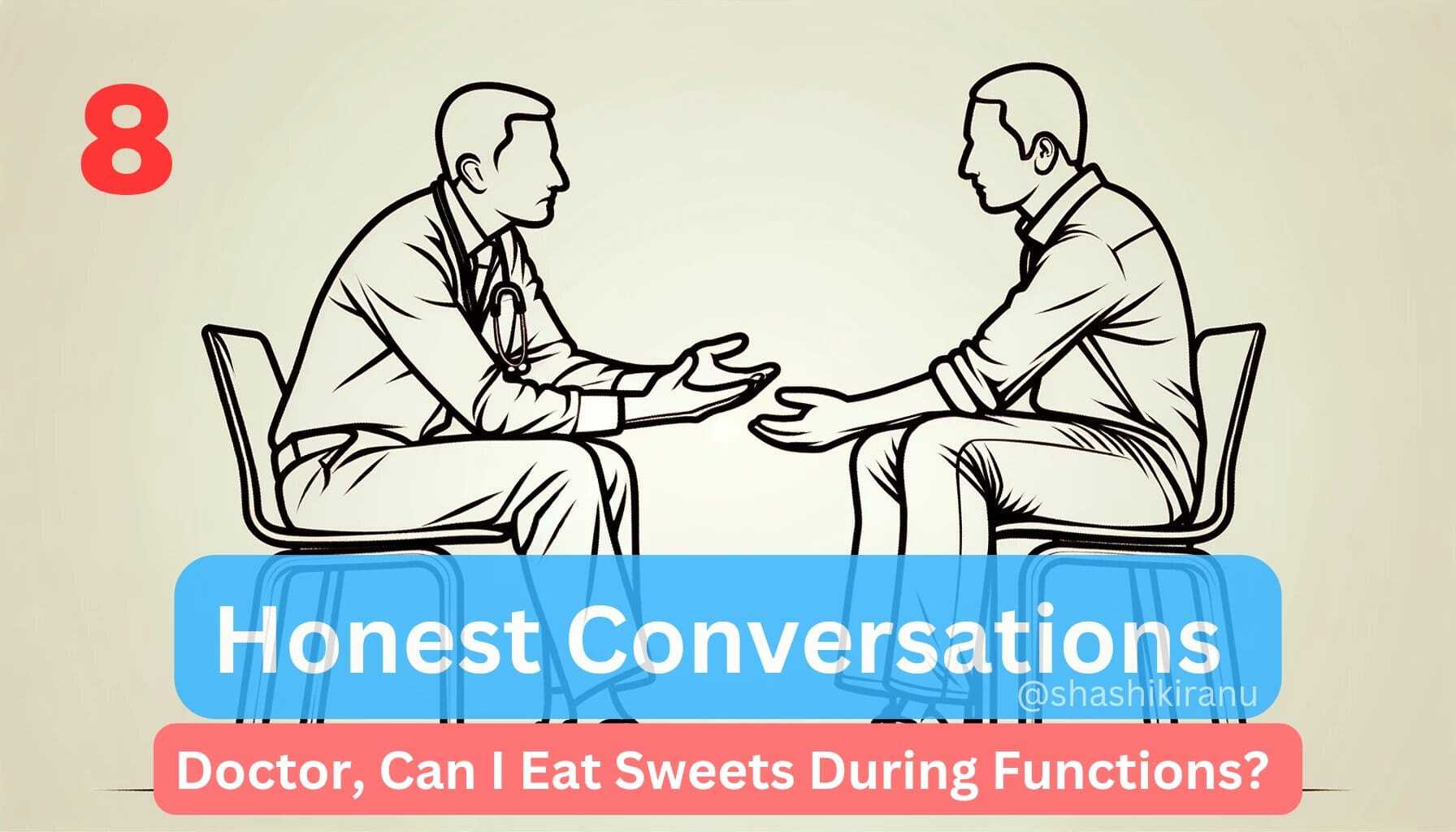
Patient: Doctor, the wedding season is starting, and I am worried about my diabetes control. In our culture, it is almost impossible to avoid sweets. If I don’t eat the payasa or sweets served on the banana leaf, the host feels offended. What should I do?
Doctor: I completely understand. In our culture, feeding someone is a sign of love and hospitality. Refusing food can feel like rejecting that love. But remember, you are not rejecting the person… you are just protecting your health. Managing diabetes does not mean you must become a monk… it just means you need a strategy.
Patient: People tell me that if the sweet is made of jaggery (bella) or palm sugar (karupatti) instead of white sugar, it is safe for diabetics. Is that true?
Doctor: That is a very dangerous myth. Jaggery has some iron and minerals that white sugar does not have, but your body processes both of them as “sugar.” Jaggery will spike your blood glucose just as fast as white sugar does. So, a bella payasa is not a “free pass,” you must treat it with the same caution as a regular sugar-containing sweet.
Patient: What about “Millet Sweets”? I see ragi laddus or foxtail millet (navane) payasa being served as “healthy options.” Can I eat more of those?
Doctor: Be careful with the “health halo” effect. Millets are good, but when you grind them into flour and mix them with generous amounts of oil or ghee along with sugar to make a sweet, they become a high-calorie energy bomb. A millet sweet is still a sweet. It might be slightly better than maida, but it will still raise your sugar levels if eaten in excess.
Patient: Can I have “just a little”?
Doctor: Moderation is key. Think of your daily calorie and sugar allowance like a daily pocket money. You have a limited budget. If you spend 80% of your pocket money on one expensive sweet (like a Mysore Pak), you have very little left for healthy food. You can have a small piece, but you must “spend” less on other things that day, like rice or chapati.
Patient: In our tradition, the sweet is always served first on the banana leaf. It is considered inauspicious to refuse the first item. How do I handle that?
Doctor: You can respect the tradition without harming your health. Allow them to serve a very small portion. Perform the ritual of touching it or eating a tiny crumb to honor the host. Then, leave the rest for the end of the meal. Eating sweets on an empty stomach causes a massive sugar spike. If you eat it after your fiber-rich vegetables and sambar, the spike is smaller.
Patient: They say, “You should not refuse Payasa because it is like refusing Lakshmi!” and “If you love your mother, you should eat Payasa!” What about these?
Doctor: That is powerful emotional pressure! But let us look at it from a different angle. We also say “arogya is bhagya” (health is wealth), right? Goddess Lakshmi represents prosperity and well-being (Arogya Lakshmi). If eating that sweet harms your body and leads to illness, aren’t you actually destroying your true wealth? You can respect Lakshmi by respecting your health.
As for the “Mother’s Love” argument… please ask yourself this. Does a mother want her child to be sick or healthy? True love is wanting you to live a long, complication-free life. You can show your love by accepting the serving with a smile, eating just one spoonful to honour the sentiment. You are accepting the love (the gesture), not the slow poison (the excess sugar).
Patient: What about temple prasada? It is often panchakajjaya or sweet pongal. My relatives say, “it is God’s prasada, it won’t harm you.”
Doctor: Bhakti (faith) is in your heart, but biology happens in your body. God gave you this body and the wisdom to protect it too. Take the prasada with devotion, touch it to your eyes with reverence, eat a pea-sized amount, and share the rest with children or others who can digest it. God understands your intention, He doesn’t want you to fall sick.
Patient: That makes sense. But once I start eating, I can’t stop, Doctor. One laddu becomes two.
Doctor: That is the “sugar trap.” Sugar is addictive. The best way to fight this is “pre-loading.” Never go to a function on an empty stomach. Eat a small, healthy snack, like a cup of salad, some nuts, or a bowl of curds, at home before you leave. Drink a glass of water as soon as you enter the serving hall. If your stomach is half-full, your craving for sweets will naturally be lower.
Patient: Some of my friends say that if I drink bitter gourd (karela/ hagalakayi) juice or methi (mentya) water in the morning, it will “cancel out” the sweets I eat at the function. Does that work?
Doctor: I wish it was that simple! While bitter gourd has mild sugar-lowering properties, it is not an antidote or a “magic eraser.” You cannot neutralize a heavy sugar load just by drinking something bitter beforehand. That is like driving rashly just because you are wearing a seatbelt.
In Kannada, sihi and kahi are opposite only in a poem. You must also understand the pathology of half-truths.
Patient: The biggest problem is when they serve it on my leaf even after I say no, I feel guilty wasting food.
Doctor: I know we believe “Annam Brahma” (Food is God) and wasting it is a sin. But treating your body like a dustbin for excess food is also not right. If they serve it despite your refusal, leave it in the corner of the leaf. You made your intention clear. Prioritize your health over social politeness.
Patient: So, I can survive the wedding season without ruining my health?
Doctor: Absolutely.
- Eat a little before you go (pre-load).
- Start with the palya/ upkari (vegetables) and kosambari (salad) first.
- Treat jaggery, honey, and millet sweets just like regular sweets.
- If you must eat a sweet, pick one small piece and eat it at the end of the meal.
Patient: Thank you, Doctor. The “daily pocket money” and the “pre-loading” ideas sound really useful.
Doctor: You are welcome. Enjoy the functions, meet friends, socialize… but keep your health on the priority list.
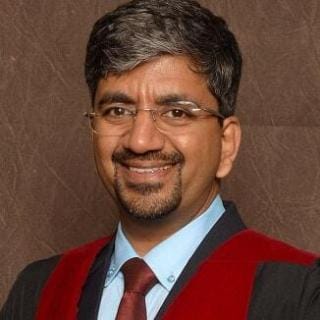
Dr. Shashikiran Umakanth (MBBS, MD, FRCP Edin.) is the Professor & Head of Internal Medicine at Dr. TMA Pai Hospital, Udupi, under the Manipal Academy of Higher Education (MAHE). While he has contributed to nearly 100 scientific publications in the academic world, he writes on MEDiscuss out of a passion to simplify complex medical science for public awareness.