
The Hydration Myth: Why Drinking “More” Is Not Always Better

Water is essential for life, but in popular culture, it has achieved a mythical status. We are constantly told that “more is better,” and that we must carry a water bottle everywhere and drink until our urine is crystal clear.
In my two-and-half decades of medical practice, I have seen the consequences of this belief. I have treated patients hospitalized not for dehydration, but for over-hydration.
The truth is that water intake is not a “one-size-fits-all” prescription. It depends entirely on your physiology. What heals one patient may harm another.
The Baseline: How Much Do You Actually Need?
For the vast majority of young, healthy individuals, the rule is simple: Drink when you are thirsty.
Our bodies possess a sophisticated sensor system (osmoreceptors) that triggers thirst long before we are dangerously dehydrated. You do not need to force fluids.
- The Quantity: A typical healthy adult needs about 2.5 liters of fluid per day. However, this does not mean you need to drink 2.5 liters of plain water. This total includes tea, coffee, milk, soups, and the significant amount of water found naturally in fruits and vegetables.
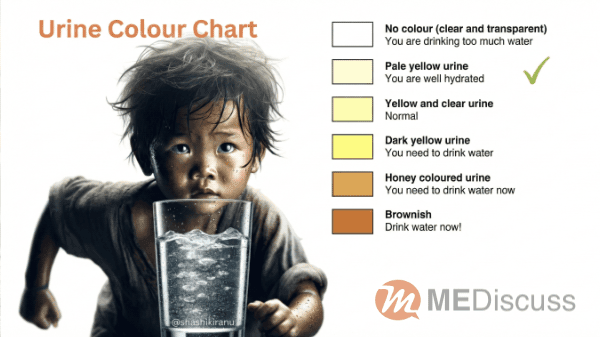
- The Visual Test: Do not aim for clear, transparent urine. That is a sign of over-dilution. The goal is pale yellow (straw-colored) urine.
Group A: Who Needs MORE Water?
Certain medical conditions require you to “flush” the system. You should aim for higher intake (approx. 3.0 to 3.5 liters) if:
- You have Kidney Stones: High fluid intake is the most effective way to prevent stones from reforming.
- You have Constipation: Hydration helps, but it must be paired with high dietary fiber. Water alone will not cure constipation.
- You are in Extreme Heat/Exercise: If you are sweating heavily, you must replace those lost fluids to prevent heat exhaustion.
Group B: Who Needs LESS Water? (The Danger Zone)
This is the most critical section of this article. For patients with compromised organs, “pushing fluids” can be fatal.
If you have Heart Failure or Kidney Disease, your body’s “pump” or “filter” is not working at full capacity. If you drink too much, that fluid has nowhere to go. It backs up into the tissues, leading to:
- Edema: Swelling of the legs and feet.
- Pulmonary Edema: Fluid backing up into the lungs (internal flooding), causing severe breathlessness.
The Rule: If you have heart or kidney issues, you must consult your doctor for a specific fluid restriction (often 1.0 to 1.5 liters per day).
The Hidden Risk: Hyponatremia (Water Intoxication)
Can water be toxic? Yes.
When you drink excessive amounts of water rapidly, you dilute the sodium levels in your blood. This condition is called Hyponatremia. Sodium is the electrolyte that regulates the water balance inside and outside your cells.
When sodium drops too low, water rushes into your cells to balance the difference. This causes cells to swell.
- In the muscles, this causes cramps.
- In the brain, this swelling is catastrophic. It can lead to confusion, seizures, coma, and even death.
This is often seen in marathon runners who over-drink, or in a condition called Psychogenic Polydipsia, where patients feel a compulsive psychological urge to drink massive amounts of water.
The Bottom Line
Hydration is about balance, not excess.
- For the Healthy: Trust your thirst. Aim for pale yellow urine.
- For the Stone Formers: Drink liberally.
- For the Heart/Kidney Patients: Measure your intake carefully.
Just as we dose medicine, we must dose our water. Listen to your body, not the hype.
PS: The Kannada version of this article is here: ದಿನಕ್ಕೆ ಎಷ್ಟು ನೀರು ಕುಡಿಯಬೇಕು? ಅತಿಯಾದರೆ ಅಮೃತವೂ ವಿಷವೇ!

Dr. Shashikiran Umakanth (MBBS, MD, FRCP Edin.) is the Professor & Head of Internal Medicine at Dr. TMA Pai Hospital, Udupi, under the Manipal Academy of Higher Education (MAHE). While he has contributed to nearly 100 scientific publications in the academic world, he writes on MEDiscuss out of a passion to simplify complex medical science for public awareness.
 wpDiscuz