
The Pathology of Half-Truths
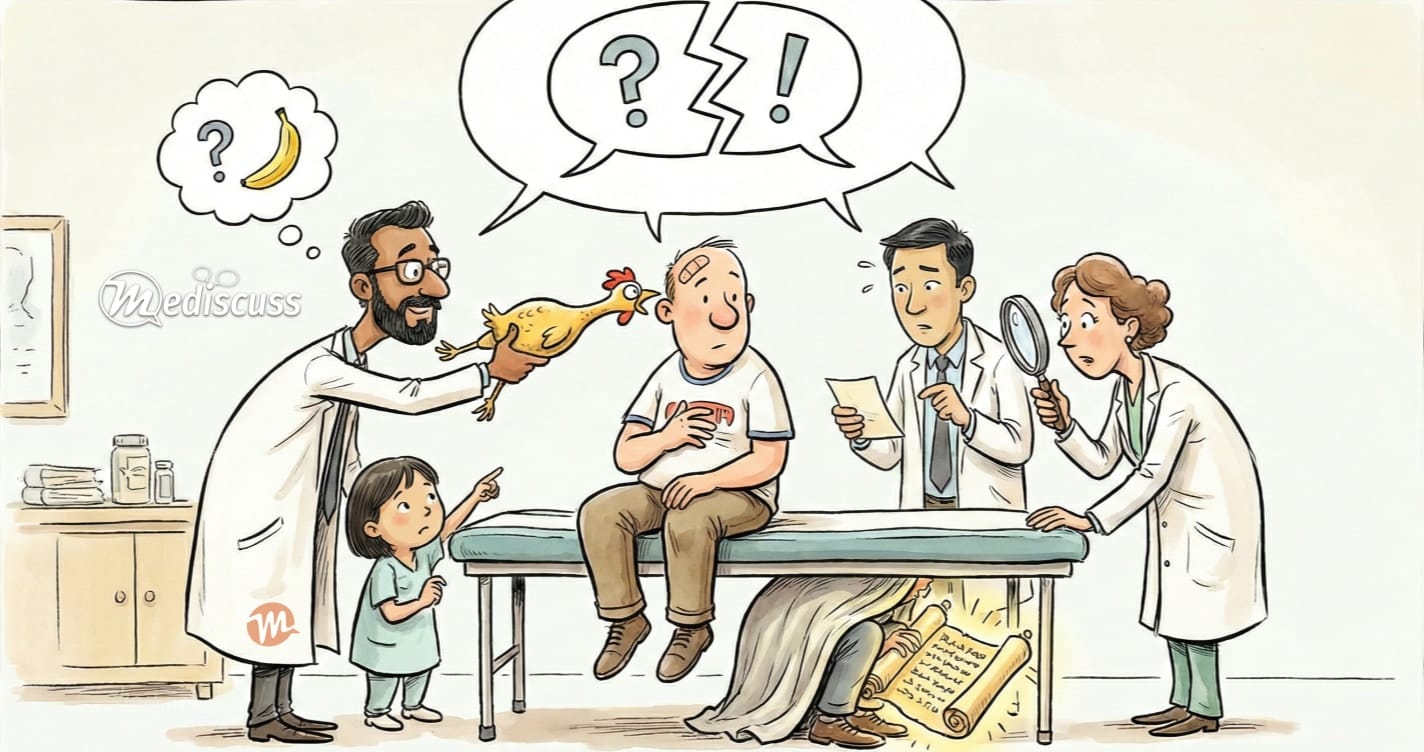
In medicine, looking at only one or just a few convenient symptoms and signs while ignoring the rest of the patient is dangerous. It leads to a wrong diagnosis. The same thing happens in language too.
We often remember famous sayings as mental shortcuts. They feel like ancient wisdom. But over time, many of these quotes have been amputated… chopped in half! We have lost the full context. Often, this reversal creates a paradox where the current common usage contradicts the original wisdom.
Both in Medicine and Life, when we mistake a half-truth for the whole (hi)story, we miss the point. Below are six famous quotes that are commonly misdiagnosed and misinterpreted.
Half quotes are often half-truths. Half history is often wrong history.
Part 1: English Quotes
“Jack of all trades, master of none.”
This is often used as an insult. It suggests a person has too many scattered interests, lacks focus, and has achieved expertise in nothing.
The original saying included a defense of the generalist:
“A Jack of all trades is a master of none, but oftentimes better than a master of one.”
Medical Context: This is the tension between the super-specialist and the General Physician. The short quote devalues the generalist; the full quote recognizes that the ability to integrate knowledge across multiple systems is often superior to having tunnel vision in just one area.
“Curiosity killed the cat.”
A warning against asking questions. Don’t take risks. Stay safe by staying ignorant.
A popular 20th-century addition completes the thought:
“Curiosity killed the cat, but satisfaction brought it back.”
Medical Context: The short version promotes fear. The full version celebrates research. Pursuing knowledge carries risk, but the “satisfaction,” the discovery of a cure or the correct diagnosis, restores life. Medicine and science are nothing without curiosity.
“Great minds think alike.”
A compliment used when two people have the same idea. It indicates agreement and celebrates consensus.
The full proverb warns against the lack of independent thought:
“Great minds think alike, though fools seldom differ.”
Medical Context: This warns against “group thinking” or diagnostic inertia. Just because the resident, the registrar, and the consultant all agree on the first diagnosis doesn’t mean that it is correct. If no one is offering a differing opinion, we may be missing the truth.
“Rome wasn’t built in a day.”
Often used as an excuse for procrastination, slow progress or even a lack of progress. “It takes time, so don’t worry about it right now.”
The original French proverb and later English variations emphasized the work, not just the time:
“Rome wasn’t built in a day, but they were laying bricks every hour.”
Medical Context: Essential for chronic disease management and rehabilitation. Healing doesn’t happen overnight, but it requires the daily “laying of bricks,” taking medication, doing physiotherapy, and lifestyle changes. It demands consistency, not just passive waiting.
Part 2: Sanskrit Verses
Ancient Indian texts deal in Dharma (righteous and contextual duty). When these are turned into catchy soundbites, we lose the nuance.
“Ahimsa paramo dharmaha.”
Non-violence is the ultimate duty. A command for absolute pacifism in every situation.
The Mahabharata offers a nuanced duality:
अहिंसा परमो धर्मः धर्महिंसा तथैव च
Ahiṁsā paramo dharmaḥ, dharma-hiṁsā tathaiva ca.
“Non-violence is the ultimate duty, but violence in the service of dharma (righteous duty) is also an ultimate duty.”
Medical Context: We want to “do no harm,” yet we must sometimes inflict harm to cure. Surgeons skillfully cut healthy skin; physicians and oncologists carefully and watchfully administer potentially toxic drugs. We perform dharma-himsa, necessary harm, to preserve health and life.
“Satyam vada, dharmam chara.”
“Speak the truth, practice righteousness.” A blunt command demanding rigid and brutal honesty.
The full version of this verse in ancient texts has the constraint of compassion too:
सत्यं ब्रूयात् प्रियं ब्रूयात् न ब्रूयात् सत्यम् अप्रियम्
Satyaṁ brūyāt priyaṁ brūyāt, na brūyāt satyam apriyam.
“Speak the truth, speak pleasantly, do not speak unpleasant truths that can cause pain.”
Medical Context: The art of “breaking bad news.” A terminal diagnosis is the raw “truth,” but a physician should not use truth as a blunt weapon. It must be delivered with empathy (speaking pleasantly/kindly) so the patient is not unnecessarily destroyed by the facts.
Conclusion
These paradoxes remind us that truth is rarely simple.
In medicine, as in life, we must avoid the comfort of easy answers and always try to get the complete picture.

Dr. Shashikiran Umakanth (MBBS, MD, FRCP Edin.) is the Professor & Head of Internal Medicine at Dr. TMA Pai Hospital, Udupi, under the Manipal Academy of Higher Education (MAHE). While he has contributed to nearly 100 scientific publications in the academic world, he writes on MEDiscuss out of a passion to simplify complex medical science for public awareness.