
Stones of Silence, Guardians of Snow
In my last note, I walked you through the physical grind of getting to Everest Base Camp (EBC). The steps, the breath, the altitude. But if I stopped there, I’d be lying to you. Because the Himalayas aren’t just about the geology.
They’re alive because of the people who live there. And, this is the heavy part… they’re sacred because of the people who sleep there forever.
The trek forced me to face both. Two encounters changed me more than the altitude ever could.
A Chance Encounter on the Trail
We were ascending toward Thukla Pass, about halfway up. The climb was brutal, and we’d stopped for a brief rest… the kind where you just stand there, hands on hips, trying to remember how to breathe.
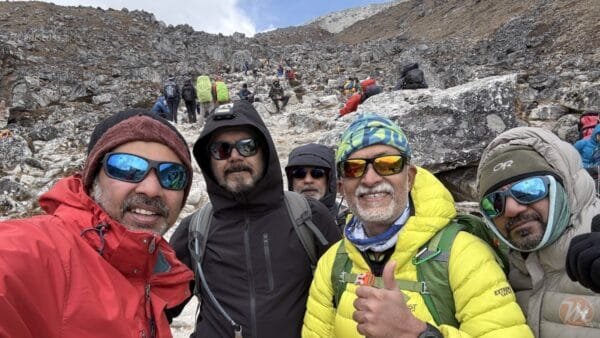
That’s when we saw him descending. A elderly-looking solo trekker in a bright yellow jacket, moving with the steady rhythm of someone who knew these trails well. Our group was blocking part of the narrow path.
“How was it up there?” Prashanth asked, making the casual small talk trekkers exchange at altitude.
The man smiled and stopped. “Worth it. Every time.”
Every time? That got our attention.
He looked at our tired faces and seemed to sense we needed more than route information. “Taking a break?”
We introduced ourselves. He was Mr. Sharad Kulkarni. From Pune. This wasn’t his first time here, he told us. He’d lost count of how many times he’d made this trek.
“You keep coming back?” we asked. “How come?”
Sharad’s expression changed. Not sad, exactly. More like someone deciding whether to open a door.
“I come to visit my wife,” he said quietly.
The words hung in the thin air. We waited.
He told us the whole story then, standing on that narrow trail. How he and Anjali had summited Everest together in 2019. Their fifth time. How they’d been caught in that traffic jam in the death zone. Hours of waiting at 8,000+ meters, oxygen running low. How he watched her develop symptoms of severe hypoxia. How she died, surrounded by strangers in a queue, at the same grand summit they’d reached together four times before.
“She’s still up there,” he said, gesturing toward the peak hidden in clouds. “But her memorial is just ahead at Thukla Pass. Do look out for her when you are there.”
That simple request… look out for her… carried the weight of a thousand unsaid things. Not just “notice the memorial.” But see her. Remember she was real. That she existed. That she mattered.
We stood there, completely unprepared for this conversation.
We watched him continue his descent, moving with the confidence of someone who’d walked this path many times before.
The Memorials at Thukla Pass
Twenty minutes later, we reached the top of Thukla Pass. Our lungs were screaming, but the view stopped us.
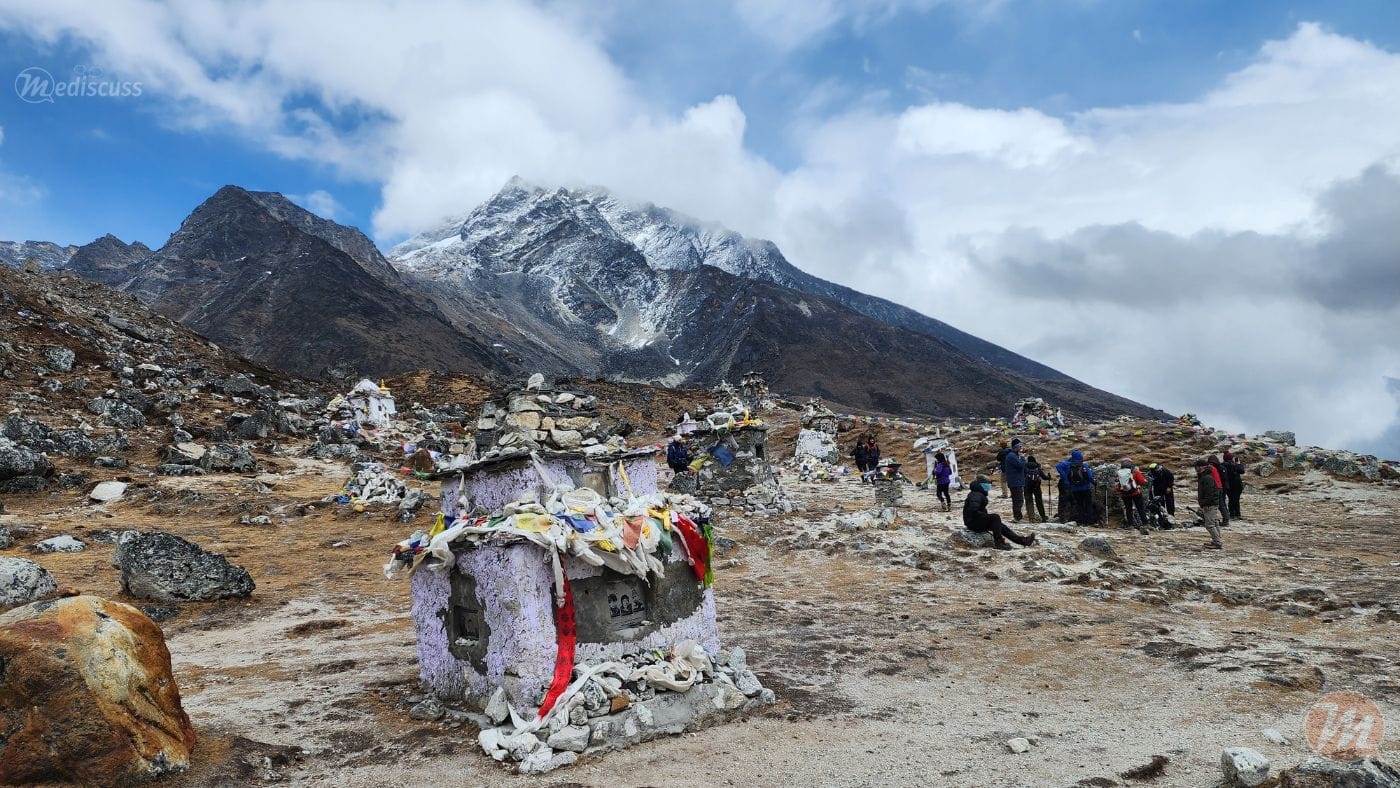
Hundreds of stone memorials (chortens) rose out of the relatively flat surface there. Prayer flags fluttered in the wind, making a sound almost like whispers. This is the final resting place for the climbers and Sherpas who died in the lap of these mountains.
We walked among them slowly, reading inscriptions. Names etched into stone. Some recent. Some decades old. Each one represented someone who came looking for a summit and met something else instead.
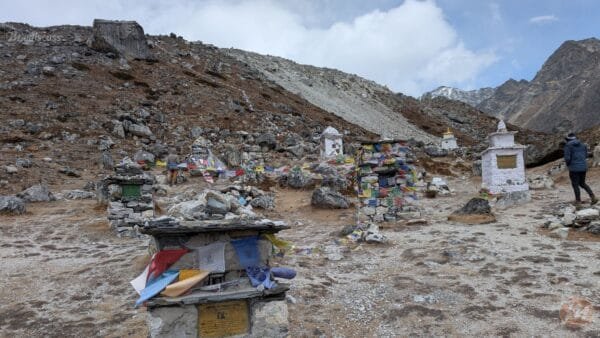
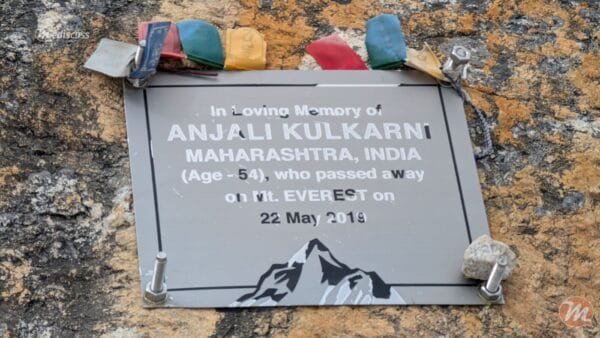
And somewhere among those stones was Anjali Kulkarni’s memorial, still warm from her husband’s visit.
That night in Lobuche, I couldn’t sleep. I kept thinking about Sharad making this pilgrimage year after year. A man who survived the mountain but couldn’t fully leave it.
Love doesn’t stop just because the heart does. And some people need to keep walking toward what they’ve lost, even knowing they can never reach it.
The mountains demand respect. Life up here hangs by a thread. And sometimes that thread snaps, leaving people like Sharad to carry the weight of what remains.
The Sherpas: Life at Full Volume
If Thukla Pass taught me about what the mountains take, the Sherpas showed me what the mountains create.
I’ve developed my own theory about their name. To me, S.H.E.R.P.A. isn’t just a noun. It’s an acronym:
S.H.E.R.P.A.
Super Humans of Everest: Resilient Partners in Adventure.
Their fitness shouldn’t be possible. We would stumble into Gorakshep at 5,164 meters, looking like zombies. My only thought was: blanket, flat surface, sleep. Then I looked out the window.
The Sherpas, who had just carried double our weight and walked faster, were outside playing volleyball in the snow.
Volleyball. At 5,000 meters.
Here is the altitude reality check:
| Activity | The “Fit” Trekker (Us) | The Sherpa (Them) |
|---|---|---|
| Arrival at Camp | Exhausted, looking for a chair, craving for coffee. | Setting up tents, cooking dinner, laughing. |
| Carrying Load | Struggling with a 5kg daypack. | Carrying 20kg+ of gear without breaking a sweat. |
| Downtime | Sleeping to recover. | Playing high-altitude volleyball. |
| Mindset | “Will I survive this?” | “Is the guest happy?” |
They don’t just survive here. They thrive. And they treat us like family, not clients.
“Just a Bit Zig-Zag”
Our guide, Mr. Pema Gyaltsen Sherpa, had a dangerous sense of humor.
When you’re exhausted, you really only have one question: “How much longer?”
Pema would give this little smile. “Idhar hi hai sir. Bas thoda zig-zag.” (It’s right here, sir. Just a little zig-zag.)
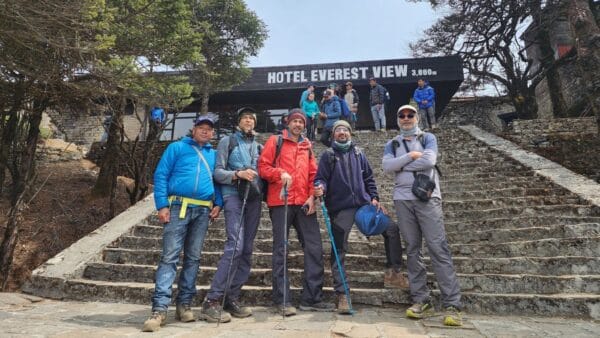
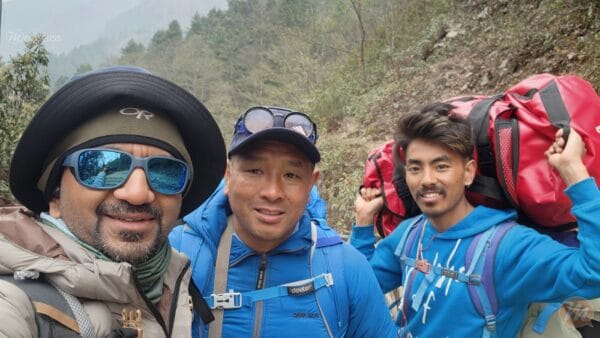
We learned that code fast.
In Pema’s dictionary, “zig-zag” didn’t mean a winding flat road. It meant a vertical, lung-crushing ascent that would take two hours and all your remaining pride.
But by the end? We loved him for it. He was our protector, our pace-setter, our comedian when morale dropped below our oxygen saturation. Even now, back in the hospital, if I hear the word “zig-zag,” I smile. I’m back in the snow.
Two Lessons From the Same Mountain
The memorials and the Sherpas are two sides of the same truth.
Thukla Pass shows you what happens when the mountains say no. When preparation meets bad luck. It’s a reminder that up here, we’re all guests, and some guests don’t get to leave.
But the Sherpas? They’re proof that humans can adapt to almost anything. They’ve evolved – genetically, culturally, spiritually – to thrive in conditions that would kill many of us. They carry our bags, guide our steps, and play volleyball while we rest. They represent resilience, not just survival.
Standing among the memorials, I felt the weight of mortality. Watching Pema laugh as he led us up another “zig-zag,” I felt the lightness of life lived fully.
The mountains take. The mountains give. Sometimes in the same day, in the same place, to the same people.
Don’t Wait
Here’s what I want you to take away from this.
Don’t think this is out of your league.
You don’t need to be an Olympian to do this. You need basic fitness, a doctor’s checkup, and the will to go. It doesn’t have to be the Everest. Any trek in the Himalayas rewires you.
We get so stuck in the grind – the office, the rounds, the commute. The same pressure and stress of daily life. We forget there’s a world out there that doesn’t care about our emails or our status or our deadlines.
Sharad goes back every year because he has to. But you? You have the chance to go while everyone you love is still here to come home to.
So please. Go. Taste life before it melts away like snow.

Dr. Shashikiran Umakanth (MBBS, MD, FRCP Edin.) is the Professor & Head of Internal Medicine at Dr. TMA Pai Hospital, Udupi, under the Manipal Academy of Higher Education (MAHE). While he has contributed to nearly 100 scientific publications in the academic world, he writes on MEDiscuss out of a passion to simplify complex medical science for public awareness.
 wpDiscuz