
Why Is It Hard to Lose Weight? The Truth About Insulin
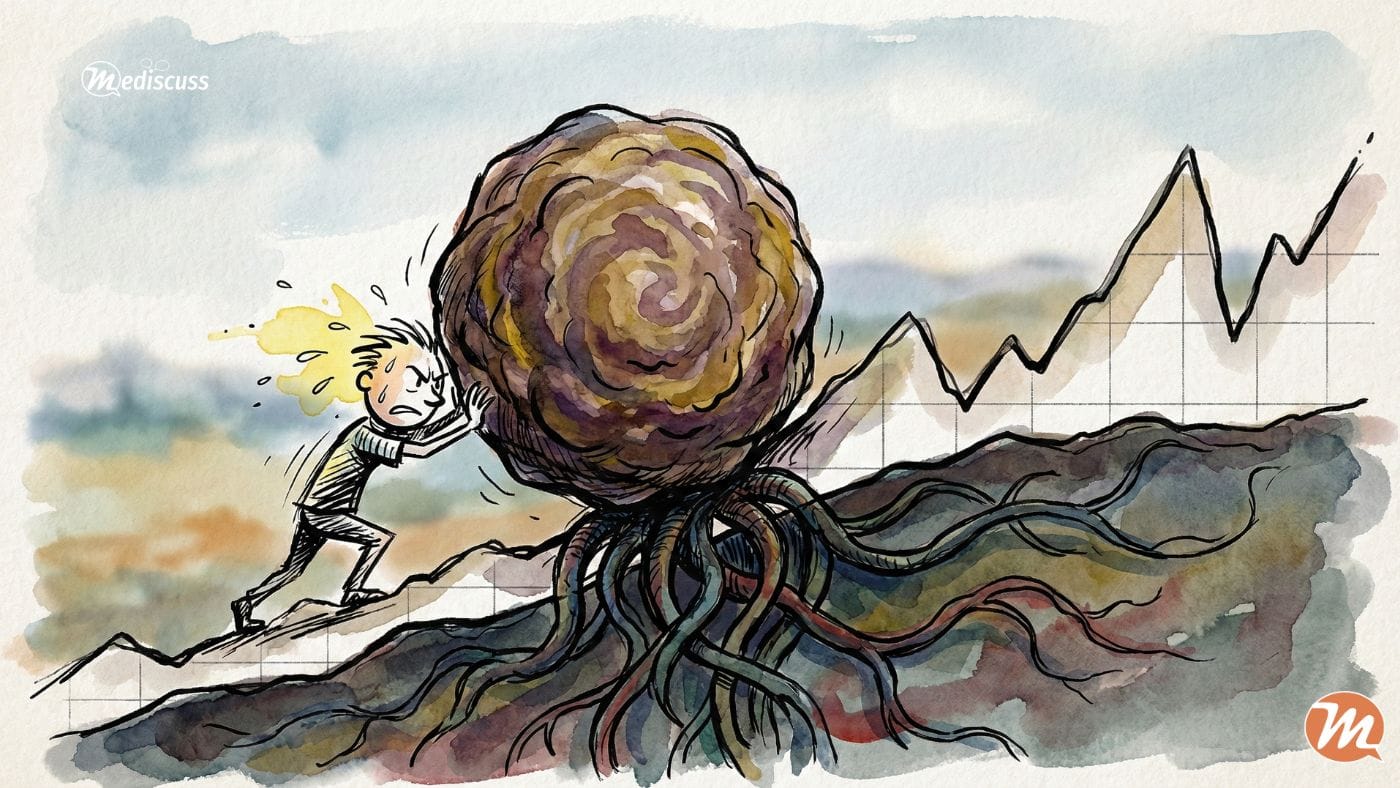
“Doctor, I eat very little. I skip dinner. I walk every day. But my weight is stuck.”
I hear this every single day. For the last 40 years, we doctors gave you a very lazy answer: “You must be eating more than you think. Just eat less and move more.”
We treated the human body like a simple bank account… Calories In minus Calories Out equals Weight Loss. But if that is true, why does your friend eat biryani and stay thin, while you gain weight just looking at a banana?
The answer is simple: Your body is not a calculator. It is a biological machine.
If you are struggling to lose weight, it is not because you lack willpower. It is because your hormones are working against you. Specifically, one hormone: Insulin.
The Body’s Weight Is Set
Think of your weight like the temperature in your room. If you set the AC thermostat to 24°C, the room stays at 24°C. If you open the window (dieting) to let hot air in, the AC just works harder to bring it back to 24°C.
Your body has a “Body Set Weight.” If you try to starve yourself to lose weight, your body thinks a famine has started. It panics. It slows down your metabolism to save energy. This is why you lose 2 kgs initially, and then gain back 4 kgs when you start eating normal food.
To lose weight permanently, we don’t need to starve. We need to reset the thermostat. And the controller for that thermostat is insulin.
The Old Myth vs. The New Reality
We used to think fat was just a storage bag for excess energy. We now know that fat is controlled by our hormones.
| Old Myth (The Calorie Theory) | The New Reality (The Hormone Theory) |
|---|---|
| “Calories are not equal” 100 calories from junk food spikes insulin. 100 calories from healthy food keeps insulin low. | |
| “Eat less frequently” Constant snacking (grazing) keeps insulin high. You need gaps (fasting) to burn fat. | |
| “Diet controls weight” You cannot outrun a bad diet. Exercise is for fitness, diet is for weight. |
The “10 Idli” Logic
Frequency of eating matters more than the quantity of food. It is not just how much you eat, but when you eat.
Let me give you a simple example. Imagine you have to eat 10 idlis in a day.
- Scenario A: You eat 5 idlis two times a day (9 AM, 8 PM).
- Scenario B: You eat 2 idlis five times a day (9 AM, 11 AM, 2 PM, 5 PM, 8 PM).
In both cases, the calories are exactly the same. But in Scenario B, you will likely gain weight. Why?
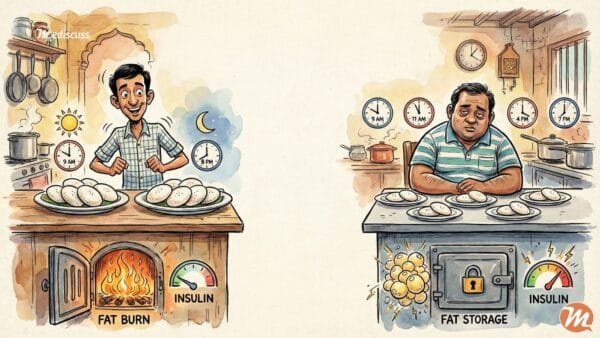
Because every time you eat, your insulin spikes. Insulin is the “fat storage hormone.” If you eat five times a day, your insulin stays high all day. In Scenario B, Your body is constantly in “storage mode.” It never gets a chance to switch to the “burning mode.”
In Scenario A, you give your body a long gap between meals. During that gap, insulin drops, and your body finally opens the fat stores to burn energy.
My “School Period” Method
Patients often ask me, “So how exactly should I eat?”
I tell them to remember their school days. Think of your eating times like subject periods in school: History period, Maths period, Science period.
- Create 3 Periods: A Breakfast Period, a Lunch Period, and a Dinner Period.
- The Duration: Each period is only 45 minutes long.
- The Rule: You can eat your full meal during these 45 minutes. After the 45 minutes, the “kitchen” is closed.
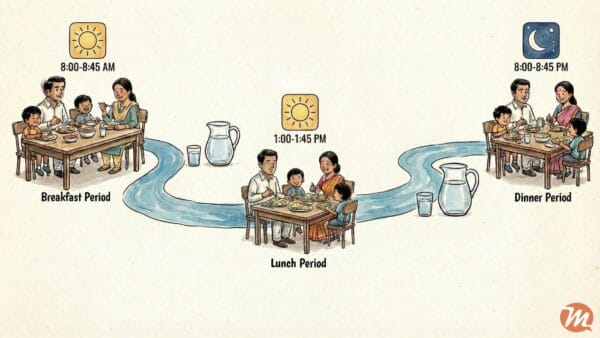
Whatever you want to eat or drink (tea, coffee, snacks), have it with your meal during that 45-minute window period. In the long gaps between these periods, you are allowed only plain water. No biscuits, no chai, no green tea, no small snacks.
Start with 3 periods. Once you are comfortable, try to make it just 2 periods (skip breakfast or dinner). This is the secret to managing your insulin levels.
Practical Tips to Stop the Craving
Often, our brain gets confused. When you feel “hungry” at an odd time, you are often actually just thirsty.
If you are serious about weight loss, try this: When you feel a sudden craving for junk food or a snack, drink a full glass of water first. Wait for 10 minutes. In most cases, the craving will vanish. That water will satisfy you.
Metabolic Triage: Where Do You Stand?
It’s not just the diet too.
Before we blame your diet, we must check your engine. Weight loss is not just about calories; it is about your metabolic health. Use the table below to identify which “Zone” you are in. This will help you understand whether you need a lifestyle tweak or a medical consultation.
Weight responds to diet: Green Zone
- Insulin sensitivity is normal.
- Continue current lifestyle.
- You are safe.
Strict diet, stuck weight: Yellow Zone
- Insulin Resistance: Levels are too high.
- Check: Thyroid (TSH) & PCOS.
- Consult a doctor and get tested.
Rapid unexplained weight gain: Red Zone
- Breathlessness/Swelling: Rule out Heart Failure.
- Purple Stretch Marks: Rule out Cushing’s disease.
- Action: Visit your doctor immediately.
A Note on Sleep
Finally, remember that you cannot cheat your biology. If you sleep less than 6 to 7 hours, your stress hormone (cortisol) goes up. Cortisol raises sugar, which raises insulin. So, poor sleep equals weight gain. I will be writing a detailed article separately on the importance of sleep soon, but for now, prioritize your rest.
Conclusion
Losing weight is not a test of your character… it is a management of your chemistry.
Do not hate your body for doing its job (surviving). Just speak to it in a language it understands: less frequent insulin.
Start today. Drink that glass of water. Suppress the craving.
Close the kitchen after every meal.
If you are in the Red Zone, do not wait. Consult your doctor. You can figure it out together.
Key Learning Points
- Never eat your carbohydrates without fibre or proteins.
- If you eat plain rice or fruit on an empty stomach, your sugar spikes like a rocket. Always start with fibre (vegetables) or protein (dal / egg).
- Eat your salad first, protein second, and rice/roti last. This simple order creates a mesh in your stomach that slows down sugar absorption and keeps insulin under control.
- Adding a small spoon of ghee to rice reduces the glycemic index and slows down sugar absorption.
Assess Your Knowledge
Test your understanding of the concepts of weight loss. This brief quiz will help reinforce your learning and get you a certificate too!
Take the Quiz →
Dr. Shashikiran Umakanth (MBBS, MD, FRCP Edin.) is the Professor & Head of Internal Medicine at Dr. TMA Pai Hospital, Udupi, under the Manipal Academy of Higher Education (MAHE). While he has contributed to nearly 100 scientific publications in the academic world, he writes on MEDiscuss out of a passion to simplify complex medical science for public awareness.
 wpDiscuz