
How Do I Know I’m Right?
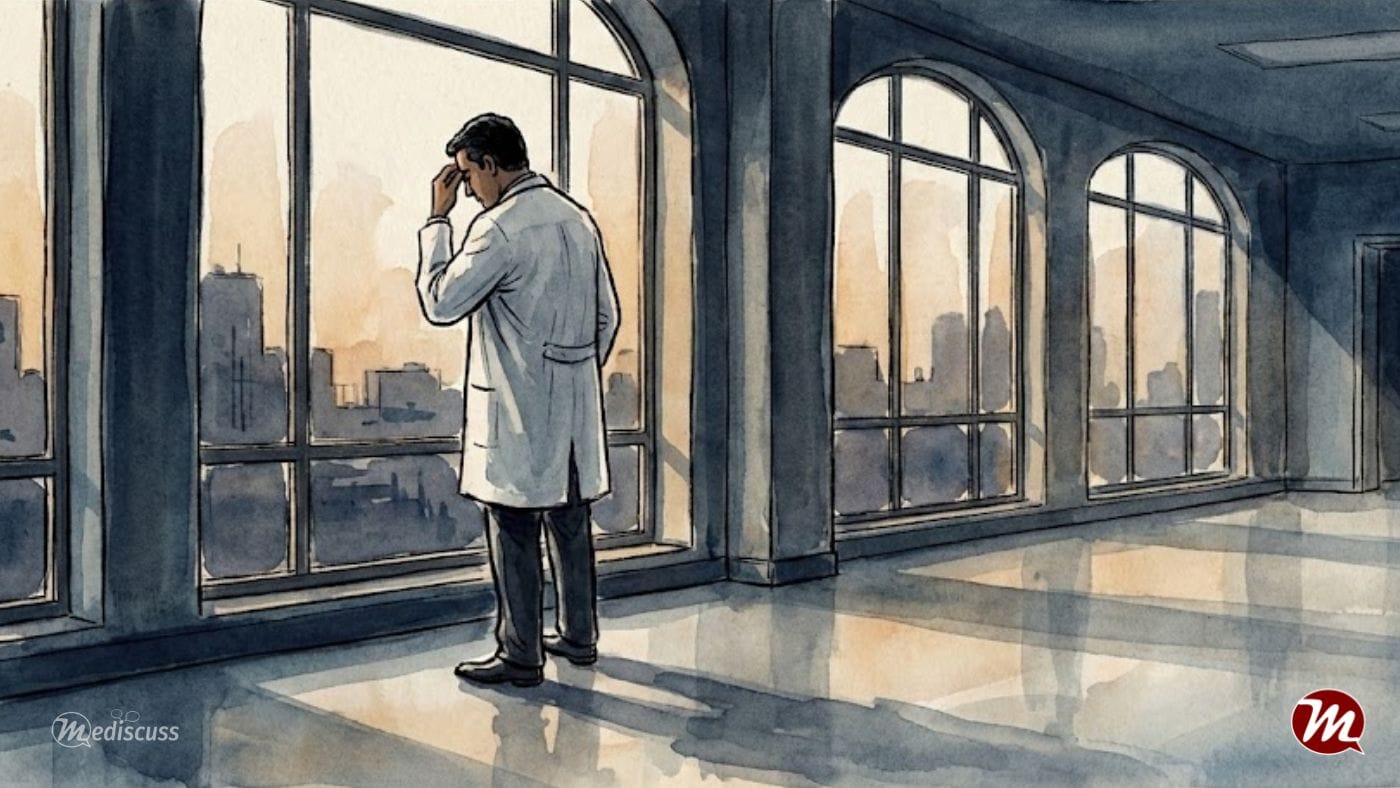
This is Part 1 of a 6-part series on death, dignity, and what medicine can learn from ancient wisdom.
The Weight We Carry
The son wants everything done. The daughter wants comfort care. The wife hasn’t spoken in two days.
I’m standing at the foot of the ICU bed, looking at Mr. Kumar. He is 75, post-stroke, day 9 on the ventilator. We’re keeping his blood pressure up with three different medications. His kidneys are failing. The machine is breathing for him because his brainstem doesn’t remember how. I come out and talk to the family.
“Doctor, will he wake up?” the son asks.
He’s not asking about neurology. He’s asking, “Tell me there’s hope. Tell me I’m not giving up on my father by letting him go.”
Here’s the thing. Clinically, I know the answer. The CT scan shows massive infarction. His lungs, which have drowned in their own secretions, are requiring full support. Every organ system is shutting down one by one, like lights going out in a building. We’re not supporting life anymore. We’re delaying death.
But morally?
How do I know I’m right?
…
I think about this question every single day.
I’ve seen many deaths. Especially during the pandemic. Doctors who lost parents and loved ones while working in different cities. Families separated by lockdowns. Husband and wife dying in different hospitals. People dying in hospitals without any loved one nearby, not even in the hospital. Crematoriums that became assembly lines. Sons who did pradakshina of their parent’s bodies alone in crowded, impersonal spaces because there was no other choice. One friend told me, “I touched my father’s feet for the last time in a parking lot. There wasn’t even space inside.”
Those deaths… isolated, clinical, rushed… they haunt me.
And they’ve taught me that how someone dies matters as much as when they die.
…
So when Mr. Kumar’s son asks me if his father will wake up, I hear the question underneath: “What would I want someone to tell me?”
I take him along to my room and pull up a chair. This conversation shouldn’t happen standing.
“I need to be honest with you,” I say. “The stroke was massive. Even if we keep supporting him with machines, the damage to his brain is permanent. He won’t wake up the way you’re hoping. We have given our best to see if he will improve by treating the infection, but the stroke is too massive.”
“But he’s stable, right? The nurse said stable.”
God, I don’t like that word. Stable.
“Stable means we’ve achieved an equilibrium where the machines are doing everything to maintain life, while waiting for recovery from the primary problem. His heart beats because we’re giving it three medications. His lungs work because a ventilator is breathing for him. But your father’s primary problem doesn’t look like it’ll recover. That’s not life. That’s… postponement.”
The daughter speaks for the first time. “Appa wouldn’t want this.”
“How do you know that?” the son snaps.
And there it is. The real fight. Not about the father. About them. About guilt and duty and who loves him more and who is willing to let go and who is brave enough to say goodbye.
I’ve seen this dozens of times.
“Can I tell you what I’m seeing?” I ask gently. “Your father’s body is telling us it’s ready to stop. Every day, we’re adding another medication, supporting with another machine, another intervention just to keep the numbers on the monitor acceptable. But those numbers don’t mean he’s getting better. They mean we’re getting better at artificially maintaining a system that wants to shut down.”
“So you’re saying we should give up?”
That word again. Give up.
“No. I’m saying we should ask ourselves: Are we extending his life, or are we just prolonging his dying?”
I’ve had the opposite conversation too. Many times. Families who wanted to stop, and I pushed them to continue. A 68-year-old woman, severe pneumonia, failing kidneys… the husband wanted to withdraw. “She’s suffered enough,” he said. But she wasn’t at the end. Her body was still fighting, still had the reserve. I convinced them to give her another week. She walked out of the hospital three weeks later.
So how do I know? When do I push and when do I release? What am I sensing in one patient that I don’t sense in another?
It’s not the age. It’s not the labs. It’s not the scans. It’s something else. Something I can feel but can’t quite name.
…
But I learned about death differently first.
I was twelve when my grandfather died. At home. In our village. He was 92. No tubes. No machines. No regret either.
I remember sitting next to him in those final days. The adults weren’t telling me much… you know how Indian families are, protecting the children from “such things”. But I could see it. My Thatha was leaving. His breathing had changed. Slower. Deeper. Sometimes jerky.
But here’s what I remember most: no panic. No rushing to hospitals. No one saying “we have to do something!” The family gathered. They prayed. They sat with him.
He died peacefully, surrounded by people who loved him. His wife nearby. His children around. Me sitting in the corner, watching something I didn’t understand but somehow wasn’t afraid of.
No breathlessness. Thank God for that. I tell families now… the most difficult thing to manage at end of life without medicines and machines is breathlessness. It creates panic in everyone. But Thatha didn’t have it. He just… slowed down. And stopped.
I didn’t know it then, but I was watching a good death.
…
My Ajji died at home too. For years, I misremembered being absent… being away at medical college in Mysore when she passed. But my sister reminded me that I was there. We spent the whole night by Ajji’s side. We peeled oranges for her. She could barely eat but insisted that we eat them instead. That was Ajji, feeding others even when she was dying. She passed peacefully in the morning. All of us around her.
I don’t know why my memory erased this. Maybe grief does that sometimes. Maybe the guilt of not giving her that injection (she died before I’d learned clinical skills) overwrote the memory of actually being present.
Two good deaths I witnessed early in my life. Thatha and Ajji. Both at home. Both surrounded by family. Both without panic.
…
Back to Mr. Kumar.
We talk for another 20 minutes. I explain what comfort care actually means. It’s not abandonment. It’s not “doing nothing.” It’s shifting the goal from fighting death to ensuring dignity and comfort. Pain control. No breathlessness. Family at the bedside. Maybe some prayers, if they want. The Gita. The Sahasranama. Mantras. Whatever brings peace.
“But what if he could recover?” the son asks. “What if there’s a chance?”
I’ve learned not to say “there’s no chance.” Because medically, there’s always some infinitessimal possibility. Miracles happen. We’ve all seen the one-in-a-thousand case.
But probability isn’t hope. It’s just mathematics. And I have to help them see the difference.
“What would recovery look like?” I ask. “Best case scenario… and I mean best case… he might open his eyes. But his right side is paralyzed. He can’t speak because of the stroke location. He may need a feeding tube permanently. Maybe a tracheostomy for the ventilator because his brain can’t manage the breathing. He may not recognize you. He may not smile when you enter the room.”
The wife finally speaks. “Let him go.”
Just three words. But they break the dam.
The son cries. The daughter cries. I excuse myself to give them privacy, but really, I’m crying too. Inside. Where families can’t see.
…
We extubate Mr. Kumar the next morning. We shift him to the private room to be with family.
He dies within four hours. His wife holding one hand. His daughter holding the other. The son reciting the Vishnu Sahasranama, with his voice breaking on chanting every name.
It’s a good death. Not because he died. But because he wasn’t alone. Wasn’t in pain. Wasn’t kept alive by machines past his body’s ability to sustain him.
But I leave that ICU carrying questions I can’t answer clinically.
Did I guide them correctly? Or did I influence them toward a decision that matched my own philosophy? What if the son was right to ask for more time? What if we’d waited another week and he’d improved? What if my subjective experiences and bias are clouding my judgment?
How do I know I’m right?
Clinically, yes. The scans don’t lie. The organ failure is objective.
But morally?
…
About two weeks later, I attend Mr. Kumar’s 13th-day ceremony. Vaikunta Samaradhane. The family requested that I come. Not as a doctor. As a person who stood with them in their difficult moment.
I stand before his photograph… garlanded, smiling, when he was alive in a frozen moment before the stroke. The priest chants. Incense fills the room. The family sits in white clothes, grief still fresh but somehow more contained than in the ICU.
And I remember Nagesh.
Many years ago, I stood in another hall like this one. Another photograph. Another family. Nagesh… 75, liver failure, the warm man who’d invited me to his home not as a doctor but as his guest. When he died in the ICU, it felt completely wrong for someone who’d lived so fully.
At his ceremony, something in me had cracked open.
Not in despair.
But in recognition.
This ceremony is doing something my medical degree never taught me. It’s not curing death. It’s healing grief. It’s giving structure to chaos. It’s saying… be here and do these for 13 days, don’t rush, let the wound close slowly, honour what you’ve lost, remember who they were, and then… only then… begin to move forward.
…
Nagesh’s daughter had touched my arm that day. “Thank you, Doctor.”
For what? For letting her father die?
No. For letting him go.
Now, standing at Kumar’s ceremony, that difference feels important. Necessary. But I don’t fully understand it yet.
Kumar’s daughter saw me from across the room. Walked towards me and said: Thank you.
The same words.
The same gratitude.
The same question I can’t answer. For what?
How do I know when to fight and when to release? When does medicine become cruelty? When does letting go become the braver act?
…
I knew I needed wisdom much older than my medical degree…
…
The Complete “Anayasena” Series
This article is part of the six-part series that explores what modern medicine can learn from ancient wisdom about dying well, living with dignity, and letting go with grace.
Subscribe to get an email when the other articles are published.
- How Do I Know I’m Right? The weight of end-of-life decisions
- When the Body Knows. The cucumber, the vine, and ripeness
- The Prayer I Whisper. Anayasena Maranam and dignity in dying
- What the World Taught Me. Ancient wisdom across cultures
- The Conversation Nobody Wants to Have. Guidance for families facing end-of-life decisions
- Coming: The Weight Doctors Carry. The practice physicians need for end-of-life care
Author’s note:
Patient names and some identifying details have been changed to protect privacy. Some stories are composites drawn from multiple patients who taught me similar lessons. The emotional truth remains intact.
…
Go back to Anayasena Series Home
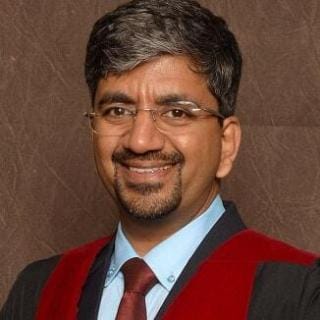
Dr. Shashikiran Umakanth (MBBS, MD, FRCP Edin.) is the Professor & Head of Internal Medicine at Dr. TMA Pai Hospital, Udupi, under the Manipal Academy of Higher Education (MAHE). While he has contributed to nearly 100 scientific publications in the academic world, he writes on MEDiscuss out of a passion to simplify complex medical science for public awareness.
 wpDiscuz