
Are Packet Masalas Safe? A Physician’s Guide
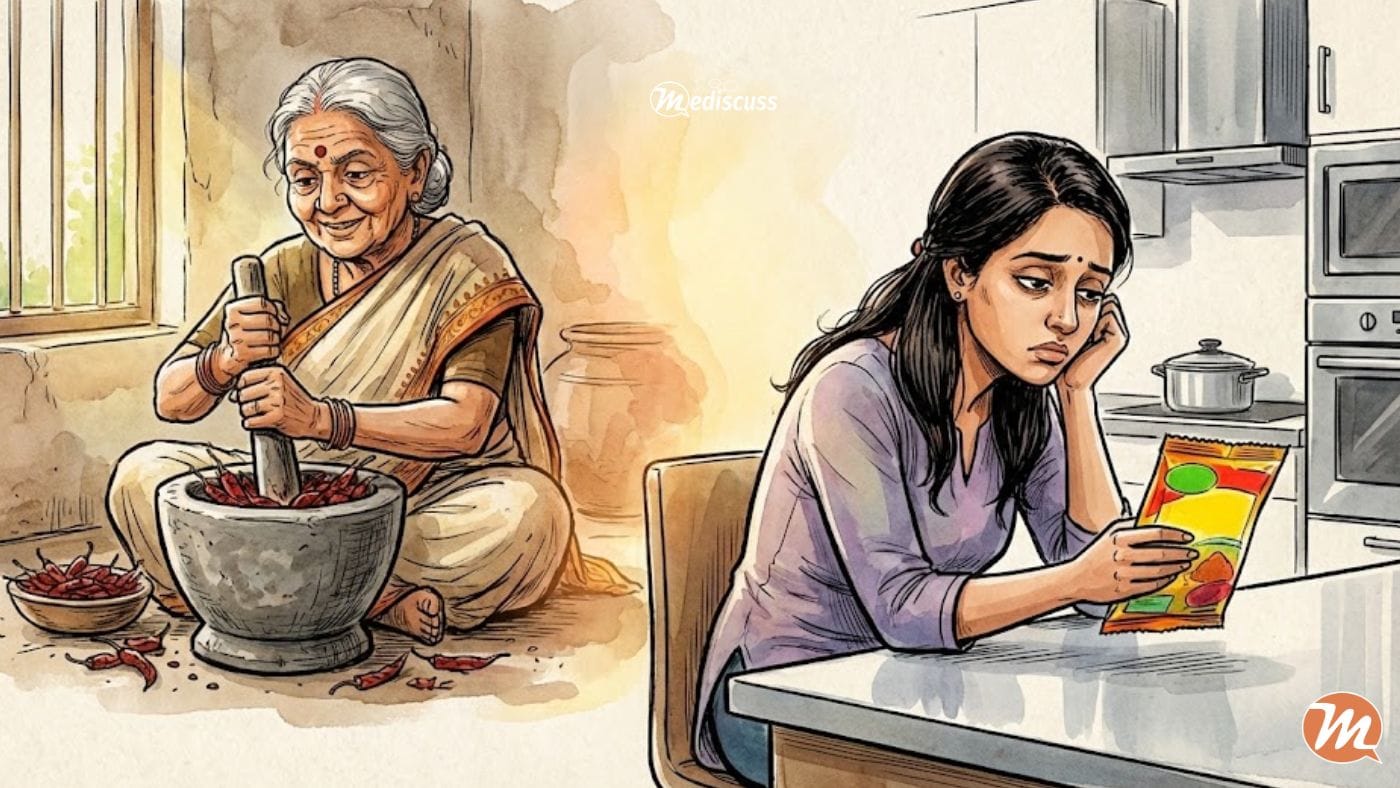
Do you remember the aroma of your grandmother’s kitchen? The sneeze-inducing pungent smell of fresh chillies when they are being pounded? The rich scent of roasted dhaniya (coriander)? But now, that sensory rich experience has been replaced by the “tear-and-pour” convenience of a plastic packet.
From “Gobi Manchurian Mix” to “Kitchen King Masala,” our shelves are lined with convenient spice mixes. But have you ever wondered why the packet powder does not clump in the rainy season? Or why it is so unnaturally bright red?
This article explores your spice rack and why “convenience” might be costing you the joy of good taste and your health too.
1. The “Free Flowing” Chemistry
If you grind spices at home, you might have noticed that they clump over time, especially in humid weather or the rainy season. This is natural because spices are rich in essential oils and moisture.
So, how does the powder you bought from the store remain loose and free-flowing for so long?
Anti-Caking Agents
Look behind the packet. You will see “E-numbers” like E551 (Silicon Dioxide) or E552 (Calcium Silicate). These are industrial additives that absorb moisture and coat the spice particles to prevent them from sticking. They are considered safe in small limits by food safety authorities, but they turn a natural agricultural product into a processed industrial product.
2. The Colour Trap: The “Red” Danger
We all believe that “red equals spicy.” Manufacturers struggle to meet this expectation, because the colour of natural chilli powder fades over time. What should they do? Solution: artificial colours.
Most reputed brands usually follow regulations and use “permitted” artificial colours. But we must be extra careful with the unbranded “packets” found in small shops. These transparent plastic packets usually do not have FSSAI certification or even ingredient lists. Because they operate without any regulations, there is a higher risk of them containing non-permitted, unhealthy, but cheap colouring dyes (like Sudan dyes or Rhodamine B) to make the product look fresh and attractive.
Don’t get colour trapped!
The “Water Test” for Adulteration
How do you know if your chilli or turmeric powder has artificial colours?
- Take a transparent glass with water.
- Sprinkle a teaspoon of the powder on the surface of water.
- Natural Powder: Will float for some time and slowly drop down. The water may become slightly coloured.
- Adulterated Powder: You will see bright streaks of colour (red or yellow) descending instantly like ribbons. This indicates water-soluble artificial dye.

A simple home test for artificial colours.
3. The Hidden Sodium Trap
This is the most dangerous problem for those with hypertension (BP).
When you buy a “Veg Fried Rice Mix” or “Paneer Butter Masala Mix,” you think you are buying spices. Read the label. The first ingredient is usually Salt or Corn Starch.
The Risk: You add this mix to your curry, and then you add your own salt as per habit. The result is a “sodium bomb.” Many ready-mixes contain up to 40% salt and fillers, which means that you are paying the price of expensive spices for cheap salt and flour.
4. Shelf Life vs. Potency
Spices are medicine. Turmeric has anti-inflammatory effect, pepper increases the bioavailability of turmeric, and jeera (cumin) helps with digestion. These benefits come from their volatile essential oils.
Myth Buster
- Myth: “Spice powders never expire, they just lose flavour.”
- Fact: Once a spice is made into a powder, the medicinal oils oxidize and evaporate rapidly. A packet manufactured 6 months ago is just a “coloured dust”. It gives colour but has lost most of its antioxidant health benefits.
5. The Middle Ground: For the Busy Professional
We cannot ignore reality. For a working woman or man managing both office and home, daily grinding of fresh spices is impossible. We need a practical solution that balances health with time constraints.
The “Weekend Batch” Strategy
Instead of relying on packet powders for everything, be selective:
- The Essentials (do it yourself): Items like pepper, jeera (cumin), and dhaniya (coriander) lose their flavour very fast. Ideally, gently roast a small batch of these on the weekend and powder them using your small mixer jar. It takes just 10-15 minutes and lasts for 2-4 weeks.
- The Difficult Ones (buy smart): Things like fine turmeric or Kashmiri chilli powder are difficult to grind at home. Buy these from a reputed brand with FSSAI certification. Avoid the “masala mixes” (like Tomato Rice Powder) and make your own mix using the basic powders.
- The Freezer Trick: If you prepare or buy a large packet of a basic spice powder, do not keep it all in the kitchen jar. Keep a small amount for daily use and store the rest in the freezer (in an airtight container). This slows down oxidation/evaporation and keeps the flavour fresh for 2-3 months.
6. The Physician’s Prescription: Your Spice Rack
The Green List (Do This)
Maximum flavour, zero chemicals.
- Whole Spices: Buy good quality whole jeera (cumin), pepper, and dhaniya (coriander).
- Home Ground: Dry roast gently and grind in small batches (enough for 2-3 weeks). This retains the medicinal oils and the flavour.
- The “Mixer” Habit: Use your small mixer jar. It takes very little time.
The Yellow List (Acceptable)
Convenient, but check the label.
- Pure Powders (Standard Brands): “Chilli Powder” or “Turmeric Powder” from reputable brands.
- Check Ingredients: Ensure the ingredient list says only “chilli” or “turmeric.” Avoid packets that list “edible oil” or “anti-caking agents” (E551) and others, if possible.
The Red List (Avoid)
These are actually “Ultra-Processed Foods” in disguise.
- “Ready to Cook” Mixes: (e.g., Gobi Manchurian Mix, Veg Pulao Mix). These are loaded with Corn Starch, MSG, excess salt, and preservatives.
- Unbranded Transparent Packets: High risk of adulteration with artificial dyes.
- “Magic” Cubes/ Tastemakers: These are just Salt, Fat, and MSG.
The Bottom Line
Spices are the soul of Indian cooking, but they are also our traditional medicines. Do not outsource your tradition to a factory.
Start small. Buy good quality whole spices like jeera and pepper, and powder them fresh at home. Your tongue will taste the difference, and your body will feel it.
Healthy Kitchen Series
This article is part of the Healthy Kitchen Series that explores we can learn from traditional kitchen wisdom about creating a truly healthy kitchen.
Subscribe to get an email when the other articles are published.
- Which Cooking Oil? The good, bad and the smelly about cooking oils.
- Which Cookware is Safe? Cooking utensils that won’t slowly harm you.
- Are Air Fryers & Microwaves Safe? Are the modern gadgets friends or foes?
- Are Packet Masalas Safe? The trap of convenience.
- How to Clean Vegetables? The pesticide problem.
- Is RO Water Healthy? Water, storage, and the cold chain.
Go back to Healthy Kitchen Series Home

Dr. Shashikiran Umakanth (MBBS, MD, FRCP Edin.) is the Professor & Head of Internal Medicine at Dr. TMA Pai Hospital, Udupi, under the Manipal Academy of Higher Education (MAHE). While he has contributed to nearly 100 scientific publications in the academic world, he writes on MEDiscuss out of a passion to simplify complex medical science for public awareness.
 wpDiscuz