
How to Clean Vegetables: Remove Most of the Pesticides
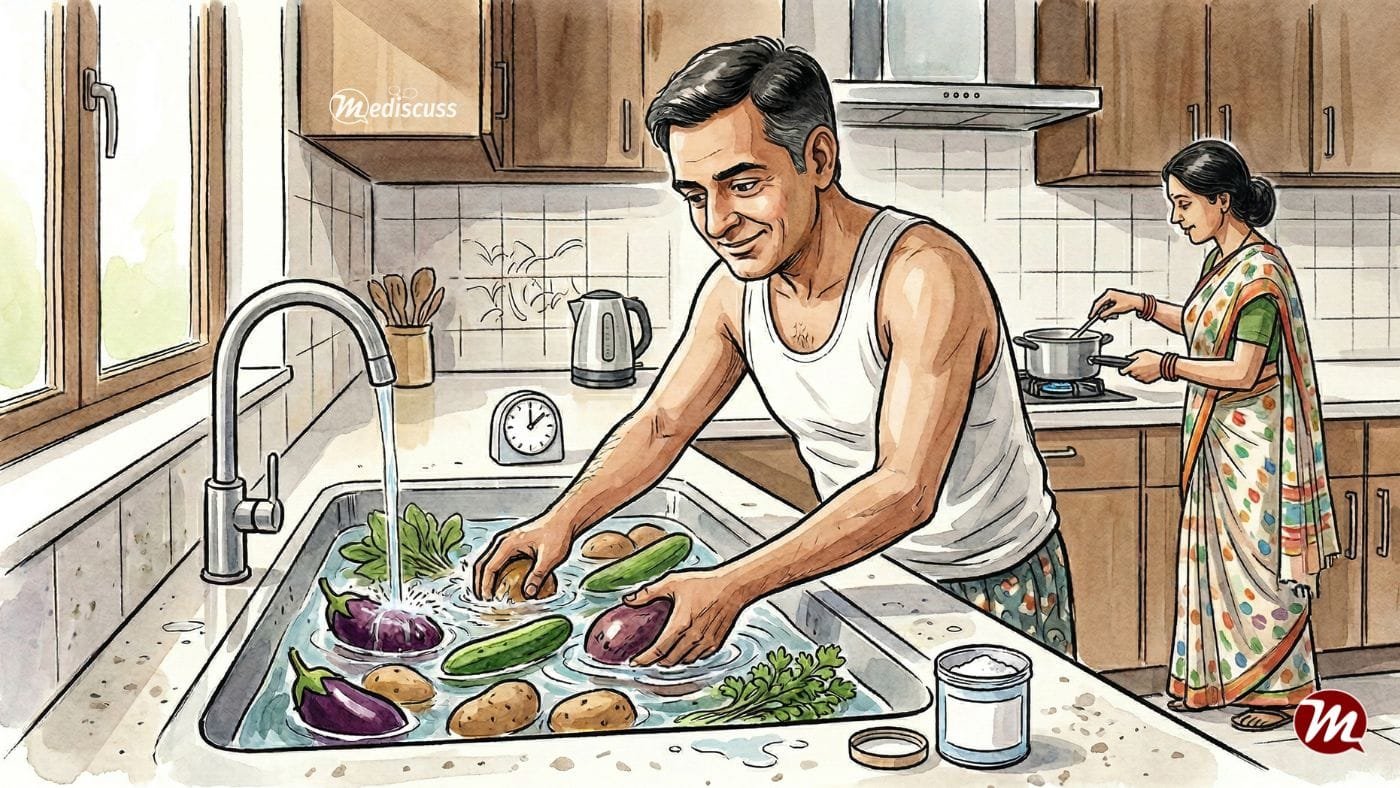
We try to eat healthy. We buy fresh fruits and vegetables, arrange them in our kitchen, and feel that we are doing the right things. Then we see it.
The white powdery layer on grapes. The unnaturally shiny wax on apples.
And we wonder. Are we eating nutrition, or poisons? I get this question almost every week. “Doctor, you ask me to eat vegetables, but they are sprayed with pesticides. I’m afraid to eat anything nowadays.”
Pesticides are real. They’re a reality of modern agriculture. But here’s what I tell those who ask me: you can’t control what happens at the agriculture farm, but you can absolutely control what happens in your kitchen wash basin.
The better news? You don’t need expensive “vegetable washes” or cleaning equipment.
You need baking soda, fifteen minutes, and learn some basic kitchen chemistry.
The Science of Soaking: Baking Soda vs. Vinegar
Running water removes loose dirt from vegetables. It makes them look clean. But pesticides, which are oily, don’t get washed off that easily. They stick to the waxy skin of fruits and vegetables. To remove these, we need to change the rules of the game.
Let’s learn basic chemistry.
The Gold Standard: Baking Soda
A University of Massachusetts study 1 put different cleaning methods head-to-head. The winner? Baking soda solution. Not commercially available vegetable wash liquids. Not vinegar. Just baking soda.
Why it works: Most pesticides are slightly acidic. They are unstable in alkaline environments. Baking soda is alkaline. It literally breaks down pesticide molecules, making them easy to wash away. This isn’t about scrubbing harder. It’s about changing the chemistry of what you’re trying to remove.
The Cleaning Recipe (Simple)
Here’s what actually works:
Method: Fill a large bowl with water. Add one tablespoon of baking soda. That’s it. You can also use the kitchen wash basic if you have lot of vegetables.
Can I add salt? Yes. A teaspoon of salt makes the solution antibacterial too. It’s a powerful combination. Baking soda + Salt.
Soak: Submerge the vegetables: apples, pears, capsicum, tomatoes. Leave them for 15 minutes. Not five. Not thirty. Fifteen.
Rinse: Wash thoroughly under cold running water afterward.
One important note: Use baking soda. Not baking powder. Please check the label. Baking powder contains cornstarch and acids. It won’t work for this. You need pure sodium bicarbonate.
What About Vinegar?
Many people prefer vinegar to clean vegetables. Vinegar is excellent for killing bacteria like E. coli on leafy green vegetables. But it is less effective than baking soda for breaking down pesticide molecules.
Use vinegar for killing germs, baking soda for removing pesticides.
However, remember that germs will be killed anyways when we cook the vegetables. You need to use vinegar only if you are using the greens as salads without cooking them.
The “Dirty Dozen” (Indian Edition)
Not all vegetables need the same treatment. Some absorb more pesticides than others.
The “Dirty Dozen” is an annual list published by the US Environmental Working Group (EWG) that identifies the 12 conventionally grown fruits and vegetables which have the highest levels of pesticide residues. 2
Here’s what actually needs extra attention in Indian kitchens, somewhat an Indian equivalent of the Dirty Dozen.
High Risk List (Soak These Compulsorily)
- Grapes: Heavily sprayed. That white powder on grapes indicates pesticides and fungicides.
- Green chillies and capsicum: Pests love them, so farmers spray them frequently.
- Spinach (palak): Large surface area, catches everything.
- Cauliflower: The structure traps both pesticides and worms in those crevices.
- Tomatoes: Frequently sprayed to prevent rotting during transport.
The Question I Hear Most: “Doctor, Is It Enough To Just Wash?”
Here’s what they really want to know: “If the plant absorbed the pesticide while growing, isn’t the poison inside the fruit? How will washing the surface help?”
It’s a smart question. And it deserves a very honest answer.
Myth Buster
- Myth: “If I can’t remove 100% of the pesticide inside the vegetable or fruit, I shouldn’t eat it.”
- Fact: There are two types of pesticides. Contact pesticides sit on the surface. Systemic pesticides get absorbed inside. Washing removes contact pesticides. That’s the majority of what you’re exposed to. Systemic pesticides do remain inside, but usually in extremely small amounts. They can’t be removed.
- The Verdict: Don’t stop eating vegetables out of fear. The benefits from that vegetable or fruit is much higher than the tiny risk of minimal systemic pesticides. You’re trading a microscopic risk for a higher benefit.
Think about it this way. The liver works harder to eliminate the alcohol in a single beer than it needs to work for managing the trace pesticides in the vegetables and fruits that you eat in a week. Perspective matters.
Special Cases: Wax and Worms
Some fruits and vegetables need special handling. Not because they have dangerous chemicals, but because standard washing doesn’t work.
The Wax on Apples
Farmers often coat apples with food-grade wax to prevent moisture loss during transport. It’s edible wax. But problem is that the wax can trap pesticides underneath.
The knife test: Gently scrape the skin with a knife. If white powder comes off, that’s wax.
My recommendation: If you want complete peace of mind, peel it. Yes, you will lose some fiber and nutrients that are in the apple skin. But if that wax layer bothers you, just remove it.
Cauliflower and Broccoli (The Worm Hideout)
Cold water doesn’t help with this problem. Those tiny worms hide deep in the crevices.
The hot water trick: Cut the florets and submerge them in hot (not boiling) salted water with a pinch of turmeric for 15 minutes. The heat forces the worms out. You’ll see them floating. It may be uncomfortable to see, but effective.
Turmeric isn’t used just for it’s colour here… it’s mildly antiseptic.
What NOT to Use (Please Note)
Some cleaning methods are actively dangerous. I’ve seen people do these things, thinking they’re being “extra careful.” They’re not.
Dish Soap or Detergent
Never use Vim, Pril, or any dish soap on vegetables. Never. These chemicals aren’t meant for consumption. Vegetables are porous, they can absorb soap residue, which causes nausea and stomach upset. The dish soap is not food-safe. Don’t do it.
Bleach or Chlorine
Absolutely not. Bleach on food creates dangerous chemical byproducts. It’s meant for floors and bathrooms, not your food.
Potassium Permanganate (Pink Water)
You see this in mass kitchens and hostels. It’s a strong disinfectant, true. But I don’t recommend it for home use. If the concentration is too high, it’s toxic. If it’s too low, it’s useless. Why risk it? Baking soda is safer, cheaper, and scientifically proven to be very helpful.
The Physician’s Prescription: Your Hygiene Checklist
The Green List (Recommended)
Effective, cheap, scientifically proven.
- Baking soda soak: The gold standard for vegetables. Fifteen-minute soak.
- Salt plus baking soda combo: Adds antibacterial power to the anti-pesticide soak.
- Turmeric hot water: Specific for cauliflower and broccoli to remove worms.
- Peeling: The only 100% guaranteed way to remove surface residue. Use for carrots, beetroot, cucumber and apples if you’re concerned.
The Red List (Avoid)
Dangerous practices.
- Dish soap or detergent: Never use soap on food.
- Bleach or chlorine: Toxic. Never use on fruits and vegetables.
- Rough scrubbing of soft skins: Don’t scrub berries or tomatoes aggressively. You’ll damage the skin and push germs inside instead of removing them.
The Bottom Line
Can we eliminate 100% of pesticides? No. Not unless you grow your own food in controlled conditions. But a simple 15-minute soak in baking soda water removes most of the surface pesticides. That’s significant. That’s good protection.
Over a lifetime, this small habit reduces the pesticide load on your liver and kidneys. It’s preventive medicine.
Don’t panic about the white powder on your grapes. Don’t throw away vegetables out of fear. Just wash them properly, and eat them. The benefits of eating that fruit and vegetable after washing are much higher than the small risks of the residual pesticides.
Your body needs those nutrients. Your liver needs those antioxidants. The tiny trace of pesticide that might remain? Your body handles it easily.
Closing Note
I’ve been practicing medicine for over 27 years. I’ve seen health trends come and go. But one thing never changes: people who eat more vegetables do better.
You don’t need organic for everything. You don’t need expensive equipment too.
You need baking soda, water, salt and fifteen minutes.
That’s the preventive medicine you can practice at home.
Healthy Kitchen Series
This article is part of the Healthy Kitchen Series that explores we can learn from traditional kitchen wisdom about creating a truly healthy kitchen.
Subscribe to get an email when the other articles are published.
- Which Cooking Oil? The good, bad and the smelly about cooking oils.
- Which Cookware is Safe? Cooking utensils that won’t slowly harm you.
- Are Air Fryers & Microwaves Safe? Are the modern gadgets friends or foes?
- Are Packet Masalas Safe? The trap of convenience.
- How to Clean Vegetables? The pesticide problem.
- Is RO Water Healthy? Water filtration, minerals and storage.
Go back to Healthy Kitchen Series Home
…

Dr. Shashikiran Umakanth (MBBS, MD, FRCP Edin.) is the Professor & Head of Internal Medicine at Dr. TMA Pai Hospital, Udupi, under the Manipal Academy of Higher Education (MAHE). While he has contributed to nearly 100 scientific publications in the academic world, he writes on MEDiscuss out of a passion to simplify complex medical science for public awareness.