
Are Air Fryers & Microwaves Safe? Kitchen Gadgets – A Physician’s Guide
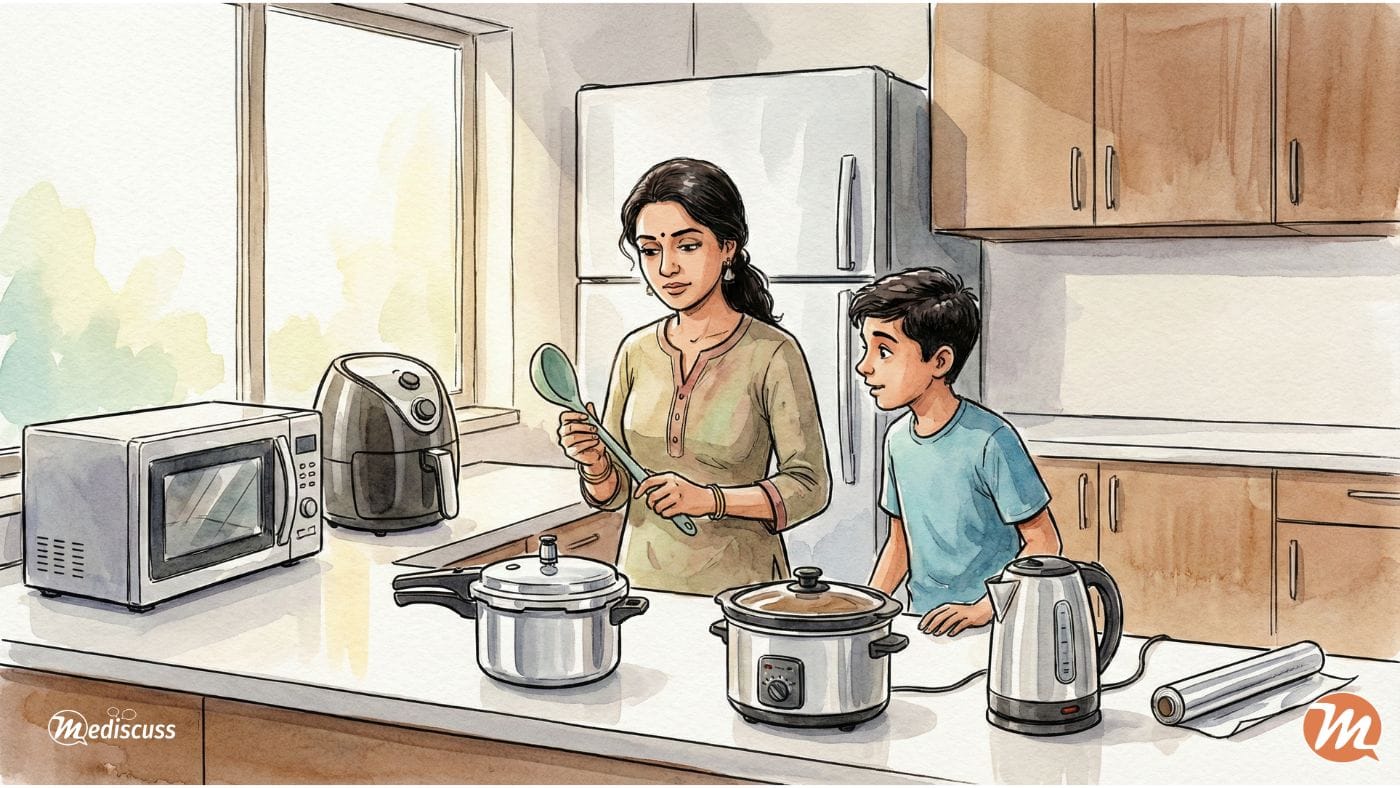
Our grandmothers cooked on firewood stoves and used clay pots. Today, our kitchens look like science labs, filled with buzzing microwaves, whistling pressure cookers, and air fryers.
With these gadgets come new fears. “Does the microwave kill nutrients?” “Is the air fryer really safe?” “Is silicone just another plastic?”
In this article, we will examine the modern “smart kitchen” through the lens of medical science.
1. The Microwave Oven:
The microwave is probably the most misunderstood appliance in history. The word “radiation” terrifies everyone, but let us look at how it actually works.
How Microwave Oven Works
Microwaves DO NOT use dangerous radiation like X-rays.
Instead, they use safe energy waves that pass through the food and target the water inside. These waves vibrate the water molecules back and forth at very high speeds. This shaking creates friction… just like rubbing your hands together to get warm. It is this internal friction that generates heat and cooks your food.
Nutritional Benefit:
Surprisingly, microwaving is one of the best ways to preserve nutrients. Because it cooks fast and uses very little water, water-soluble vitamins like Vitamin C and B-Complex are retained better than in boiling. 1
Myth Buster #1
- Myth: “Microwaving food makes it radioactive.”
- Fact: Impossible. Once the beep sounds and the light goes off, the waves are gone. There is no residual radiation in your food, just heat.
The Real Danger: Plastic
The oven is safe, but the container might not be. Heating food in plastic (even “BPA Free” or “Microwave Safe” plastic) can cause chemicals called phthalates to leach into your food. This disrupts our hormones.
Physician’s Recommendation: Use the microwave without any worry, but only with glass or ceramic containers. Never use any plastic in microwave ovens.
2. The Air Fryer:
The air fryer is becoming a common kitchen appliance, but many people don’t completely understand how it works. It is basically a powerful convection oven that circulates superheated air around the food.
How Air Fryer Works
Think of an air fryer as a powerful, mini oven.
Inside the top section, a heating coil generates intense heat while a high-speed fan blows this hot air downwards. The air swirls around the food rapidly, hitting it from all sides at once. This fast-moving hot air quickly dries out the surface, creating a crispy, golden-brown crust. It mimics the texture of deep frying, but uses hot air instead of a pool of oil.
Nutritional Benefit:
- Air frying reduces your oil intake by up to 80% compared to deep frying. But the bigger benefit is chemical safety.
- When starchy foods like potatoes are deep-fried in hot oil, they form a harmful chemical called acrylamide (a potential cancer risk).2
- Air frying cooks the food using hot air instead of oil, significantly lowering the formation of this chemical, but still giving you that crispy taste.
The Teflon Concern
Is the air fryer basket coated with Teflon?
- Yes, most air fryer baskets have a non-stick coating (PTFE).
- However, unlike a tawa on a gas stove, air fryers are electronic devices with a maximum temperature limit (usually 200°C). Since Teflon only degrades above 260°C, the device physically cannot get hot enough to release toxic fumes under normal operation. It is safe.
- Precaution: Just like your non-stick pan, as explained the previous article on safe cooking utensils, if the basket coating starts peeling or chipping, you should replace the basket to avoid microplastics.
3. The Pressure Cooker:
A common belief among many people is that pressure cookers make rice “unhealthy” because they trap the starch, whereas the traditional open-pot method (where you drain the excess water or ganji) removes starch.
The Medical Reality
- Glycemic Index (GI): It is true that draining the water removes some starch, slightly lowering the GI of the rice. However, the difference is not magical. Eating a large plate of “drained” rice will still make your blood sugar go high.
- Nutrient Loss: The disadvantage of the open-pot method is that when you throw away the ganji water, you are also throwing away water-soluble vitamins (B-Vitamins) and minerals.
- Pressure Cooker Advantage: Pressure cooking preserves these vitamins.
Physician’s Recommendation: If you are diabetic, a control on how much you eat is much more important than the cooking method. Pressure cooking is perfectly healthy and safe.
4. Fridge, Freezer & Reheating
Refrigeration is the single biggest advancement in food safety. However, improper use causes “Fried Rice Syndrome” (Bacillus cereus food poisoning).
The “Reheated Rice” Danger: Rice contains spores of bacteria called Bacillus cereus that can survive cooking. If cooked rice is kept at room temperature for many hours, these spores can grow into active bacteria and produce toxins. Reheating destroys the bacteria, but it does not destroy the toxin.
Safety Rule: Do not leave cooked rice outside for more than 2-3 hours. Refrigerate it promptly.
5. Other Gadgets & Utilities
A. The Electric Kettle
Most electric kettles on the market have a plastic body or a transparent plastic window to show the water level.
The Risk: When water boils at 100°C, it creates a harsh environment. If plastic components touch the boiling water, they degrade over time, shedding microplastics directly into your tea or coffee.
Recommendation: Look for a kettle with a full stainless steel interior. Open the lid and check inside… there should be no plastic gauges, windows, or glued parts touching the water.
B. Slow Cooker
Slow cooker is not as common in Indian kitchens as the pressure cooker, but it is gaining popularity for making rajma, dal makhani, etc.
How it Works: It cooks food at a very low temperature over 6 to 8 hours. The inner pot is usually made of heavy ceramic or stoneware, which is chemically inert and safe.
Nutritional Benefit: Because it cooks slowly with a closed lid, it breaks down tough proteins in complex food items and pulses without destroying heat-sensitive nutrients. It is an excellent, healthy tool for “set it and forget it” cooking.
C. Silicone Ladles & Baking Cups
With the rise of non-stick pans, colourful silicone ladles have entered our kitchens.
Are they plastic? No.
Food-Grade Silicone is a synthetic rubber made from bonded silicon (a natural element) and oxygen. It is chemically inert.
- For Sambar/Curries (Boiling): Perfectly safe. Silicone is heat resistant up to 220°C. Boiling liquids only reach 100°C.
- For Tadka (Vaggarane): Be careful. Hot oil during tadka can exceed 250°C. Do not leave a silicone spoon resting inside a hot tadka/vaggarane pan, as it may degrade at very high temperatures.
D. Aluminum Foil
We often wrap hot chapatis or sandwiches in aluminum foil. While convenient, foil is thin metal.
The Risk: If you wrap hot, acidic foods (like lemon rice, pickles, or tomato-based rolls) in foil, the acid reacts with the aluminum, causing it to leach into the food.
Better Alternative: Use parchment paper (butter paper) or a clean cloth for wrapping hot food.
The Kitchen Gadget Triage Checklist
The Green List (For Daily Use)
Safe, evidence-based, and healthy.
- Stainless Steel Pressure Cooker: The gold standard. Preserves vitamins better than open boiling.
- Microwave (only with glass/ceramic): Excellent for nutrient retention and safe reheating.
- Food-Grade Silicone Ladles: Good for stirring curries and protecting your pans.
- Slow Cooker: Ceramic pots are inert and excellent for healthy stews.
The Yellow List (Use with Caution)
Safe if used correctly, but requires attention.
- Air Fryer: Healthy mechanism, but ensure the basket coating is intact. Do not char or burn food.
- Electric Kettle: Check the inside. Ensure water touches only steel, not plastic windows.
- Aluminum Foil: Okay for cold sandwiches. Do not use for hot, acidic items (lemon rice/pickles).
The Red List (Avoid)
These practices carry proven health risks.
- Plastic in Microwaves: Even if labeled “Microwave Safe,” avoid it. Switch to glass.
- Reheating Rice >1 Time: Increases risk of food poisoning toxins. Eat fresh or refrigerate immediately.
- Scratched Air Fryer Baskets: Peeling coating means microplastics in your food. Replace the basket.
Bottom Line
Technology is not the enemy of health; ignorance is. A microwave is healthier than deep frying, and a pressure cooker is better than open boiling, if you use them correctly.
If you must remember one rule from this article: Keep plastic out of the heat. Whether it is the microwave, the kettle, or hot food storage, heat and plastic are a toxic combination.
Healthy Kitchen Series
This article is part of the Healthy Kitchen Series that explores we can learn from traditional kitchen wisdom about creating a truly healthy kitchen.
Subscribe to get an email when the other articles are published.
- Which Cooking Oil? The good, bad and the smelly about cooking oils.
- Which Cookware is Safe? Cooking utensils that won’t slowly harm you.
- Are Air Fryers & Microwaves Safe? Are the modern gadgets friends or foes?
- Are Packet Masalas Safe? The trap of convenience.
- How to Clean Vegetables? The pesticide problem.
- Is RO Water Healthy? Water filtration, minerals and storage.
Go back to Healthy Kitchen Series Home

Dr. Shashikiran Umakanth (MBBS, MD, FRCP Edin.) is the Professor & Head of Internal Medicine at Dr. TMA Pai Hospital, Udupi, under the Manipal Academy of Higher Education (MAHE). While he has contributed to nearly 100 scientific publications in the academic world, he writes on MEDiscuss out of a passion to simplify complex medical science for public awareness.
 wpDiscuz