
Which Cooking Oil? A Physician’s Guide
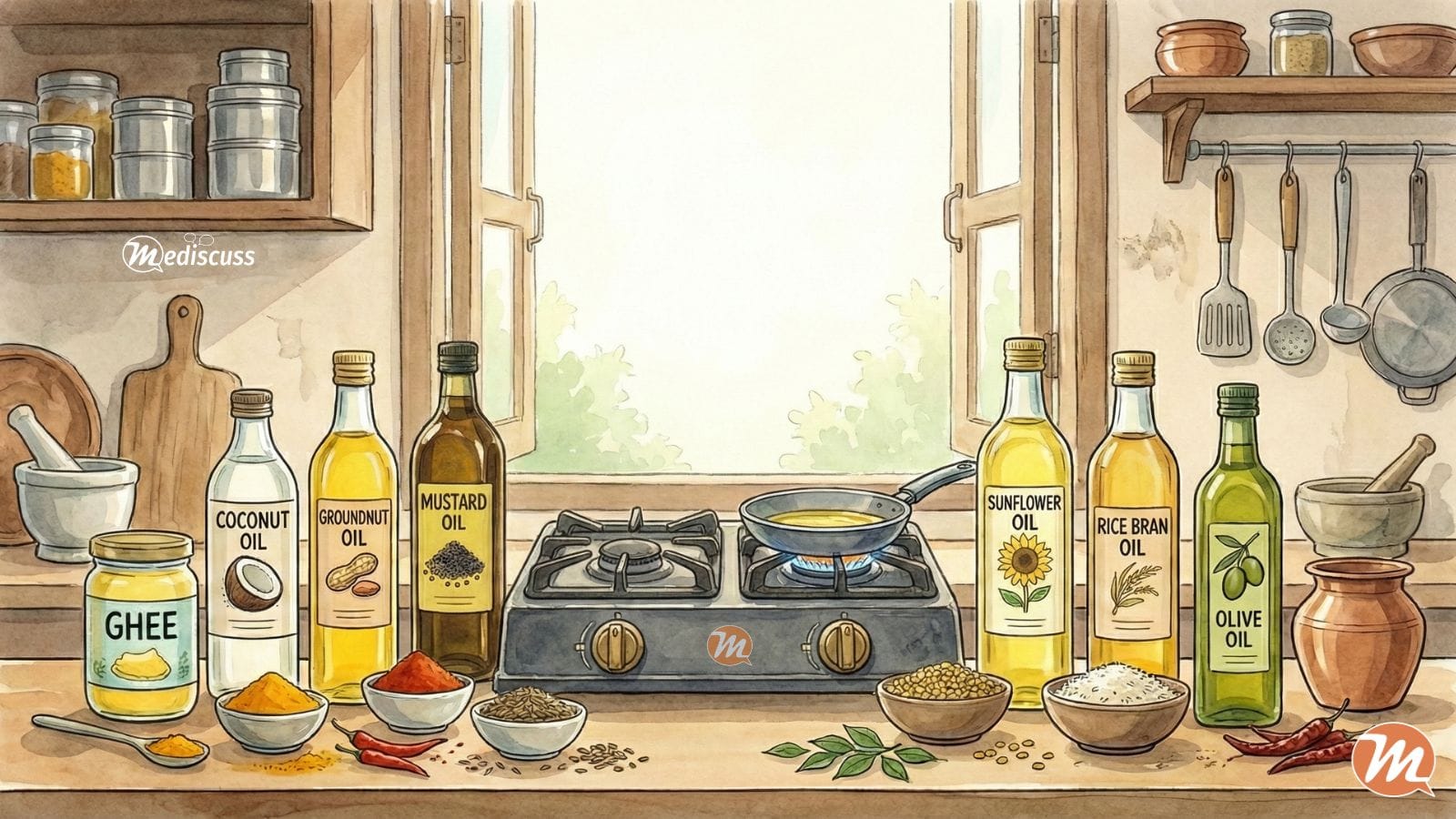
The Oil Crisis in Your Kitchen
For the past few decades, we abandoned our traditional ghee for plastic bottles of “refined” oil because we wanted to save our hearts. We were told these modern choices were “cholesterol-free,” “light,” and “clear.”
But science suggests we may have made a mistake. What if the “heart-healthy” refined oil that we bought to protect heart is actually damaging it?
This article explores the reality of refined vegetable oils, the dangers of reheating oils, and why traditional wisdom regarding ghee, coconut, groundnut and mustard oils was right about the advantage to our metabolic health.
The Problem with “Refined” Vegetable Oils
Most oils sold today, such as “refined” sunflower, soybean, corn, canola oil, and other such oils are heavily processed industrial products. They may promise health benefits, but the manufacturing process tells a totally different story.
To make these oils “refined,” manufacturers subject these seeds to harsh treatments:
- Extraction: Using chemicals like hexane.
- Heat: Subjecting the oil to very high temperatures.
- Bleaching: Removing natural colour.
- Deodorizing: Removing the natural smell.
Refined. That sounds very sophisticated. But nutritionally, it represents total degradation. It was a very clever “language-trick” that made a heavily processed product sound beneficial to us.
The Inflammation Factor
The primary concern with refined seed oils is Inflammation. These oils contain high levels of Omega-6 fatty acids. While the human body requires a small amount of Omega-6, an excess disrupts the delicate balance between Omega-6 and Omega-3.
This imbalance triggers chronic, low-grade inflammation. This invisible stress affects the heart, blood vessels, and overall metabolism. Over time, a constant overload of these inflammatory oila results in obesity, diabetes, and heart disease, the exact problems that these oils were marketed to prevent.
Myth: “Refined oil is good because it is cholesterol-free.”
Fact: This is a marketing tactic. Cholesterol is naturally found only in animal products. Sunflower or groundnut oils never contained cholesterol in the first place.
The Poisons in Your Kadai: Reheating Oil
A common practice in many kitchens is saving leftover oil after deep frying. You may think that this avoids wasting precious oil, it causes significant health risks.
When oil is heated to high temperatures, its chemical structure breaks down. This thermal degradation produces harmful chemicals called Aldehydes. These chemicals are invisible and tasteless but are toxic to the body. They have been linked to neurodegenerative conditions like Alzheimer’s disease, cardiovascular disease, and certain cancers.
Guidelines for Deep Frying:
- The One-Use Rule: If you choose to deep fry with refined oil, use it once, cool it, and discard it.
- Reduce Volume: Use a smaller pan (kadai) and less oil to reduce wastage.
- Ghee Exception: Ghee is more stable. You can deep fry in ghee, filter it, and use it just one more time for tempering (tadka/vaggarane). Never use it beyond that.
How to Discard Used Cooking Oil
Repeated heating makes cooking oil toxic, so it should never be reused. However, do not just pour the used oil down the kitchen sink or toilet, as it will harden, block your plumbing, and pollute local water sources.
Here is the safe way to throw it away at home:
- For Small Amounts (Shallow Frying): Let the pan cool down. Wipe the leftover oil and grease completely with a paper towel or old newspaper. Throw the oily paper in your dry waste bin and wash the pan with soap.
- For Large Amounts (Deep Frying): Let the oil cool to room temperature. Pour the oil into an old, sealable container that you plan to throw away, like a thick plastic box or a milk carton.
- The Absorption Trick: To prevent messy leaks in your garbage bin, mix the liquid oil with absorbent kitchen waste. Used tea leaves or coffee powder are excellent for this… they soak up the oil quickly and neutralize the smell too.
- Final Step: Seal the container tightly and throw it in your regular municipal solid waste (dry waste) bin.
The Hidden Fat: RBD Palm Oil
Even if you switch to healthy oils for home cooking, you may still be consuming “Edible Vegetable Oil” through processed foods. In 90% of cases, this vague ingredient listed on biscuits, rusks, bhijias, and instant noodles is RBD Palm Oil (Refined, Bleached, and Deodorized).
Unlike fresh red palm oil, which is rich in Vitamin E, RBD palm oil is a processed industrial product designed for prolonging shelf life, not for promoting human health.
Action: Check the ingredient labels. If a packet says “Edible Vegetable Oil” or “Palmolein” without any further details, avoid it.
Rediscovering Traditional Oils
1. Ghee: Liquid Gold
Ghee was wrongly blamed for decades. However, it is one of the most stable cooking oils available.
- High Smoke Point: Ghee remains stable up to 250°C, making it safe for high-heat cooking.
- Nutrient Absorption: Vitamins A, D, E, and K are “fat-soluble.” Ghee acts as a vehicle to transport these nutrients.
- Satisfaction: Unlike empty calories, good fats induce satisfaction (satiety) and reduce cravings.
2. Coconut Oil: The Tropical Miracle
For years, coconut oil was demonized due to its saturated fat content, though it was preferred in the coastal regions of Karnataka and Kerala. In chemistry, however, “saturated” means stability.
- Heat Resistance: Coconut oil does not oxidize or break down easily at high temperatures.
- Selection: Choose “Cold Pressed” or “Virgin” coconut oil. It should smell like coconuts.
3. The Middle Path
A. Groundnut Oil:
If ghee is too expensive and you don’t like the aroma of coconut oil, groundnut (peanut) oil is the ideal middle ground. It is high in Monounsaturated Fats (MUFA), similar to olive oil, but stable for Indian cooking.
Important: Avoid “Refined” groundnut oil. Look for Filtered or Wood Pressed varieties.
B. Mustard Oil:
For those in North and East India, Mustard Oil holds a similar place of honour. It is highly heat-stable and heart-healthy too.
Important: It must be heated to the smoking point to remove its raw pungency before cooking. Like groundnut oil, always choose “Kachi Ghani” or “cold-pressed” versions and not refined ones.
The Foreign Fashion: Olive Oil
The “Mediterranean Diet” is healthy, but it must be adapted to the Indian context.
Extra Virgin Olive Oil (EVOO) is loaded with delicate antioxidants. When EVOO is heated to high temperatures (like Indian tadkas), these nutrients get destroyed. In addition, beware of “Pomace Olive Oil,” which is an industrial residue extracted from waste using chemical solvents.
Recommendation: Use Extra Virgin Olive Oil RAW. Use them in salads, soups, or breads. But do NOT use it for Indian high-heat cooking.
The Physician’s Prescription:
To simplify your shopping list, here is the quick guide to cooking oils.
✅ The Green List (Buy These)
These are stable, natural, and time-tested options.
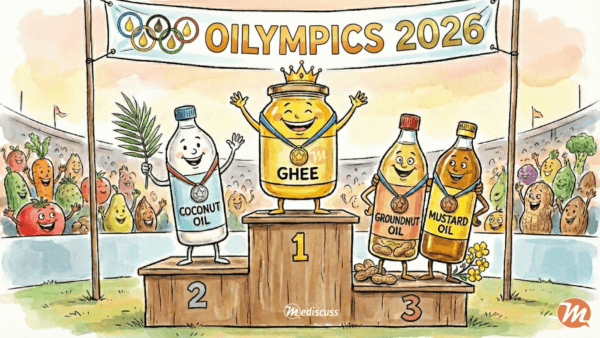
- Desi Ghee (Cow Ghee): Best for everything (frying, rice, rotis). Highest smoke point, very stable in high heat.
- Coconut Oil (Cold Pressed): Best for South Indian curries and stir-frying.
- Groundnut Oil (Filtered/Wood Pressed): Best for daily cooking with a neutral taste.
- Mustard Oil (Cold Pressed): Best for North/East Indian dishes. Must be high-heated to reduce pungent flavour.
⚠️ The Yellow List (Use with Caution)
Use for specific purposes only.
- Extra Virgin Olive Oil: Use raw only (salads). Never heat.
- Rice Bran Oil: A backup for deep frying due to high smoke point, but usually chemically extracted.
- Butter: Use for topping or baking. Burns easily if used for frying.
❌ The Red List (Do Not Use)
These cause inflammation and long-term health damage.
- Refined Vegetable Oils: Sunflower, soybean, corn, canola, cottonseed, etc.
- Pomace Olive Oil: Industrial waste product.
- Vanaspati / Margarine: Contains Trans Fats, the worst enemy of heart-health.
The Bottom Line
Trust nature more than factories. Buy “Cold Pressed” even if it costs more. You will naturally use less of it because it is richer and more satisfying.
Clean your kitchen today for the sake of your heart.
Check Out: More Healthy Kitchen Insights
- The Healthy Kitchen: A Physician’s Guide to Health & Safety
- Which Cooking Oil? A Physician’s Guide
- Which Cookware is Safe? A Physician’s Guide
- Are Air Fryers & Microwaves Safe? Kitchen Gadgets – A Physician’s Guide
- Are Packet Masalas Safe? A Physician’s Guide
- How to Clean Vegetables: Remove Most of the Pesticides
- Is RO Water Healthy? A Physician’s Guide to Water Safety
Go back to Healthy Kitchen Series Home

Dr. Shashikiran Umakanth (MBBS, MD, FRCP Edin.) is the Professor & Head of Internal Medicine at Dr. TMA Pai Hospital, Udupi, under the Manipal Academy of Higher Education (MAHE). While he has contributed to nearly 100 scientific publications in the academic world, he writes on MEDiscuss out of a passion to simplify complex medical science for public awareness.
 wpDiscuz