
Is RO Water Healthy? A Physician’s Guide to Water Safety
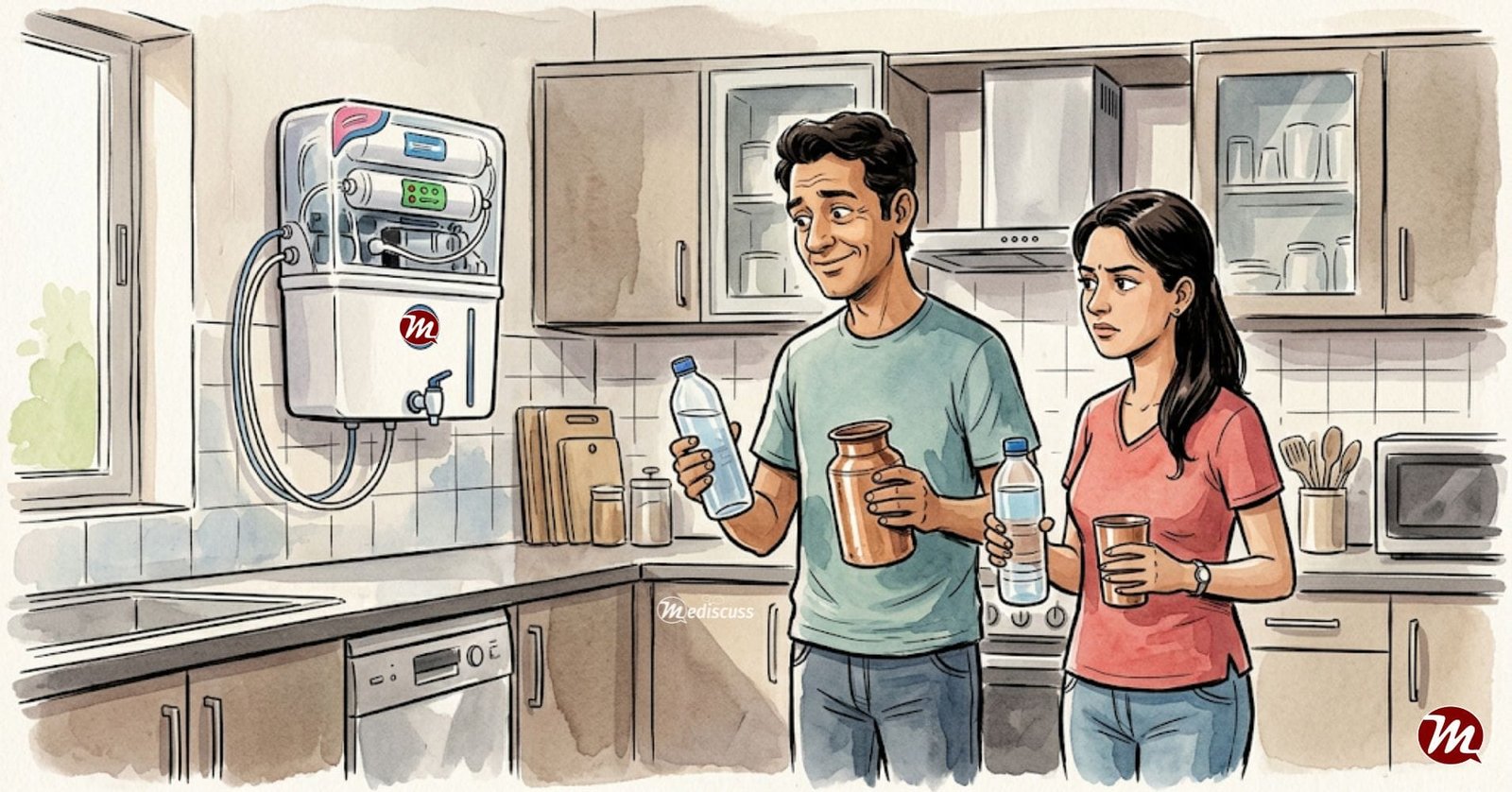
Water is life.
In India, ensuring the safety of our drinking water is a primary health focus. To protect our families, we have ‘upgraded’ from boiling our water to using high-tech Reverse Osmosis (RO) systems that promise absolute purity.
Modern water purifiers provide convenience at the touch of a button.
- But is “purer” always healthier?
- Are we stripping the life out of our water in our search for safety?
Let’s filter the medical facts from the common myths.
What is TDS?
TDS stands for Total Dissolved Solids. It is the total concentration of dissolved minerals, salts, and metals in your water, measured in milligrams per litre (mg/L) or parts per million (ppm). A simple handheld TDS meter (available for ₹200-400 online or at a store near you) lets you check your tap water and the water purifier output in seconds. This TDS number will help you decide which kind of purifier you actually need. I will explain below.
1. RO: De-mineralised Water
Reverse Osmosis (RO) is a highly effective technology. It forces water through a filter membrane that is so fine that it removes dissolved solids, heavy metals, and viruses.
It is extremely effective. Along with contaminants like arsenic and lead, it removes essential minerals like calcium and magnesium too! These minerals have an important role in our heart health and bone density. Though drinking water is not our primary source of these minerals, it contributes a about 10-20% of daily intake. The rest comes from our diet.
The Hidden Mineral Deficit
Many people have vague muscle cramps and fatigue. Though there are many causes, long-term consumption of completely de-mineralised RO water is an important reason. When your purifier takes out all dissolved solids, you lose that daily magnesium and calcium intake from water. The WHO has noted that prolonged consumption of de-mineralised RO water may impact overall mineral levels.
The reassuring news: This is easy to fix, and you do not need to discard your RO unit.
“I already have an RO. What should I do?”
If you have already invested in an RO unit, there is no need to replace it. You can correct the mineral balance with one of these simple steps:
- Step 1: Adjust the TDS Controller (Zero Cost): Most Indian RO units (Kent, Aquaguard, Livpure, Pureit) have a built-in “TDS Adjuster.” It is a small valve, usually at the back of the unit, that mixes mineral-containing water back into the RO output. Many service technicians set this to the lowest possible TDS during installation, thinking “lower is better.” Talk to your technician and ask them to set the output TDS between 50 and 150 mg/L. You can verify this yourself with a handheld TDS meter. I personally have done this with the RO purifier at my home.
- Step 2: Install a Remineraliser (if needed): If your RO unit does not have a TDS controller, or if you want an additional layer of mineral correction, get your technician to fit an “Alkaline” or “Mineral Guard” cartridge. This adds calcium and magnesium back into the water after filtration. However, this is an expensive option.
2. Do You Actually Need an RO?
A Simple Decision Guide
Check your tap water TDS with a handheld meter, then follow this guide:
- TDS below 300 mg/L: You generally do not need an RO. A UV purifier will kill pathogens while retaining your water’s natural minerals. This is the case for most municipal tap water in coastal and peninsular India.
- TDS 300 to 500 mg/L: A UV purifier with a good sediment pre-filter is usually sufficient. Consider RO only if the water has a salty or metallic taste.
- TDS above 500 mg/L: RO is genuinely necessary. This is common with borewell water in dry regions. Set the TDS controller to an output of 50–150 mg/L.
- Known chemical contamination (arsenic, fluoride, lead): RO is essential irrespective of the TDS level.
The UV/UF Purifier (Non-RO)
If your municipal tap water is chemically safe and has a TDS below 300, a standard UV (Ultraviolet) purifier is an excellent choice. It uses UV light to kill bacteria and viruses without altering the natural mineral composition of the water. It is the ideal option for the majority of Indian urban households.
The 20-Litre “Can” Water
Many urban homes depend on large glassy-blue 20-litre plastic jars. This has hidden risks:
- Quality Control: Many local bottling units do not have strict regulatory control. You may simply be consuming untreated borewell water.
- Plastic Degradation: These polycarbonate cans are reused extensively and usually transported in direct sunlight. This accelerates the leaching of microplastics and harmful chemicals into the water.
What about sealed branded bottles (Bisleri, Kinley, etc.)? These are manufactured under BIS standards and are generally safe for occasional use. Remember, they are also often transported or stored outdoors or in sunlight. In addition, they are environmentally costly and not a sustainable daily solution.
3. The Gold Standard: “Boiled & Cooled”
Before advanced filtration, our homes relied on boiled water. It was often infused with cumin (jeera), clove (lavang) or other herbs. Medically, boiling is one of the most potent methods for biological purification.
Heating vs. Rolling Boil
Just heating water until small bubbles form is NOT enough for complete purification.
The Rule: Bring the water to a vigorous, rolling boil for 1 minute. This sustained high heat is sufficient to effectively kill viruses, bacteria, and cysts of worms. If you live high altitudes (above 2,000 metres), boil for up to 3 minutes.
“But doctor, boiling takes too much effort!”
Boil a large vessel of water (5-6 litres) after dinner and allow it to cool overnight in a covered stainless steel vessel. By morning, you have safe, mineral-intact water ready for the day.
Shelf Life of Boiled Water
Boiled water stored in a clean, covered vessel remains safe for about 24 hours. After that, the risk of environmental recontamination increases. Boil a fresh vessel of water daily.
4. The Storage: Copper, Clay, Glass, or Steel?
The vessel you use to store purified water is as important as the purification method itself.
Copper Vessels (Tamra)
Ancient traditions recommend copper, and modern microbiology acknowledges the oligodynamic effect (the ability of copper to inhibit bacterial growth.) However, this effect requires a minimum of 8 hours of contact time (overnight storage). Simply filling a copper vessel and drinking from it an hour later has little antibacterial benefit.
Copper also requires strict daily maintenance:
- Oxidation: Copper reacts with moisture and air to form a greenish layer of copper salts. If the vessel is not scrubbed clean daily (using lemon or tamarind), consuming water from it can lead to excessive copper intake over time.
- Acid Reactivity: Never store acidic liquids (like lemon water or buttermilk) in copper. The acid strips the metal rapidly, causing severe gastro-intestinal problems.
Clay Pots & Glass
- Clay (matka/madike): An excellent, sustainable option. It cools water via natural evaporation and adds an earthy flavour that encourages adequate hydration. Maintenance tip: If you have unglazed clay pots, scrub them once in 1-2 weeks and sun-dry them to prevent bacterial biofilm formation inside the porous surface.
- Glass & Stainless Steel: The most inert and clinically safe options. They do not leach chemicals, are easy to sanitise, and preserve the true taste of the water.
The Green List (Recommended)
Optimal for safety and mineral retention.
- Boiled & Cooled: The most reliable method for biologically suspicious drinking water. Remember: 1 minute of rolling boil is necessary.
- Stainless Steel / Glass Storage: Chemically inert, durable, and hygienic.
- UV/UF Purifiers: Ideal for low-TDS water (<300 mg/L), as they eliminate microorganisms but retain natural minerals.
The Yellow List (Use With Awareness)
Safe if used correctly.
- RO Systems: Necessary if your water source has high TDS (>500) or known chemical contamination. Ensure your TDS adjuster/ controller is adjusted to 50–150 ppm, or use a remineraliser cartridge.
- Copper Vessels: Beneficial if for overnight storage (8+ hours) only if cleaned thoroughly every single day.
- Clay Pots: Excellent, but require periodic scrubbing and sun-drying to prevent bacterial biofilm formation.
The Red List (Avoid)
These have definite health risks.
- 20-Litre Plastic Cans: High risk of plastic degradation and poor hygiene.
- Sun-Exposed Plastic Bottles: Never consume water from a disposable plastic bottle left in a hot car or in direct sunlight.
- Cooking with Contaminated Tap Water: If your tap water is chemically contaminated (heavy metals or high TDS), do not use it for cooking dal or rice. Boiling actually concentrates the chemical contaminants instead of removing them. Use your RO water instead.
Further Reading
We discussed the quality of water, but what about the quantity? Are you drinking too much water unnecessarily?
Read: The Hydration Myth — Why Drinking “More” Is Not Always Better
The Bottom Line
Do not blindly equate “technological advance” with “health.” If your local water has a low TDS, simple boiling or UV filtration is superior to an expensive RO machine. Store your water responsibly in steel, glass, or clay, and minimise the use of plastics.
Healthy Kitchen Series
This article is part of the Healthy Kitchen Series that explores we can learn from traditional kitchen wisdom about creating a truly healthy kitchen.
Subscribe to get an email when the other articles are published.
- Which Cooking Oil? The good, bad and the smelly about cooking oils.
- Which Cookware is Safe? Cooking utensils that won’t slowly harm you.
- Are Air Fryers & Microwaves Safe? Are the modern gadgets friends or foes?
- Are Packet Masalas Safe? The trap of convenience.
- How to Clean Vegetables? The pesticide problem.
- Is RO Water Healthy? Water filtration, minerals and storage.

Dr. Shashikiran Umakanth (MBBS, MD, FRCP Edin.) is the Professor & Head of Internal Medicine at Dr. TMA Pai Hospital, Udupi, under the Manipal Academy of Higher Education (MAHE). While he has contributed to nearly 100 scientific publications in the academic world, he writes on MEDiscuss out of a passion to simplify complex medical science for public awareness.