
Which Cookware is Safe? A Physician’s Guide
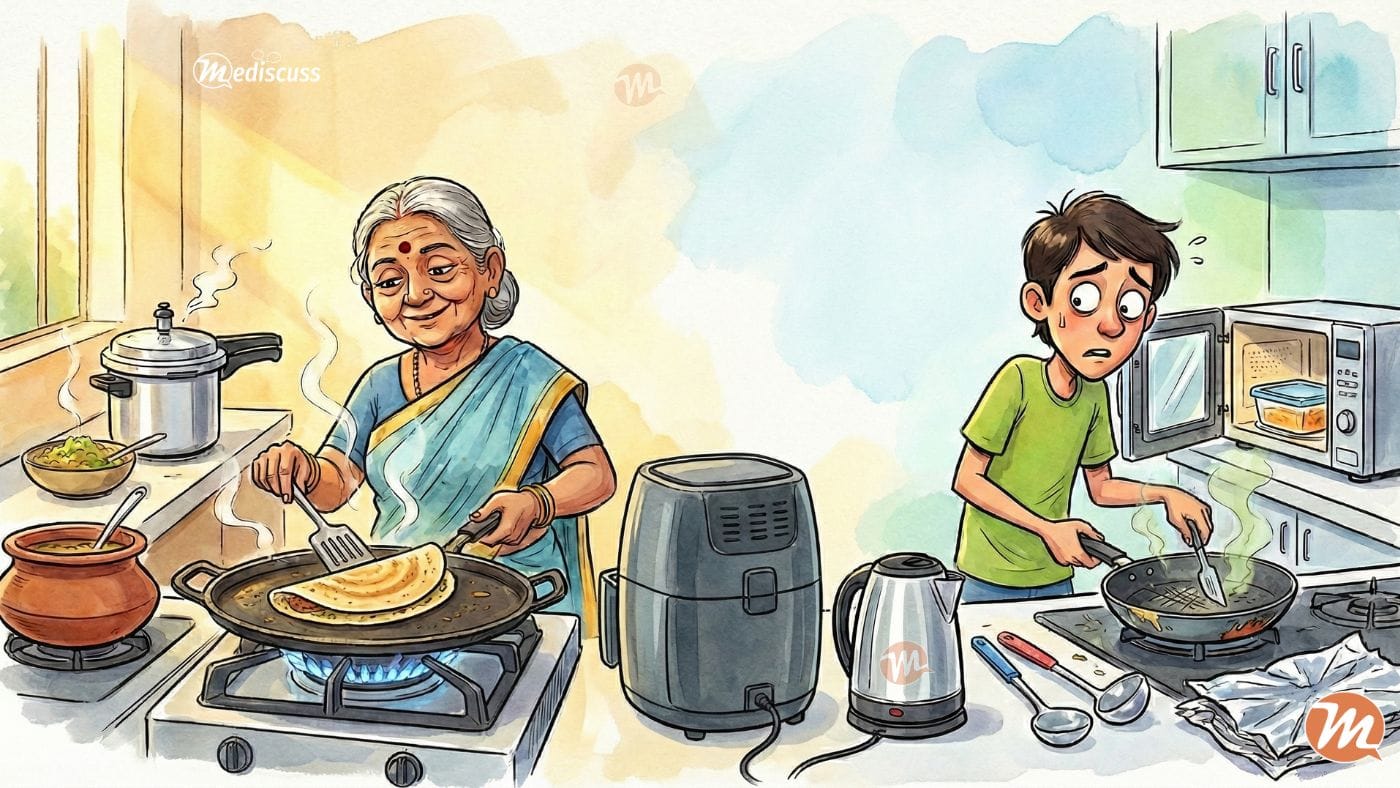
We carefully check food labels for sugar and preservatives, but how often do we check the vessel that cooks it? The modern Indian kitchen has become a compromise between convenience and tradition.
Are your cooking utensils silently adding chemicals to your food? Are giving more importance to convenience than safety? Let us learn the chemistry of the kitchen, separating “fear” from “facts.”
1. Non-Stick (Teflon) Utensils
Many people ask me: “are non-stick utensils safe?”
Non-stick cooking utensils use a coating called PTFE. It is safe at low heat but becomes unstable when overheated. The main issue in an Indian kitchen is that our cooking style is almost always “high heat.”
The “Dosa & Roti” Question
This is the most common question I get: “Doctor, can I use non-stick tawas for dosas and chapathis?”
Technically, yes… but practically, it is not the ideal choice. Here is why:
- Heat: Making a crispy dosa requires the tawa to be hot (around 200°C – 230°C). If you leave the tawa empty on the flame for just 2 minutes while preparing for the next dosa, the temperature can spike beyond 260°C. At this point, Teflon degrades and releases invisible and harmful fumes.
- Durability: Using sharp metal ladles (soutu/karchhi) or flat turners (kai/sattuga/chattu/lalta) creates micro-scratches on the Teflon, exposing it for more degradation. Even scrubbing hard with a scotch-brite pad slowly peels the layer.
Scrubbing with Coconut Fibre (Coir):
Coconut fibre is natural, but it is still abrasive, and can cause scratches. Using it vigorously on Teflon will eventually scratch the surface. However, it is a very good scrubber for iron and steel vessels.
Myth: “If I eat a flake of coating from a scratched tawa/pan, I will get cancer.”
Fact: Swallowed flakes of Teflon are chemically inert and will simply pass through your intestines without any changes or danger. The real danger of a scratched tawa/pan is that the damaged surface releases millions of microplastics into food when heated. The long-term hormonal effect of these particles is unknown, so it is safer to stop using damaged tawa/pans.
The Restaurant Secret
Why are restaurant Dosas always crispier and tastier? They don’t use Teflon, but use massive cast iron tawas.
Recommendation: Keep a dedicated heavy cast iron tawa for dosas and rotis. It retains heat better, crisps the batter naturally, and lasts for 100 years. Keep your non-stick pan only for low-heat items like eggs or sauteing vegetables.
Indian Cooking Temperature Guide
| Cooking Task | Typical Temp | Teflon Safety Verdict |
|---|---|---|
| Boiling Milk / Sambar | 100°C | ✅ Safe |
| Deep Frying (Poori/Bajji) | 170°C – 190°C | ✅ Safe (If oil doesn’t smoke) |
| Roti / Dosa / Paratha | 200°C – 230°C | ⚠️ Borderline (Do not overheat) |
| Tadka / Vaggarane | 250°C – 270°C | ❌ UNSAFE (Coating degrades) |
| Dry Roasting (Peanuts/Rava) | 300°C+ | ❌ DANGEROUS (Fumes release) |
2. The Metals: Iron, Aluminum & Copper
Aluminum: No Confusion
There is often confusion about aluminum. Is it toxic? Does it cause memory loss?
- Old fears linked aluminum to Alzheimer’s disease. However, recent evidence confirms that the kidneys of a healthy person efficiently filter out dietary aluminum. It is not a poison. [Reference: Alzheimer’s Society UK]
- However, though it is not “toxic,” raw aluminum is highly reactive. If you make rasam, sambar, or anything with tamarind/tomato/lemon in an aluminum vessel, the acid dissolves the metal. This results very tiny pits in the vessel and gives your food a metallic taste.
Verdict: Avoid “indalium” or cheap aluminum for curries. Use hard anodized aluminum (with dark grey surface) instead… it is sealed and does not react with acid.
Cast Iron: Therapeutic
Cooking in iron is a mild form of therapy too. Many studies have shown that cooking acidic foods (like tomato rasam) in an iron pan increases the iron content of the food significantly.
Study: Brittin & Nossaman (1986) – Iron content of food cooked in iron utensils.
3. Understanding “Seasoning” of Cast Iron
Many people avoid iron cookware because they think maintaining it is difficult. They ask: “Does seasoning mean that I keep on adding too much oil to my food?”
Chemistry Simplified: Polymerization
Does Cast Iron become Non-Stick? Yes! When you heat a thin layer of oil on iron beyond its smoking point, it changes in structure. The oil bonds with the iron to form a hard, slick surface. This is called Polymerization.
Is this polymerization permanent? It is “semi-permanent.” It builds up in layers every time you cook. If you scrub it with a harsh steel wool (metal scrubber), you will strip this layer off and have to start again. If you wash it gently with a sponge or coconut fibre, the layer stays.
Does the oil count? No. Once polymerized, that oil is no longer something that gets into the food… it has become a solid part of the pan’s surface.
Myth: “Cast iron is non-stick from day one.”
Fact: Iron is naturally porous. Food will stick unless the pan is “seasoned” (polymerized with oil). A well-seasoned iron pan is healthy, but a raw iron pan can be frustrating and may make food taste metallic.
4. Quick Note on Modern Gadgets
(I will cover this in detail in a separate article soon, but here is the summary.)
Microwave: The word “radiation” scares people, but microwaves use non-ionizing waves that simply vibrate water molecules. They are not dangerous and they do not damage DNA. The real danger is plastic. Never heat food in plastic containers (even the “microwave-safe ones”), as heat can leach chemicals into your meal. Use only glass or ceramic utensils for microwave cooking or heating.
Air Fryer: Air fryers are great devices for reducing oil. They also reduce acrylamide, a potential cancer-causing chemical formed when starchy foods (like potatoes) are deep fried in high heat. By using air for frying, instead of oil, you can reduce this risk.
5. The Physician’s Kitchen Checklist
Safe, durable, and healthy. Use these for 90% of your cooking.
- Stainless Steel (Tri-ply): The workhorse. Best for sambar, rasam, boiling rice, and anything acidic. It is inert and rust-free.
(Note: “tri-ply” means the vessel has an aluminum core sandwiched between two layers of steel. This makes sure that heating is uniform without the aluminum ever touching your food.) - Cast Iron Tawa: The king of dosa, roti, and chapathi. Naturally non-stick, once seasoned as described above.
- Iron Kadai: Best for deep frying and dry curries (palya/sabzi/upkari).
- Clay Pots: Excellent for making curries, sambar and kootu, provided it is unglazed and lead-free.
Acceptable for specific tasks, but requires discipline to reduce risk.
- Non-Stick (Teflon): Use strictly for delicate low-heat items (eggs, pancakes). Never use for tadka/vaggarane.
- Hard Anodized Aluminum: A good lightweight alternative to iron. Safe as long as the dark grey coating is intact.
- Pressure Cookers: Stainless steel cookers are preferred over aluminum ones for long-term durability and safety.
These carry risks of chemical leaching or bacterial growth.
- Scratched Non-Stick Pans: If it is peeling, you are eating microplastics. Discard it.
- Uncoated Aluminum for Sour Foods: Do not cook tamarind/tomato/lemon containing dishes in cheap aluminum.
- Plastic in Microwaves: Even if labeled “Microwave Safe,” they are not really safe. Use only glass or ceramic.
The Bottom Line
You don’t need to overhaul your kitchen in a day. Start with one change: Buy a good cast iron tawa for your dosas. It might be heavy to lift, but it lightens the chemical load on your body. Then make the other changes as per your comfort. Do not be afraid of the microwave, just avoid using plastic in them.
Healthy Kitchen Series
This article is part of the Healthy Kitchen Series that explores we can learn from traditional kitchen wisdom about creating a truly healthy kitchen.
Subscribe to get an email when the other articles are published.
- Which Cooking Oil? The good, bad and the smelly about cooking oils.
- Which Cookware is Safe? Cooking utensils that won’t slowly harm you.
- Are Air Fryers & Microwaves Safe? Are the modern gadgets friends or foes?
- Are Packet Masalas Safe? The trap of convenience.
- How to Clean Vegetables? The pesticide problem.
- Is RO Water Healthy? Water filtration, minerals and storage.
Go back to Healthy Kitchen Series Home

Dr. Shashikiran Umakanth (MBBS, MD, FRCP Edin.) is the Professor & Head of Internal Medicine at Dr. TMA Pai Hospital, Udupi, under the Manipal Academy of Higher Education (MAHE). While he has contributed to nearly 100 scientific publications in the academic world, he writes on MEDiscuss out of a passion to simplify complex medical science for public awareness.
 wpDiscuz