
What the World Taught Me
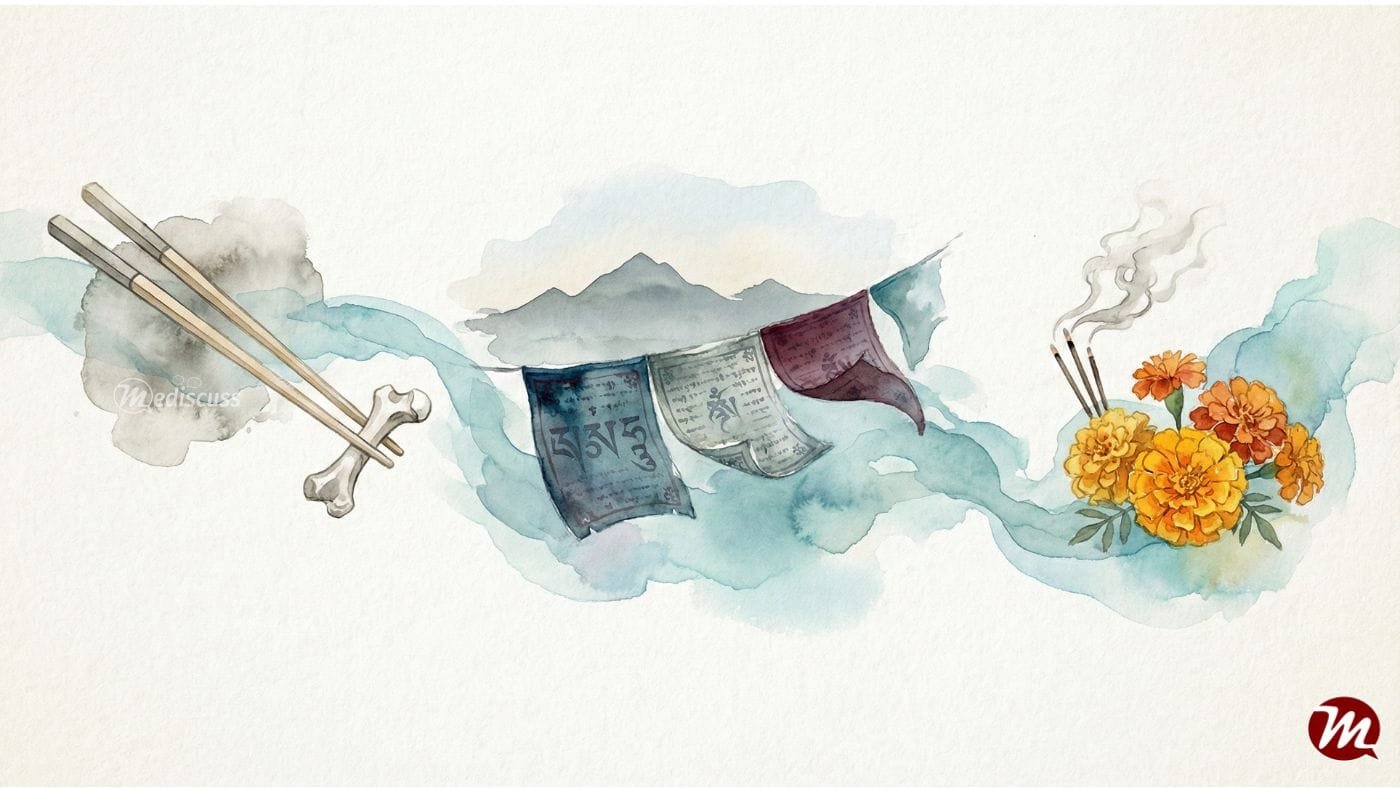
This is Part 4 of a 6-part series on death, dignity, and what medicine can learn from ancient wisdom.
Ancient Wisdom Across Cultures
I was standing in the Fat Tsz.
I looked at the thousands of ancestral urns stacked from floor to ceiling.
Hong Kong. November 2008.
I’d come for a medical conference. But I’d taken an afternoon to visit this place, one of the largest columbariums in the city.
Row after row of small niches. Each containing ashes. Each with a photo, offerings, incense.
Families were there. Some praying. Some just… sitting, remembering their dead.
I watched a woman in her seventies place fresh oranges in front of her husband’s urn. She spoke to him. Softly. In a dialect of Chinese. I couldn’t understand the words, but I understood everything.
She was maintaining the relationship. Still cooking for him. Still telling him about the grandchildren.
…
And I thought: We do this too.
Shraaddha. Pinda Daana. The 13 days. The annual ceremonies.
We also keep talking to our dead. Keep feeding them. Keep the relationship alive.
Different forms. Same truth.
…
That realisation sent me on a journey I didn’t expect.
Not a planned research project. Just curiosity. The physician in me started asking: Is this wisdom universal? Did every culture that watched someone die learn similar truths?
Over the next fifteen years, I became an accidental student of death rituals.
Visiting when I travelled. Reading when I couldn’t. Watching. Listening. Trying to understand.
What I found changed how I practise medicine.
…
The Pyramids and What Remains
December 2015. I’m standing in the burial chamber of one of the great pyramids.
It’s smaller than I expected. Bare stone walls. The sarcophagus, empty now, sits in the centre.
But what strikes me is the care. The precision. The absolute conviction that went into building this.
They believed the body might return. That the ka, the life force, might need this vehicle again. So they preserved it. Mummified it with resins and wrappings. Buried it with everything needed: food, jewellery, boats, even servants.
The ultimate preservation. The ultimate hope that what was loved could be kept intact.
…
I visited again in October 2018. This time to the Egyptian Museum in Cairo. Looking at mummies up close.
The wrappings. Layer upon layer. The care taken with each finger, each toe. The amulets placed between layers. The prayers written on the cloth.
This wasn’t denial. This wasn’t even a refusal to accept death.
This was hope. Hope that preservation might allow return. Hope that love could transcend mortality.
…
And I realised: This is the opposite of cremation. We return the body to elements within a few hours. They preserved it for millennia.
But both come from the same place.
Both say: This body mattered. This life mattered. We honour both.
We just disagree on method, not meaning.
They kept the vehicle intact, hoping for return.
We release the vehicle completely, trusting the soul has already moved on.
Different philosophies. Same respect.
…
The Geography of Grief
Something else struck me as I studied these practices.
Where you die shapes how you’re mourned.
The ancient Egyptians buried their dead in the desert. Dry climate. Sand. Natural preservation. Limited wood for fire. Burial made sense.
Islamic traditions, born in Arabian deserts. Christian practices, originating in Middle Eastern landscapes. Jewish customs, same geography. All three Abrahamic faiths bury their dead.
Not because burning is wrong. Because wood was scarce. Burial was practical.
…
India. Forests. Rivers. Abundant wood.
Cremation made sense. Return the elements quickly. Let the river carry the ashes. Clear, efficient, spiritually meaningful.
Hindu, Buddhist, Jain traditions all cremate.
Again, not because burial is wrong. Because fire was available.
…
Tibet. High altitude. Frozen ground most of the year. Can’t dig graves. Wood is rare, precious.
Sky burial, jhator, made sense.
The body is taken to a designated site. Offered to vultures. Within hours, nothing remains but bones.
To modern sensibilities, this seems harsh. Disrespectful.
But in Buddhist philosophy, it’s the ultimate generosity. The body, now empty of consciousness, becomes food. Serves life. Completes the cycle.
Not brutal. Beautiful.
…
The Parsi community in India, Zoroastrians who migrated centuries ago, built Towers of Silence. Dakhma. Bodies placed on raised platforms, exposed to sun and vultures.
Not because of cruelty. Because they believe earth, fire, and water are sacred, shouldn’t be contaminated with death. Air and birds are the pure method.
…
I started seeing the pattern.
Desert cultures bury. Forest cultures burn. Mountain cultures expose.
Not because one is right and others wrong.
Because humans are practical. We work with what we have.
And then we transform practicality into meaning. Into ritual. Into sacred practice.
…
Confronting the Physical Reality
However different the method, the patterns around it are remarkably similar.
Japan practises Kotsuage. After cremation, families use ceremonial chopsticks to pick bone fragments from ash. Together. Passing bones person to person. The skull placed last, on top.
We do Asthi Sanchaya. The eldest collects specific bones. Places them in the kalash.
Different cultures. Same wisdom: The mind cannot accept what the hands have not held.
You must touch death. Confront what remains. Only then can you begin to let go.
…
The Irish wake. The body stays in the home. Family and community gather around it for days. Drink. Tell stories. Sit with the dead.
We do the same. The body at home for viewing before cremation. Family gathered. Not because it’s pleasant. Because it’s necessary.
…
Relationship Continues
Madagascar. The Malagasy practise Famadihana, “turning of the bones.”
Every few years, families exhume their ancestors. Remove them from the family crypt. Rewrap them in fresh silk. Dance with them. Carry them around the village. Tell them what’s happened since they left. Celebrate them.
I read about this and thought: That sounds morbid.
Then I thought: We do Shraddha. Annual ceremonies. We cook the foods they loved. We invoke them. We maintain the connection.
We don’t dig them up. But we don’t let them go either.
Relationship transforms. It doesn’t end.
…
Indonesia. The Torajan people practise Ma’Nene. Every few years, they exhume bodies, clean them, dress them in new clothes, take family photos with them.
Western media calls it “creepy” or “macabre.”
But Torajans say: “They’re still family. We care for them.”
Same truth. Different expression.
…
The Body is Vehicle, Not Person
Every tradition I studied, despite wildly different disposal methods, understood this: The body is not the person.
Egyptians preserved it, but knew the ka had left.
We cremate it, knowing the atman has departed.
Tibetans offer it to vultures, understanding consciousness has moved on.
Christians bury it, trusting the soul is with God.
Muslims bury it, believing the ruh continues.
The vehicle deserves honour. Respect. Care.
But it’s not the person.
“Vasamsi jirnani yatha vihaya” – just as we discard worn-out clothes.
Every culture discovered this independently.
…
Manikarnika Ghat: The Ultimate Confrontation
But nothing prepared me for Manikarnika.
October 2023. Varanasi. Kashi.
I walked from the Kashi Vishwanath temple towards the ghats. The newly widened steps opened suddenly onto the Ganga. And there it was.
Manikarnika Ghat.
Hundreds of bodies cremated here every day. Every single day. For millennia.
Millennia. Yes. After all, Kashi is the world’s oldest living city.
…
The pyres were burning. Not one or two. Dozens. In different stages.
Some just starting, the body still visible under the wood. Some fully aflame, orange and roaring. Some reduced to ash and bone.
I stood there. Just a little away from the temple. On the banks of the Ganga. Smoke rising into the sky.
And I walked among them.
…
The cremation ground has a multi-storied structure too. Bodies at every level.
I went up the stairs.
Bodies stacked. Some finished. Others ready. Many in process.
Death, in every stage, happening simultaneously.
…
I’d seen cremations before. Attended dozens. But always one at a time. Always with some distance.
This was different.
This was death as constant. As normal. As inevitable as breathing.
No hiding. No sanitising. No pretending it doesn’t happen.
Just fire. And ash. And the serene Ganga flowing on.
…
People come to Kashi to die.
Not to visit. To die.
They live here for months. Years. Waiting. Because if you die in Kashi, if your body burns at Manikarnika, if your ashes enter the Ganga here, you achieve moksha. Liberation. Release from the cycle.
I saw some. The dying. Sitting in dharamshalas near the ghats. Some walking slowly along the river. Some carried on cots.
Waiting for death. Not in fear. In hope.
…
Standing there, watching the pyres burn, something shifted in me.
Not horror. Not revulsion.
Calm.
A deep, unexpected calm.
Because this, I realised, is the truth we all avoid. This is what we spend our lives running away from.
Death. Constant. Inevitable. Happening to everyone.
But here, it wasn’t hidden in hospital rooms behind closed doors. It wasn’t whispered about. It wasn’t treated as failure.
It was just… happening. Openly. With ritual. With reverence. With the Ganga as witness.
…
I came back in February 2025.
Same place. Same pyres. Different bodies.
This time I stayed longer. Sat on the steps. Just watched.
A family preparing their father. The eldest son walking around the pyre seven times. The priest chanting. The moment when the face is exposed one last time before the fire takes it.
Another family, already at the ash-collecting stage. Quiet. Focused. Doing what must be done.
And pilgrims. Thousands of them. Walking past the cremation ground like it’s the most natural thing in the world. Because here, it is.
…
Death gives a calm that nothing else can give.
I didn’t expect that sentence to be true. But it is.
Not the calm of denial. The calm of acceptance.
They say death is the kindest way to lose a person.
Because it’s complete. It’s final. It’s honest.
No ambiguity. No false hope. No “maybe they’ll change, maybe they’ll come back.”
Just… gone. Returned to elements. Released.
…
Standing at Manikarnika, I understood what every tradition I’d studied was trying to teach.
You must confront death to lose your fear of it.
Not think about it. Not philosophise about it. Confront it.
Walk among the pyres. Touch the bones. Sit with the dying. Watch the transformation from body to ash.
Then, and only then, can you practise medicine without terror. Without seeing death as failure.
Then you can sit with families and say: “It’s time to let go,” without your own fear making them feel abandoned.
…
I’m standing between worlds now.
One foot in the ICU, one foot at the cremation ground. One hand on the ventilator controls, one hand holding prayer beads.
And I’ve learnt: I need both.
The technology to save lives when they can be saved.
The wisdom to release lives when they’re ready to go.
…
I came back from Manikarnika with ash on my clothes.
Not metaphorically. Literally. The smoke carries it everywhere. You can’t walk among burning pyres without the ash of strangers settling on you.
Modern medical training would call this unhygienic.
But I understood what the ash represented.
Not death. But completion. Not failure. But release. Not the end. But transformation.
…
Sometimes now, before difficult family meetings, I remember that smoke rising into the Kashi sky.
And I think: Death is not failure. It’s completion.
Our job isn’t always to prevent it.
Sometimes our job is to help it happen well.
Anāyāsena.
Without struggle.
Every culture learnt this.
Now it’s our turn to remember.
…
The Complete “Anāyāsena” Series
This article is part of the six-part Anāyāsena series that explores what modern medicine can learn from ancient wisdom about dying well, living with dignity, and letting go with grace.
Subscribe to get an email when the other articles are published.
- Chapter 1: How Do I Know I’m Right? The weight of end-of-life decisions
- Chapter 2: When the Body Knows. The cucumber, the vine, and ripeness
- Chapter 3: The Prayer I Whisper. Anāyāsena Maranam and dignity in dying
- Chapter 4: What the World Taught Me. Ancient wisdom across cultures
- Chapter 5: The Conversation Nobody Wants to Have. Guidance for families facing end-of-life decisions
- Chapter 6: The Weight Doctors Carry. The practice physicians need for end-of-life care
…
Go back to Anāyāsena Series Home
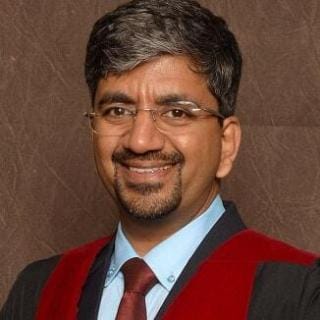
Dr. Shashikiran Umakanth (MBBS, MD, FRCP Edin.) is the Professor & Head of Internal Medicine at Dr. TMA Pai Hospital, Udupi, under the Manipal Academy of Higher Education (MAHE). While he has contributed to nearly 100 scientific publications in the academic world, he writes on MEDiscuss out of a passion to simplify complex medical science for public awareness.
 wpDiscuz