
The Conversation Nobody Wants to Have
For Families
This is Part 5 of a 6-part series on death, dignity, and what medicine can learn from ancient wisdom.
I was thirteen when my grandfather died.
He was 92. Passed away peacefully at home. Painless. Natural. Surrounded by the life he’d built.
I was just a child. Watching the adults handle everything. The rituals. The decisions. The grief. But even then, I remember wondering: Did anyone know what he wanted?
Years later, when I became a doctor, that question came back. Did my father talk to his father about this? Did my uncles? Did anyone ask: “If something happens, what would you want?” Or did they do what seemed right, what tradition dictated, what the family agreed upon… without ever knowing what he would have chosen?
But I wasn’t thirteen when my own father was ageing. I was a doctor by then. A doctor who regularly sat with patients and families having exactly this conversation. Did I have it with my own father? No. I told myself… He’s not that sick yet. There’s time. It feels awkward. We’ll talk about it later. The same excuses everyone uses. And then he died. And I still don’t know what he would have wanted.
Two generations. Two missed conversations.
That’s why, when Priya brought her father to my clinic, I wasn’t going to let them leave without having it. Not this time.
…
Mr. Rao is 85. Has early Parkinson’s disease. Still managing well with medications. Still living independently. Still sharp.
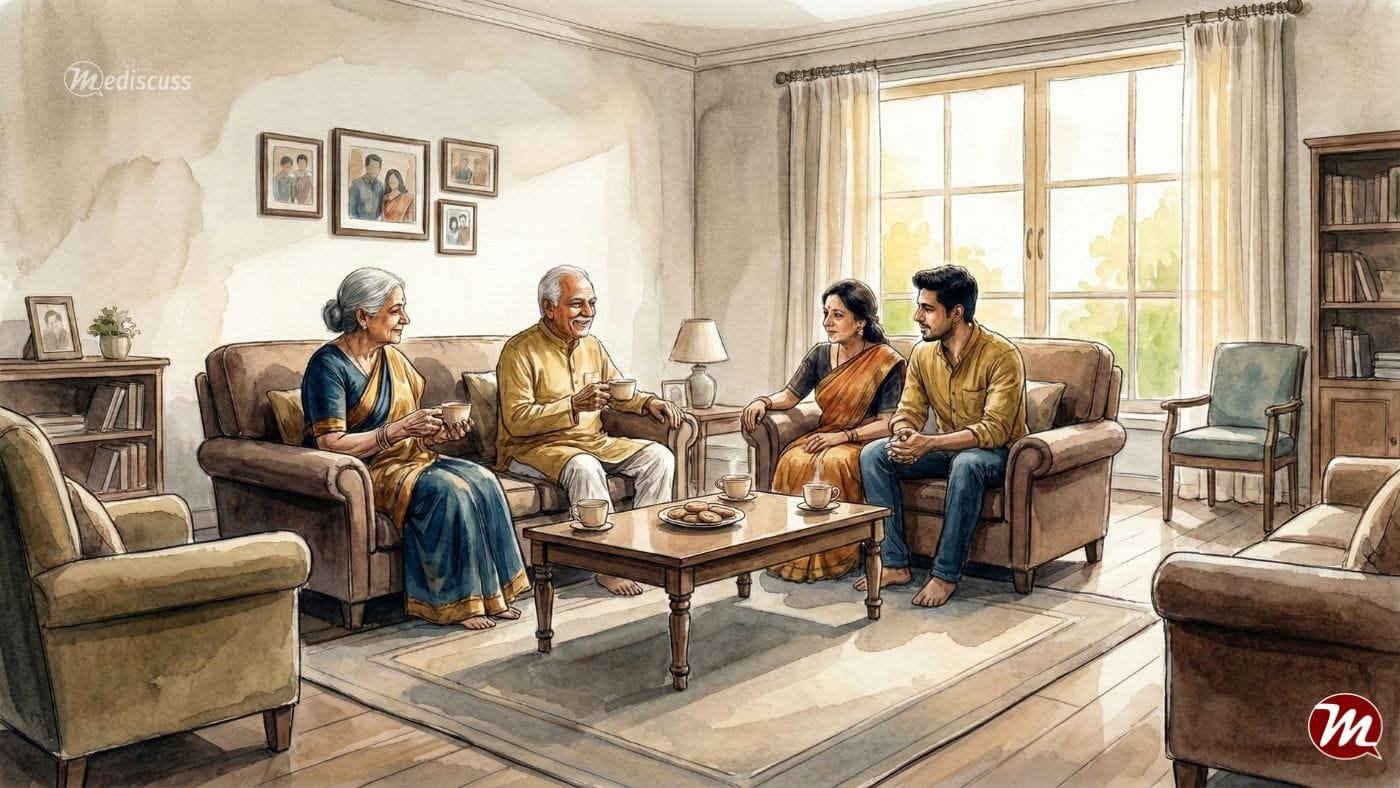
But Priya, his daughter, has come prepared. She’s brought a notebook. A pen. She’s clearly been thinking about this. “Doctor,” she says, looking at me, then at her father, “I need to ask my father some difficult questions. And I need your help.” Mr. Rao shifts uncomfortably. “Priya, why now? I’m fine.” “Appa, I know. But remember Suresh uncle? His family didn’t know what he wanted. They fought for two weeks in the ICU. Brothers stopped talking to each other. I don’t want that for us.”
I watched this convesarion unfold. The daughter, determined but gentle. The father, resistant but listening. This is the conversation I never had. And I’m going to make sure they have it.
“Mr. Rao,” I say gently, “Priya’s right. This isn’t about you being sick. It’s about you being well enough to tell us what you’d want.” He looks at me. Then at her. “You really want to do this now?” Priya nods. Her eyes are already wet. He sighs. “Okay. What do you need to know?”
…
I’ve learnt, over many such conversations, that there’s a pattern to it.
You can’t just blurt out “Do you want CPR?” That’s too abstract. Too clinical. Most people have no idea what CPR actually involves. You have to start somewhere real. Somewhere they can picture. “Mr. Rao,” I begin, “let’s say something serious happens. A big stroke. A heart attack. You can’t speak, can’t tell us what you want. What would matter most to you in that moment?”
He thinks about this. Really thinks. “Not suffering,” he says finally. “I don’t want to suffer.” “Okay. And if keeping you alive means you’d be suffering… in pain, or on machines, or unable to recognise people… would you want treatment to continue?”
Silence. This is the moment. The moment families usually try to avoid.
Priya is looking at her father. Waiting. “No,” he says quietly. “If I can’t… if my mind is gone, or if I’m just suffering… no. Don’t keep me like that.” Priya writes this down. Her hand is shaking slightly.
“What about your heart stopping?” I ask. “Should we try CPR?” “What does that involve?” he asks. I explain. Most people think CPR is what they’ve seen on television… dramatic, clean, successful. They don’t know the reality. It is successful in about ten to fifteen per cent of the time in elderly patients. And when it works, sometimes, there may be broken ribs, maybe even brain damage from lack of oxygen during the time when heart stopped.”
His eyes widen. He’s quiet for a moment. Then… “No. If my heart stops, let me go.”
Priya is crying now. But she keeps writing.
“What about where?” I continue. “If the end is near, would you rather be in hospital or at home?” “Home,” he says immediately. “Always home.” “Even if it means you might die sooner than if we kept you in ICU?” “Especially then. I want to die in my own bed. With my family. Not with machines beeping.” Priya nods. Writes: Home. Always home.
“Are there specific people you’d want present?” I ask. He thinks. “All my children. If possible. And…” he pauses. “I’d want someone to read the Bhagavad Gita. The chapters on death, especially chapters 2, 8, and 13. Recite the Vishnu Sahasranama. Can you arrange that?” “We can do that, Appa,” Priya says softly. “And music,” he adds. “Bhajans. Not film songs. Proper devotional music.” She’s writing faster now. Getting the details. The specifics that will matter when the moment comes.
Then he asks the question I hear sometimes… “What if I change my mind?”
“Then you change your mind,” I say. “This isn’t written in stone. This is what you want today. This is only for the time if you can’t tell us. So we know what you would have wanted.” He nods. He seems relieved.
The conversation takes forty-five minutes. At one point, Mr. Rao gets angry. “Why are you planning my death? I’m not dying tomorrow!” Priya, to her credit, doesn’t back down. “Appa, Uncle Suresh wasn’t dying tomorrow either. Until he was. And then nobody knew what he wanted. And his sons fought. And one of them doesn’t talk to the others anymore.” He calms down. Continues.
By the end, they have clarity. No CPR. No prolonged ventilator support. Home over hospital if the end is near. Comfort over cure if there’s no meaningful recovery expected. The Gita and Sahasranama recited, bhajans playing. All his children present if possible. And if he can’t talk or think anymore, they should let him go. Priya has written it all down. Dated it. Both of them signed it. “Give a copy to all your siblings,” I tell her. “Make sure everyone knows. So there’s no confusion.” She nods.
…
About six months later, Mr. Rao’s Parkinson’s disease progresses suddenly. Aspiration pneumonia. ICU admission. But Priya knows exactly what to do. She has the document. “This is what my father wanted.” No CPR. No prolonged support. Comfort care. Home if possible. They shift him home after two days. Home care arranged. Oxygen for comfort. Medications for breathlessness. His children all come. Someone reads the Gita. Another Vishnu Sahasranama later. Bhajans play softly in the background. He dies three days later. At home. In his own bed. All his children around him.
Priya calls me afterwards. Not crying. Steady. “Thank you, Doctor. For making us have that conversation.” She pauses. “I can live with this decision. Because I know it’s what Appa wanted. There’s no doubt. No guilt. No wondering.” Another pause. “My cousins fought over Suresh uncle. Fighting about what he would have wanted. Everyone claiming to know. Nobody actually knowing.” “We didn’t have to do that. Because we asked. Because Appa told us.”
…
Now I know the patterns of these conversations.
The resistance comes first. “Why are we talking about this? I’m fine!” And you have to gently insist: “That’s exactly why we need to talk, Appa. While you’re well. So I know.” Then the anger. “You want me to die!” And you stay calm: “No. I want to honour what you would choose.” Sometimes there’s deflection. “Whatever you think is best.” But that’s exactly what you can’t accept. You push, gently: “I don’t want to guess. I want to know.”
The timing matters.
Not during a medical problem. That’s too late, too emotional, everyone is panicking. Pick a calm moment. After a friend’s parent dies. After reading something like this. After a health problem that recovered well. That’s when you say… “Appa, this made me think. If something happens to you and you can’t tell us, I need to know what you’d want.”
In India, legal advance directives exist but not widely established yet. But even without legal weight, documented wishes are extremely helpful when families are confused or divided. When one sibling wants to continue treatment and another wants to let go, having the parent’s own words… written, dated, signed… settles it.
What this gives you isn’t certainty about the outcome.
Death comes anyway. But it gives you certainty about the choice.
When you’re standing in that ICU at two in the morning, being asked “What should we do?…” you’ll know. Not because you decided. Because they did. And you’re honouring what they wanted.
…
You may not be thirteen when you are reading this. And your parents may still be here. Have the conversation. Write down the answers if possible. So that when the time comes… and it will… you’ll know you honoured them.
Anāyāsena.
Without struggle. Not just for them. For you too.
…
The Complete “Anāyāsena” Series
This article is part of the six-part Anāyāsena series that explores what modern medicine can learn from ancient wisdom about dying well, living with dignity, and letting go with grace.
Subscribe to get an email when the other articles are published.
- Chapter 1: How Do I Know I’m Right? The weight of end-of-life decisions
- Chapter 2: When the Body Knows. The cucumber, the vine, and ripeness
- Chapter 3: The Prayer I Whisper. Anāyāsena Maranam and dignity in dying
- Chapter 4: What the World Taught Me. Ancient wisdom across cultures
- Chapter 5: The Conversation Nobody Wants to Have. Guidance for families facing end-of-life decisions
- Chapter 6: The Weight Doctors Carry. The practice physicians need for end-of-life care
Go back to Anāyāsena Series Home
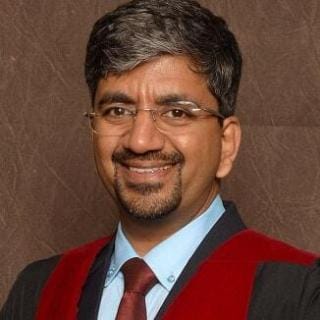
Dr. Shashikiran Umakanth (MBBS, MD, FRCP Edin.) is the Professor & Head of Internal Medicine at Dr. TMA Pai Hospital, Udupi, under the Manipal Academy of Higher Education (MAHE). While he has contributed to nearly 100 scientific publications in the academic world, he writes on MEDiscuss out of a passion to simplify complex medical science for public awareness.
 wpDiscuz