

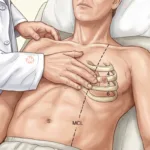




It is a Sunday evening in a district hospital. A 31-year-old construction worker fell from scaffolding on Friday, about 4 metres, and landed on his back. He was taken to a primary health centre, then to a private nursing home, and has now reached you on a spine board. His back is tender at the thoracolumbar junction. He cannot move his legs. His pressure is 88/50 mmHg and his pulse is 64. This is an illustrative case, not a real patient.
The Spinal Injury Pathway tells you what to do for him tonight: how to grade his neurology, how to score the injury, what to draw up, what pressure to aim for and for how long, and when he should be decompressed. What it no longer carries is most of the why. The Indian figures, the trials and the mechanisms that used to sit in its Scores and Evidence tabs have moved here, so that the tool stays quick at the bedside. By the end of this article you will know who this patient usually is in India, and what each of the tool’s instructions rests on.
Use this at the bedside
Open the tool: Spinal Injury Pathway
Get the CDSS app: install the MEDiscuss CDSS on your phone
1. The Indian patient is younger, and more often complete
Western textbooks picture spinal cord injury as an elderly fall. The Indian picture is different, and it comes from one centre.
1,138 people with traumatic spinal cord injury at the Indian Spinal Injuries Centre over eight years: mean age 34.4 years, male to female 5.9 to 1, and 63 per cent married. Road traffic accidents caused 45 per cent and falls from height 39.6 per cent. Two-thirds had paraplegia and 71 per cent had complete injuries (Chhabra 2012).
That last figure is the one to carry. A complete injury in a thirty-year-old married man who was working that morning is the modal Indian case, and it is a different clinical and social problem from the elderly fall that dominates Western series. It is also why the tertiary column ends in rehabilitation rather than in discharge.
“So that is how common it is in India?” No, and this is a mistake worth avoiding. There is no national spinal trauma registry in India. Every figure above is from a single tertiary centre. None of them is a national incidence and this tool does not present them as one. Our patient fits that picture closely, but that is the shape of who reaches a tertiary centre, not a count of how many are injured.
2. Why the grade is worth the rectal examination
The tool asks you for his ASIA grade, the American Spinal Injury Association Impairment Scale, and reminds you that the grades are anchored at the sacral segments: perianal sensation or a voluntary anal contraction makes the injury incomplete, however dense the rest of the examination looks. Why go to that trouble at the bedside?
The grade earns its place: in a prospective series of 105 cervical injuries at a north Indian trauma centre, the ASIA grade at presentation was the only independent predictor of in-hospital mortality. “Independent” means that it still predicted death after the other factors measured had been allowed for. The tool gives this series without a paper on its reference list, and so does this article.
3. The Canadian C-spine rule, and what it was tested against
The national workflow carries no imaging rule at all, and the tool fills the gap from the workflow’s own reference, NICE NG41, which carries the Canadian C-spine rule. Why that rule and not NEXUS, the other one residents learn?
In the head-to-head trial of 8,283 patients, the Canadian rule was both more sensitive and more specific than the NEXUS criteria, 99.4 against 90.7 per cent and 45.1 against 36.8 per cent, and would have produced fewer radiographs. The Canadian rule would have missed one patient with a clinically important injury. NEXUS would have missed sixteen (Stiell 2003).
Sensitivity is how many of the real injuries a rule catches; specificity is how many of the uninjured it lets go without an X-ray. The Canadian rule did better on both at once, which is unusual. The tool keeps the warning that comes with it: in that trial the 45 degrees of neck rotation the rule turns on was never assessed in one patient in ten, and a rule applied to its last question but one is not the rule that was validated.
4. Decompression: twenty-four hours or seventy-two
The workflow recommends decompression of acute cord compression under 72 hours. The 2024 AO Spine and PRAXIS guideline recommends it within 24 hours, regardless of level, as the preferred option (Fehlings 2024). The tool prints both. What is the 24-hour position built on?
Patients decompressed inside a day were about twice as likely to improve by two or more grades at six months, relative risk 2.76. They gained a further 4.50 points on the motor score. The same guideline declined to recommend surgery inside 12 hours. The samples are small, the definition of ultra-early varies between studies, and the evidence is inconsistent. So earlier is better up to a point, and that point has not been found.
Our patient was injured on Friday and reaches you on Sunday. He is already past 24 hours and well inside 72. This is exactly the band where the two documents disagree, and it is a common place to be in Indian practice. The tool does not choose for you; it prints both and asks the spine surgeon to.
5. Hypotension with a slow pulse is two different things
Look at his numbers again: 88/50 mmHg with a pulse of 64. Two conditions with similar names are often confused here. This is the table the tool uses, whole, including the mechanism row that has moved here from the tool.
| Feature | Neurogenic shock | Spinal shock |
|---|---|---|
| What it is | A circulatory state | A neurological state |
| Mechanism | Loss of sympathetic outflow below the lesion, unopposed vagal tone | Transient loss of reflexes below the lesion |
| Seen with | Lesions at or above T6 | Any level |
| At the bedside | Low pressure, slow or normal pulse, warm peripheries | Flaccid, areflexic, absent bulbocavernosus reflex |
| Answers to | Vasopressor, after haemorrhage is excluded | Time |
Neurogenic shock is the circulation losing its sympathetic tone below the injury, so the vessels dilate and the heart is left to the vagus nerve, which slows it. Spinal shock is the cord below the injury going quiet for a while, so the reflexes vanish. The same unopposed outflow explains priapism, which the tool treats as a sign of cord injury: it is the same unopposed parasympathetic outflow that produces the bradycardia.
“So his low pressure is neurogenic shock?” Not yet. The tool’s rule is one sentence, and it is the most important line in this article: a trauma patient who is hypotensive without a tachycardia is bleeding until proved otherwise, and is in neurogenic shock only once that has been proved. He fell 4 metres. Look for the bleeding first.
6. What the national workflow is
Much of the tool is a careful reading of one document, the ICMR Standard Treatment Workflow for spinal injury. It helps to know what kind of document it is. It is a one-page national document, dated July 2024, written for four tiers of an Indian health system and honest about that: its own disclaimer calls it advisory, based on expert opinion and available evidence, and says variation by individual patient is expected. It is the only Indian national statement on this condition. Five searches of the specialty societies and of the literature found no Indian clinical practice guideline for acute traumatic spinal injury.
That is why the tool prints the workflow first, and then fills each gap from the workflow’s own references, and says so each time.
Back to the district hospital
Our patient comes off the spine board on arrival; it is an extrication device, not a bed. His pressure is treated as bleeding until a bleed is excluded, and only then as neurogenic shock, with a vasopressor rather than litres of crystalloid. He has a rectal examination before anyone writes a grade. His whole spine is imaged, because one fracture means looking for a second. He is past 24 hours, so the decompression decision is made with both positions in front of the surgeon. And whatever the grade, his catheter, his chest and his thromboprophylaxis are looked after from the first day, because those are what kill most of these patients later. Each of those steps is a line in the tool. Now you know what stands behind each line.
Try this
A 70-year-old woman tripped on a step at home and complains of neck pain. She is alert, walked into the department, and the pain came on later, not at once. She can rotate her neck 45 degrees to each side. Does she need cervical imaging under the Canadian rule as NICE states it? Illustrative case.
Answer. Yes. She is 65 or older, which is a high-risk factor in the rule, and a high-risk factor sends the patient to imaging before the low-risk questions or the rotation test are reached. Her ability to rotate her neck does not clear her. The rotation test only clears a patient with no high-risk factor and at least one low-risk one.
Take-home points
- The modal Indian patient with spinal cord injury is a young man with a complete injury. The figures come from one centre, not a registry.
- Do the rectal examination: the ASIA grade is anchored at the sacral segments.
- Use the Canadian C-spine rule, and ask every one of its questions, including the rotation.
- Hypotension without tachycardia after trauma is bleeding until proved otherwise.
- Decompression within 24 hours is the 2024 preferred option; the workflow says 72. Know which band your patient is in.
Use this at the bedside
Open the tool: Spinal Injury Pathway
Get the CDSS app: install the MEDiscuss CDSS on your phone
Declaration: the author built and maintains the tool. It is free to use. The figures in this article are those the tool carried in its Scores and Evidence tabs on 4 November 2026, each from the source named beside it; where the tool names no paper, the article says so. The Spinal Injury Pathway is still in administrator preview, pending clinical review.
References
- Indian Council of Medical Research, Department of Health Research. Standard treatment workflow: spinal injury (ICD-S14.109A). New Delhi: Ministry of Health and Family Welfare; 2024.
- National Clinical Guideline Centre (UK). Spinal injury: assessment and initial management. NICE guideline NG41. London: National Institute for Health and Care Excellence; 2016.
- Fehlings MG, Tetreault LA, Hachem L, Evaniew N, Ganau M, McKenna SL, et al. An update of a clinical practice guideline for the management of patients with acute spinal cord injury: recommendations on the role and timing of decompressive surgery. Global Spine J. 2024;14(3_suppl):174S-186S.
- Kwon BK, Tetreault LA, Martin AR, Arnold PM, Marco RAW, Newcombe VFJ, et al. A clinical practice guideline for the management of patients with acute spinal cord injury: recommendations on hemodynamic management. Global Spine J. 2024;14(3_suppl):187S-211S.
- Fehlings MG, Wilson JR, Tetreault LA, Aarabi B, Anderson P, Arnold PM, et al. A clinical practice guideline for the management of patients with acute spinal cord injury: recommendations on the use of methylprednisolone sodium succinate. Global Spine J. 2017;7(3 Suppl):203S-211S.
- Walters BC, Hadley MN, Hurlbert RJ, Aarabi B, Dhall SS, Gelb DE, et al. Guidelines for the management of acute cervical spine and spinal cord injuries: 2013 update. Neurosurgery. 2013;60(CN_suppl_1):82-91. [Superseded on haemodynamic management by reference 4 above]
- Liu Z, Yang Y, He L, Pang M, Luo C, Liu B, et al. High-dose methylprednisolone for acute traumatic spinal cord injury: a meta-analysis. Neurology. 2019;93(9):e841-50.
- Hoffman JR, Mower WR, Wolfson AB, Todd KH, Zucker MI. Validity of a set of clinical criteria to rule out injury to the cervical spine in patients with blunt trauma. N Engl J Med. 2000;343(2):94-9.
- Stiell IG, Clement CM, McKnight RD, Brison R, Schull MJ, Rowe BH, et al. The Canadian C-spine rule versus the NEXUS low-risk criteria in patients with trauma. N Engl J Med. 2003;349(26):2510-8.
- Chhabra HS, Arora M. Demographic profile of traumatic spinal cord injuries admitted at Indian Spinal Injuries Centre with special emphasis on mode of injury: a retrospective study. Spinal Cord. 2012;50(10):745-54.
- Lalwani S, Singh V, Trikha V, Sharma V, Kumar S, Bagla R, et al. Mortality profile of patients with traumatic spinal injuries at a level I trauma care centre in India. Indian J Med Res. 2014;140(1):40-5.
- Lalwani S, Punia P, Mathur P, Trikha V, Satyarthee G, Misra MC. Hospital acquired infections: preventable cause of mortality in spinal cord injury patients. J Lab Physicians. 2014;6(1):36-9.


Leave a Reply