




The Tragedy
On August 26–27, 2026, catastrophic floods struck the Nepal-Tibet border, centred on Gyirong, the same crossing the pilgrims in this series passed through on the way to Kailash. Hundreds of lives have been lost, with many more still missing on both sides of the border, including pilgrims travelling this same route to Mansarovar. We passed through that immigration building ourselves in July. Reading the reports and watching the videos of what has happened there since has been very hard.
My thoughts are with everyone affected: the families still waiting for news, the rescue teams working in extremely difficult terrain, and the fellow yatris caught in this disaster. They are in our prayers.
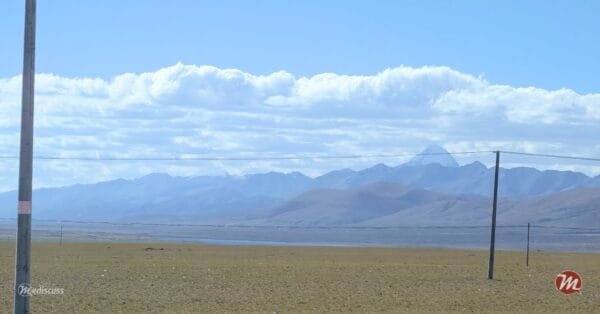
I saw it first from a distance.
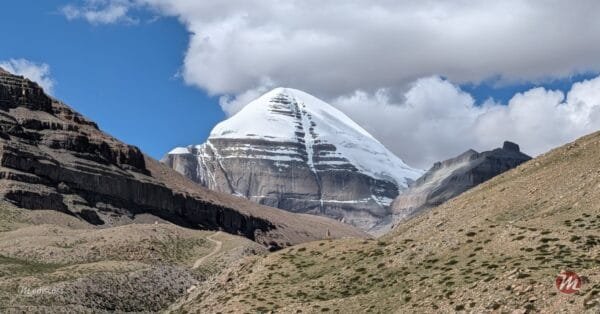
A gray-blue triangle against the gray-white clouds. Far off across the Tibetan plains as we drove towards Manasarovar.
Something in me gave way when I understood what I was looking at. My eyes filled. My throat choked.
A gratitude too large to hold arrived all at once, and I could not speak.
I did not speak to anyone for many minutes. There was nothing to say, and saying anything would have made it smaller.
By temperament, I am not a man who weeps easily. I have stood at many bedsides and kept my composure when it was my job to. I have stood in front of many peaks and looked at them with awe.
But Kailash undid me completely.
The spiritual weight of this place hits you before the Parikrama 1 begins, while driving in, while you are still a visitor and not yet a pilgrim.
Then we went closer, and stood at the edge of Lake Manasarovar itself, looking towards the South Face of Kailash. I have travelled to many places. I have never felt this precisely as though I had arrived home.
We were not permitted to step into the water. The Chinese guards were very strict. So I stood on the grassy bank and began to chant portions of the Sri Rudram that I knew.
And the lake appeared to answer.
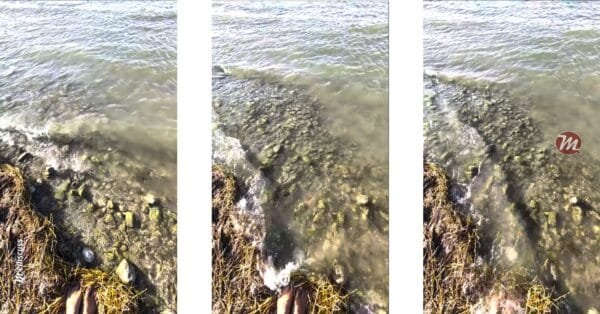
As I chanted mentally, the wind picked up. The waves began to roll higher. They came in and washed over my feet, over the backs of my heels, and withdrew.
I am a physician. I know exactly what to call this. Wind over a large high altitude lake is not a miracle, it is meteorology. I can explain the mechanism.
But there is a difference between explaining a thing and receiving it. The mechanism was ordinary. The timing was not. I chose not to explain.
Later we viewed the South Face from Ashtapada. The mountain stood impossibly close, enormous and personal. The sheer scale of it emptied me out completely. There is a particular kind of humility that arrives when your eyes cannot make sense of what they are seeing, and your mind simply stops arguing.
You Do Not Plan This Journey
None of this was supposed to happen, not like this.
I did not plan to be here.
The original schedule of the Yatra was cancelled, and I had given up hope for the year. Then friends tried again, and included my name. It was postponed once again. Then the Chinese permit was delayed, and the whole plan hung by a thread, and again I let it go and made my peace with not going.
And then, without warning, the permit just came. The visa followed within 4 days. And from that moment everything that had been stuck for months moved with an ease that was almost supernatural, as if a door I had stopped knocking had simply opened on its own.
They say you cannot plan a journey to a place like this. It happens when the call comes, and not a single day before. I used to consider this as a spiritual cliché. I no longer do. I have felt the difference between arranging a trip and being sent for a trip.
A Mountain That Does Nothing
Mount Kailash was born from a collision.
Two continents collided. The floor of an ancient ocean called the Tethys was crushed and lifted miles up into the sky. That happened more than thirty million years ago. Modern humans have been here for about three lakh years. Compared to the lifespan of that mountain, our entire human species is just a blink.
If the mountain had a mind, it might look down at the endless line of pilgrims and wonder:
“I am only rock and ice. I do nothing. I stand here in freezing wind. I do not move. I do not speak. Yet century after century, these fragile breathing creatures push their bodies to the very edge of survival, simply to come and walk in circles around me. What is it that they are looking for?”
That is probably the view of the mountain.
But to the one walking the Parikrama, Kailash is never still. It is alive. It changes with every minute, every shift of cloud, every new angle of the path. You keep turning your head to look at the same mountain and it is never the same mountain!
Both things are true at once. The stone does nothing. The stone does everything. Learning to understand and accept that contradiction is, I think, the whole point of the walk.
You do not choose Kailash. Kailash chooses the year, and the year chooses you.
The Door of Death
The Parikrama itself begins at Yamadwar.
The name is not just a metaphor. It means, literally, the Door of the God of Death.
You do not just walk past it. We performed three pradakshinas, three circumambulations, around the structure, and only then stepped into and through it.
Something shifts in you in that moment. You are choosing, knowingly and willingly, to walk through the gate of mortality. In our tradition, passing through Yamadwar with full awareness is meant to remove the fear of death 2 permanently.
I spend my working life at the other side of that door. I have written a good deal about dying well 3. And still, standing at a gate on a cold day, I felt the difference between knowing about death and walking through a door named after it.
The door strips you. Whatever you were carrying about your career, your standing, your work, it does not come with you. You step out on the other side empty. Which is exactly what the days ahead demand.
From Yamadwar, the South Face of Kailash rises clean into view behind the little golden-spired stupa. I had already stood before this same face up close at Ashtapada, and here it was again, framing the gate, as though the mountain had come to see us off at its own threshold. The same face, twice given.
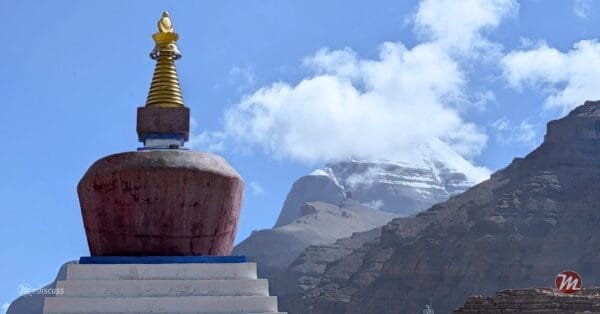
Then, having crossed the gate and chanted the Maha Mrityunjaya mantra 4, the great verse of deliverance from death, we did something before taking a single step of the walk. Facing the mountain, we offered twenty one sashtanga namaskaras… full prostrations, the whole body laid flat on the ground, the entire body touching the earth, rising, and going down again.
It is a strange thing to do with an exhausted body at high altitude, and that is the point. A prostration is an argument you have with your own pride. Twenty one times we surrendered, and requested the mountain… take us in. Let us complete this walk. We have made a human plan, and we keep it now at your feet, for you to permit or refuse as you see fit.
You do not begin this Parikrama by walking. You begin it by lying down.
Shiva’s Half
Walk a little, and you begin to notice that the Parikrama is not one journey. It is two.
From Yamadwar to Dirapuk, the presence of Shiva is absolute. The landscape is stark, silent and formidable. Nothing here is decorative. Nothing here is trying to please you. It simply is.
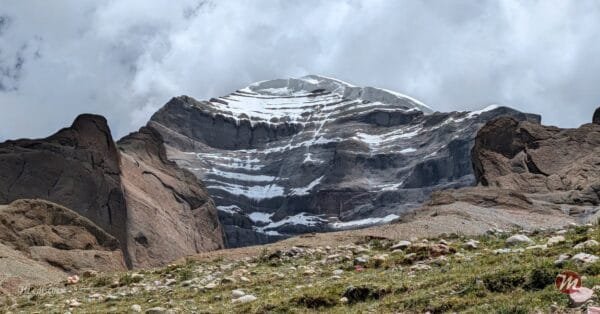
The first great wall to rise before you is the West Face.
The Mother, Seen Upside Down
There is a brief moment near the West Face that I almost missed and walked past.
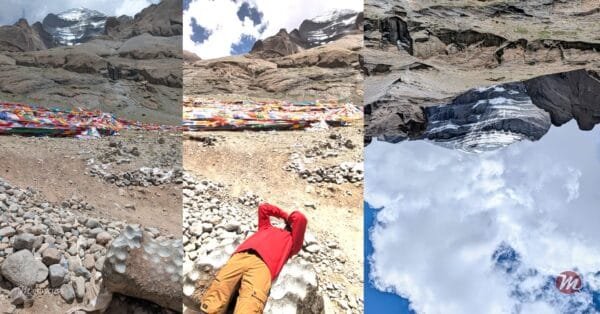
Next to the walking path in front of the West Face, there is a smooth boulder with shallow cups, as if the mountain had pressed its own fingers into the stone. Pilgrims lie back on it. I did too. I want to tell you why it matters. At first, though, it looks like nothing more than a place to rest a tired spine.
When you lie back on that rock and look up, the West Face of Kailash appears inverted. The whole mountain turns over above you. The peak that had been pointing at the sky now points down at your own chest.
Upright, Kailash is Shiva. Every line of it rises, still and absolute, the way I had felt him all morning.
Turned over, something else appears!
I thought, lying there, of the eleventh verse of the Soundarya Lahari. Adi Shankaracharya describes the Sri Chakra… the interlocking triangles of Shiva and of Shakti, the masculine forms and the feminine forms pointing in opposite directions, and only where they cross does creation happen. Shiva upright. The Mother inverted. Neither one complete without the other.
That is exactly what the saddle rock does. It takes the upright mountain of the Father and turns it into the downward form of the Mother, and for just a moment, with the blood running to your head and the peak pointing downwards, you are granted a glimpse of Devi even here, in the very heart of Shiva’s half of the mountain.
But you have to work for it. You have to lie down. You have to let the world invert. She does not stand up and announce herself. She is glimpsed, briefly, with effort, and never easily. That is entirely the character of the Mother Goddess.
I did not understand, that morning, that the mountain had just shown me half of something. The other half was waiting for the next day, on the far side of the pass, where the Father would return the favour. But that is a story for the third essay of this series.
The North Face
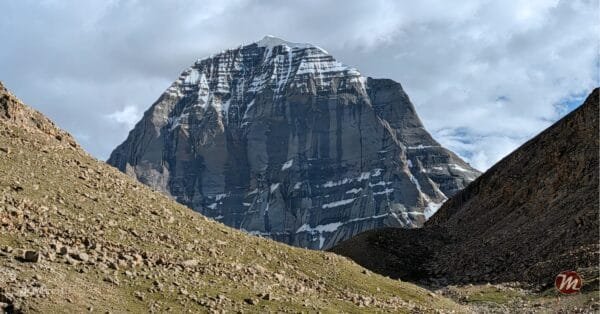
Then you come to Dirapuk, and to the North Face.
There is a pause for the physical effort. We had time, and we used it. We sat in front of that colossal North Face, in freezing air, and together we chanted the Soundarya Lahari, the Sri Rudram and the Lalitha Sahasranama. I was very fortunate to have good company for chanting on the Parikrama. Some verses are better carried by more than one voice.
Sitting under the North Face, you feel it… the unmoving, eternal stillness of Shiva. Not peace exactly. Something much older than peace. The stillness of a thing that has no need for you.
And here is what I could not stop thinking about. That wall above me is not granite. It is sandstone and conglomerate. It is compressed sea floor. Pebbles, sand and mud, rolled smooth on the bed of a vanished ocean, cemented together, and then raised five kilometres into the sky.
The most immovable object I have ever sat in front of, is made entirely of things that were once carried by water.
An Unexpected Blessing at Sunset
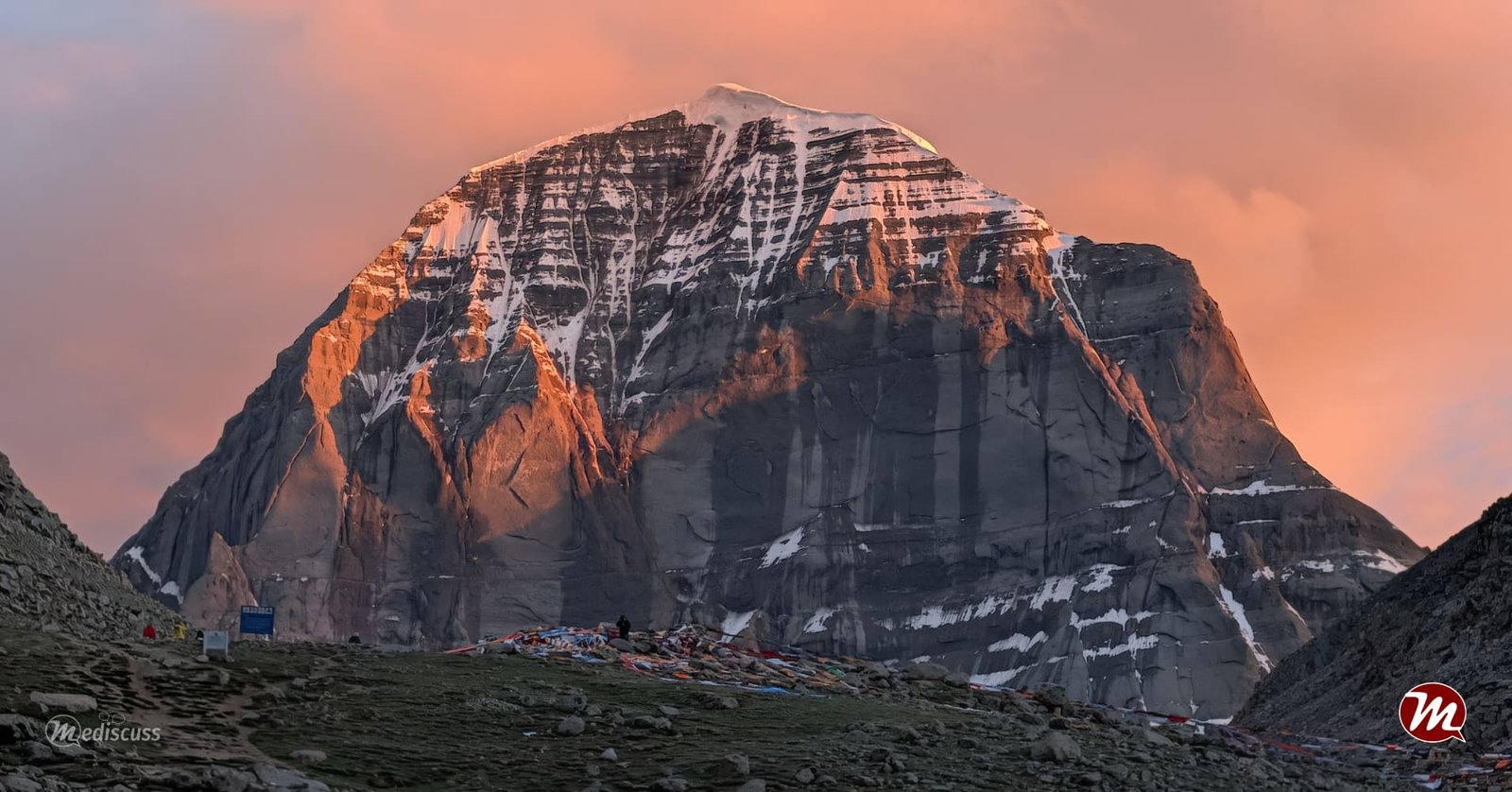
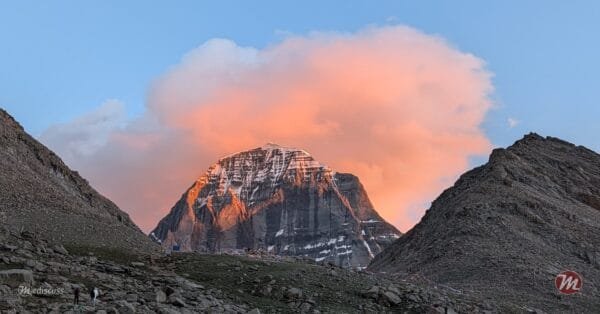
We were still before the North Face as the sun began to set. The light dimmed, the cold pierced our skin, and then the whole face of Kailash appeared to catch fire! The grey rock turned to warm gold, then to a deep orange. A single cloud settled on the peak and turned the same impossible orange, and for a few moments, the mountain and the sky were of the same colour.
That evening, at Dirapuk, the mountain gave us something it does not give everyone.
We stood there, a small group of exhausted pilgrims, and simply watched. Nobody spoke. There was nothing to arrange, nothing to chant, nothing to do but just receive it.
I want to be careful here, because I know exactly what sunset is. I know why the light becomes reddish orange as it travels a longer path through the atmosphere. This knowledge was of no use to me in that moment, and none of it made the sight less holy. A thing can be entirely explained scientifically, and can still arrive as a blessing.
Granted All Four Faces
It is worth saying, because it is not a small thing. Not every pilgrim who completes the Parikrama is granted a clear view of all four faces of Kailash. The mountain keeps the weather close to it’s chest, and it decides what it will show. Many walk the full circle and see only two or three faces, the rest covered by cloud.
Many of us were granted all four. The south from Ashtapada and again from Yamadwar, the west from the saddle rock area, the north from Dirapuk, and the east as the circle closed, the next day. And beyond even that, two even rarer gifts… the golden North Face at sunset, and the crown of the East Face at the end.
I do not write this as an achievement. I did nothing to earn it. A blessing, unasked for and undeserved, from a mountain that owed me nothing.
Blessed is the only suitable word, and I use it very carefully.
The Turning
On the second day, everything changes.
You leave Dirapuk and climb into the oxygen-thin heights of the Dolma La Pass, then descend past the emerald pool of Gauri Kund. Somewhere on that ascent, the energy of the mountain changes completely.
It is no longer Shiva’s domain. What the saddle rock offered as a brief, upside down glimpse now becomes the whole world around us. Here the presence of Devi is no longer something you must lie down and work for.
It is overwhelming, and it is everywhere.
And the timing of that shift is not accidental. It comes at the exact point where your lungs are crying for oxygen, your legs have stopped obeying you, and stillness is of no use to you. What carries you over that pass is not the stillness. It is the fierce, protective, deeply personal “energy” of the Mother.
Shiva asks you to stop. Devi makes you move.
A mountain that offers you both of those is a great teacher.
What the Stone Is Looking For
So we return to the question that the mountain asked. What are these fragile creatures looking for?
I think we go to be small.
Everything in a modern life, and everything in my profession in particular, trains us to be large. We measure, we intervene, we correct, we control. We are rewarded for it. And it is good work. But it slowly and quietly builds a person who believes that they must be the subject of every sentence.
Kailash does not argue with that person. It just stands there being thirty million years old, and the self simply dissolves.
The mountain does nothing. That is precisely what it does.
…
Next in the series:
Part 2: Guests in the Thin Air. Gulls that fly in from the Arabian Sea to breed at 15,000 ft (4,570 m), a marmot that carries the plague, and the animals who make our presence here possible.
Part 3: What the Pass Takes. 36,000 steps, 205 vertical staircases, and a crossing at 18,600 ft (5,670 m).
Companion guides:
- A Pilgrim’s Guide to Chanting on the Parikrama. Where to chant what, and why the mountain divides itself and its verses that way.
- A Physician’s Guide to the High Mountains.
- The Tibetans call this Kora: a circumambulation, or pradakshina of Kailash ↩︎
- An essay on the Maha Mrityunjaya Mantra, part of the Anāyāsena Series. ↩︎
- Anāyāsena Series. ↩︎
- An essay on the Maha Mrityunjaya Mantra, part of the Anāyāsena Series. ↩︎




Leave a Reply