



This is part 2 of the 3-part series on my Kailash Mansarovar Yatra.
The Tibetan plateau does not welcome you.
Above 15,000 ft (4,570 m) the air is thin, the wind is freezing, and the land is nothing but rock, dust and some grass here and there. To a visitor who is struggling simply to walk and to breathe, the place looks uninhabitable. It’s not hostile. Just uninterested.
And then you look up, and a bird is playing in the wind.
That is the quiet insult. Every living thing here is feeling at home. We are the only ones struggling. We arrive wrapped in thermal layers, carrying our medicines, checking our heart rates on our wrists, and we last a few days.
Birds That Should Not Be Here
As we walk along the rivers in the valley, I see a gull. A sea gull.
A sea gull.
Thousands of kilometres from any sea, at an altitude where a fit human adult cannot climb a small slope without stopping for breath.
It is the brown-headed gull, and it is not lost. It spends its winter on the warm coasts of the Indian subcontinent, at sea level, on the same shores that many of us know from childhood holidays. Then during every summer it flies to the freezing wetlands of Tibet, to Kailash, and raises its young.
Think about what that means.
That bird makes, twice a year, a physiological transition that would put some human beings in a hospital bed. It does not acclimatise for days at 9,000 ft. It does not take acetazolamide. It just goes.
Sharing that sky are the ravens, huge, shiny and unbothered, and the red-billed choughs, which are frankly showing off. They ride the freezing, unpredictable currents above the trail with complete ease, dropping and rising and turning for no reason I could detect other than that they enjoy it. We met the choughs late on the first day, just before Dirapuk, wheeling over the approach to the North Face as if to announce it.
Even ordinary sparrows flit around the camps. Sparrows. The same small brown bird that chirps outside my window in Udupi, thriving in air where lifting a backpack leaves me winded.
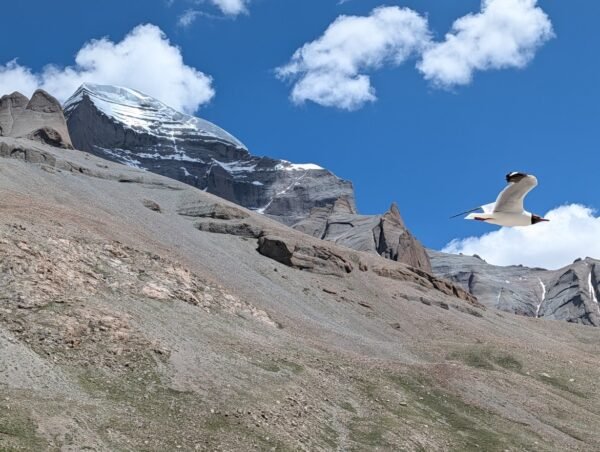
We measure human performance at this altitude in percentages of what a body can normally do. The birds are not operating at a percentage of anything. This is simply where they live.
The Marmot, and My Mistake
Further along the path you meet the residents who stay all year.
I had a very close encounter with a Himalayan marmot, on the first day, somewhere on the long stretch between the West Face and the North. They are large, robust animals, members of the squirrel family, wrapped in thick fur and built entirely for one purpose: to survive a six month Himalayan winter by sleeping through it, deep underground.
This one came right up to me and stood upright on its hind legs, perfectly still, like a small sentinel taking my measure.
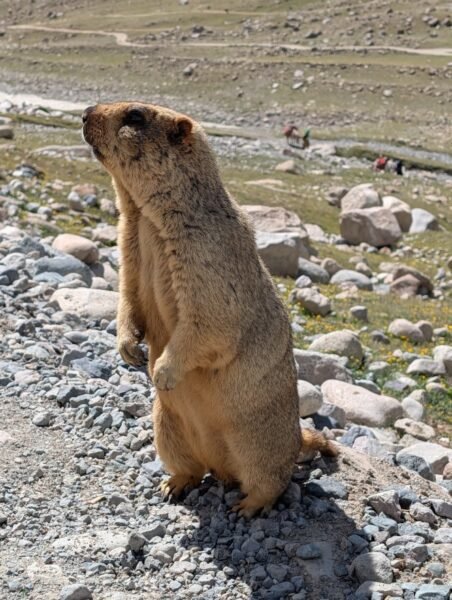
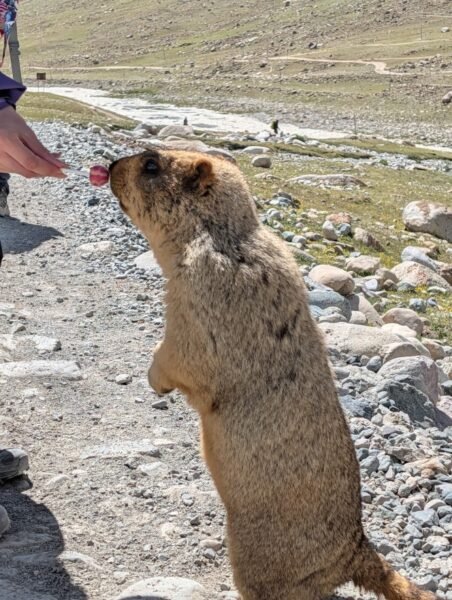
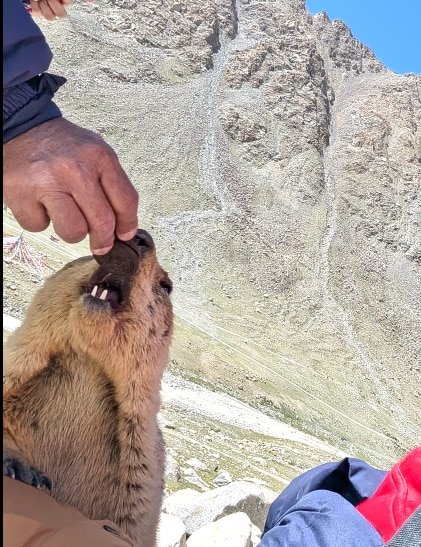
Millions of pilgrims walk these paths. The animals have learned that humans mean food. And in the charm of that moment, with this curious creature standing an arm’s length away, I fed it a biscuit from my hand.
It was a lovely moment. It was also a mistake, and I want to be plain about that rather than leave it as a charming anecdote.
The obvious risk is the animal itself. Marmots have chisel-like incisors built for a hard life. A misjudged snatch at a biscuit and my finger would have been part of the transaction.
The real risk is the one you cannot see. Himalayan marmots are a well documented natural reservoir of Yersinia pestis, the bacterium that causes plague. The bacteria live in fleas buried deep in that thick fur. A flea that jumps, or close contact with the animal, is all the disease requires. The high regions of this plateau still see occasional human outbreaks, and this is exactly how they begin.
Plague is not a medieval curiosity. It is a living organism with a living address, and I had just invited its landlord to eat out of my hand.
Do not do what I did. Not because the rules say so, but because feeding them corrupts their diet, teaches them to approach the next human, and puts a disease with a very old reputation one flea jump away from someone with no hospital within several days’ travel.
The wildlife here is beautiful. It is also, still, wild.
The Animals Who Carry Us
While the marmots and the birds are the wild heart of the plateau, we should be honest about who makes our presence here possible at all.
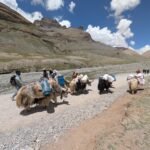
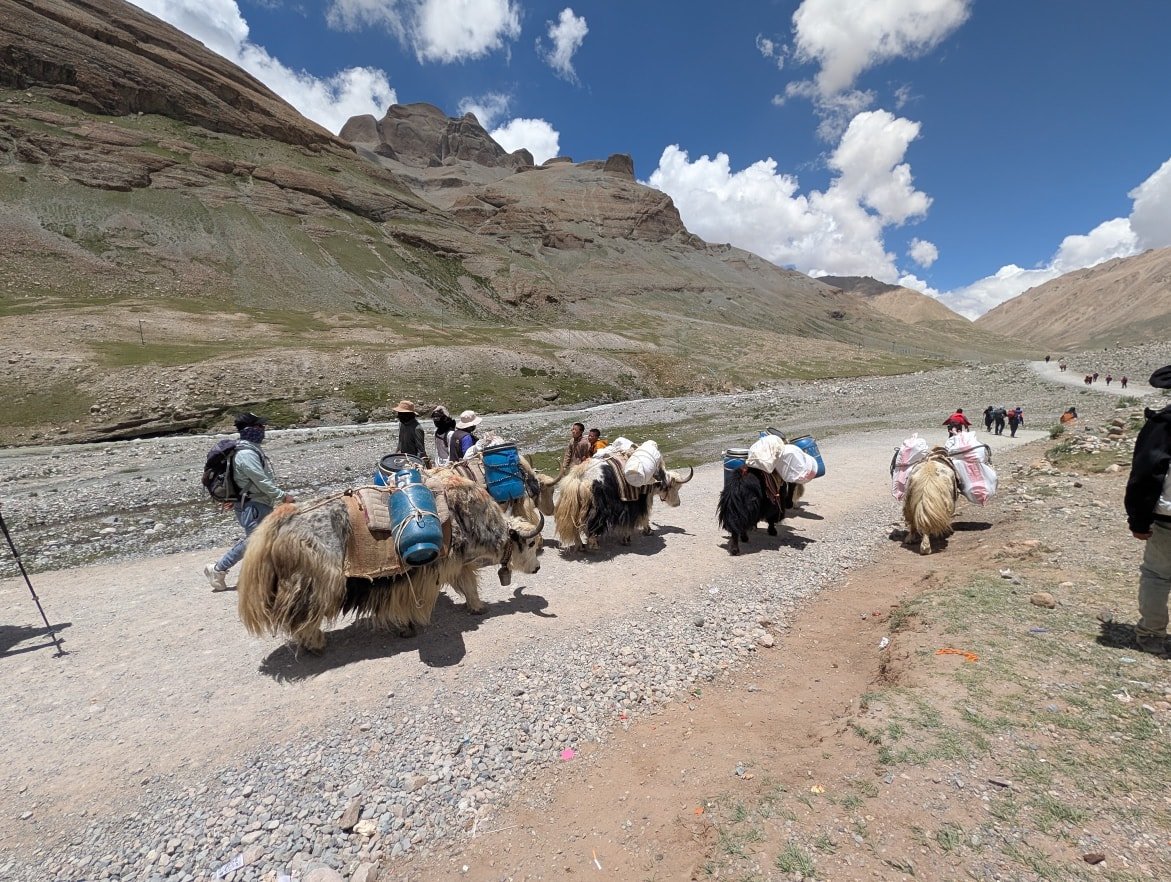
The yaks are the engines of the high Himalayas.
They are built for the altitude in a way that is almost unfair. Ordinary cattle brought up to these heights fall ill. Their lungs clamp down on the low oxygen, the pressure in the vessels rises, and the right side of the heart eventually fails under the load. Yaks simply do not do this. Their vessels stay relaxed, their hearts stay unstrained, and they walk on.
I watched a single yak carry two full gas cylinders up a steep incline with the calm of someone strolling under an umbrella. Behind it, a group of doctors and engineers and business people stopped every fifty steps to breathe.
Alongside them are the ponies, picking their way across loose scree with a surefootedness that makes no sense to anyone who has slipped on it. For pilgrims who cannot walk, or whose bodies simply will not take the punishment of the Parikrama, these ponies are the only way forward. They carry human faith over ground that leaves the fittest of us gasping.
The Ones We Did Not See
And then there is everything the mountain kept away from us.
High on the cliffs, out of sight of the endless human line, herds of blue sheep move across vertical rock as though gravity were a local custom they had opted out of. Down on the vast plains, the Tibetan wild ass runs free. And somewhere, perfectly matched to the grey scree and old snow, the snow leopard is watching a valley.
We saw none of them. That is the correct outcome.
I found that I did not mind at all. In fact, knowing they were there and had chosen not to show themselves added something the sighting would have taken away. We were not owed a snow leopard. We had not earned one. The mountain is not a park.
In Part 1, I wrote that we come here to be small. The wildlife is where that lesson stops being philosophy and becomes a fact you can watch.
The yaks, the ponies, the ravens, the marmots and the unseen cat in the slope are all at home. Every one of them belongs to this mountain.
We are the visitors. Fragile, well equipped, medicated, breathless visitors, passing briefly through someone else’s house.
The least we can do is not feed the marmots.
KAILASH MANSAROVAR YATRA SERIES
Previous in the series: Part 1, The Silent Witness: The Duality of Kailash.
Next in the series: Part 3, What the Pass Takes. 36,000 steps, 205 vertical flights, and a crossing at 18,600 ft (5,670 m).
Companion guide: A Physician’s Guide to the High Mountains. Acclimatisation, hydration, and the physiology of going slow.


Leave a Reply