






It is two in the morning in a district hospital. A 58-year-old farmer has had crushing chest pain for three hours. The ECG shows ST elevation in II, III and aVF. The nearest catheterisation laboratory is three hours away by road. The intern on duty has the ACS pathway open on her phone. It tells her what to do: tenecteplase now if nothing forbids it, and the transfer arranged at the same time. This is an illustrative case, not a real patient.
The tool gives her the thresholds and the doses. It no longer gives her the reasons. Those used to sit in its Protocols and Evidence tabs, and they have moved here so that the tool stays quick to use at the bedside. By the end of this article you will know why the pathway says what it says. Where do the 120 minutes come from? Why does India lyse and send? What did high-sensitivity troponin change? And which trials wrote each line of the shock plan?
Use this at the bedside
Open the tool: Acute Coronary Syndrome Pathway
Get the CDSS app: install the MEDiscuss CDSS on your phone
1. One umbrella, three diagnoses, two clocks
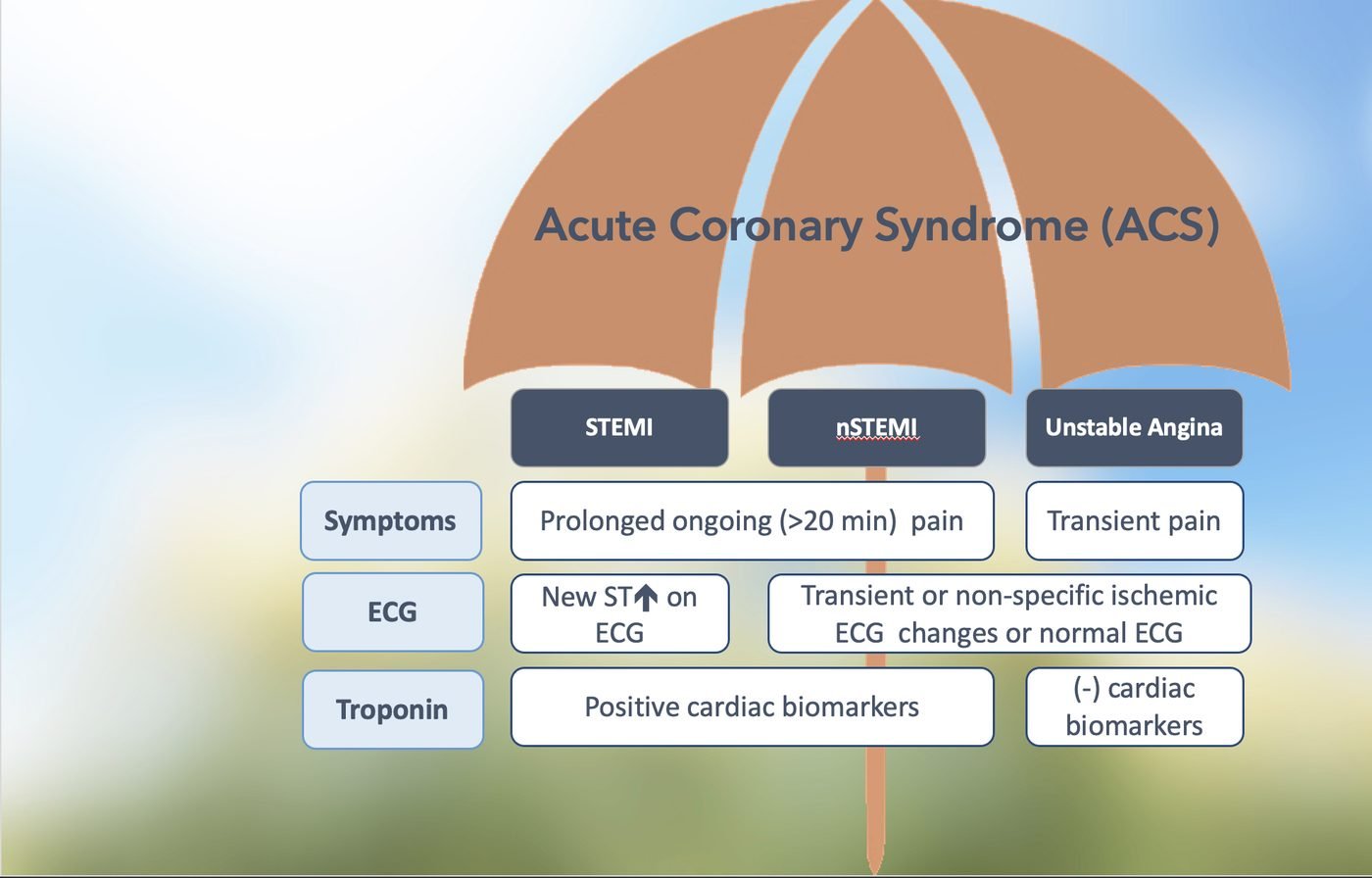
Why one word, “syndrome”, for three diagnoses? Plaque rupture or erosion with thrombus is one disease along a spectrum: the labels describe how much artery is blocked and for how long, not different illnesses. The ECG decides the first fork in minutes, persistent ST elevation meaning an occluded artery and a reperfusion clock; everything else waits for the troponin. The 2023 ESC guideline folded the STEMI and NSTE-ACS documents into one for that reason, and this tool follows (ESC 2023).
Our farmer is on the first branch. His artery is shut, and a clock is running.
What the ST segment is telling you
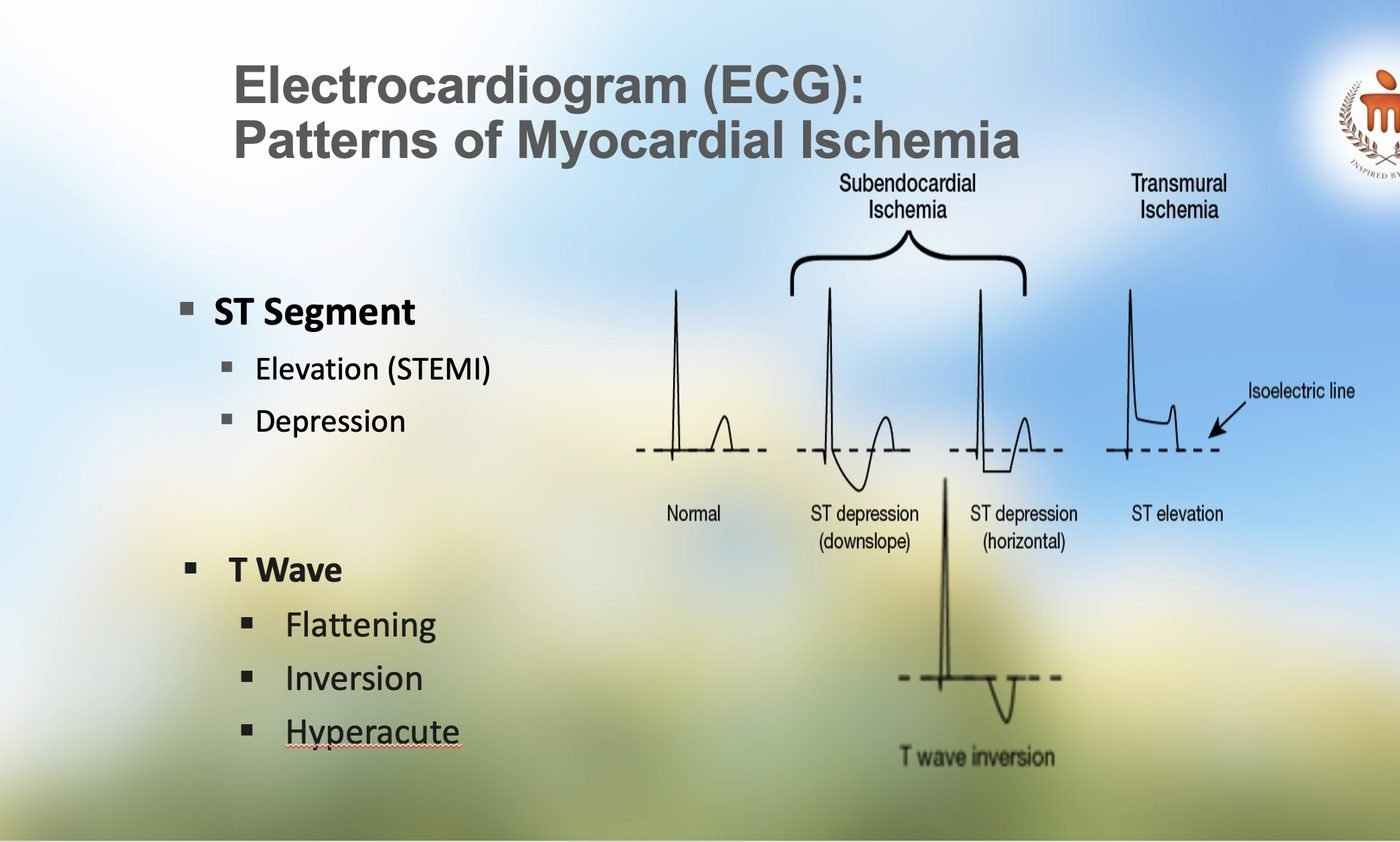
The inner layer of the ventricle, the subendocardium, is the first to run short of blood. Ischaemia confined to it depresses the ST segment. When the whole thickness of the wall is starved, the injury current points the other way and the ST segment rises. That is why ST elevation in two contiguous leads means a fully blocked artery, and why the tool asks for your reading of the ECG first.
2. Time is muscle, and the number is 120
DeWood’s angiograms in 1980 found a fresh occluding clot in nearly nine of ten transmural infarctions, fewer as the hours passed. The artery is shut and the clot is dissolving on its own, which is what puts a clock on the decision.
“So why not always send the patient for an angioplasty? Isn’t PCI better?”
It is better when it is quick. 120 minutes is the exchange rate, from the diagnostic ECG to the wire crossing. Beyond it the advantage of primary PCI is spent and a lytic given within 10 minutes does better, particularly in the first 3 hours after onset when the clot is fresh and the two strategies are close to equivalent.
STREAM tested exactly that in early presenters who could not reach PCI within an hour (STREAM). Tenecteplase then transfer matched primary PCI on death, shock, heart failure and reinfarction at 30 days. The cost was more intracranial bleeding, until the dose was halved at 75 years and above. The half dose in the elderly came from the STREAM amendment after excess intracranial bleeding. The tool still prints that half dose; this is where it came from.
The Indian corollary from CREATE. The median patient reached hospital 6 hours after the pain began (CREATE). The delay a tool cannot fix is the one before the door.
Our farmer is three hours from a laboratory: well beyond 120 minutes. He is in the first 3 hours of his pain. The lytic is the right drug for him tonight.
3. Lyse and send: the Indian standard
Most Indian patients with STEMI present to a hospital without a catheterisation laboratory and most receive streptokinase: 96 per cent of lytics in CREATE, 95 per cent in the Tamil Nadu STEMI programme. That programme showed the district hospital’s job does not end at the bolus (Tamil Nadu).
| Tamil Nadu STEMI programme, 35 spokes to 4 PCI hubs | Before | After |
|---|---|---|
| Angiography | 35 per cent | 61 per cent |
| PCI | 30 per cent | 47 per cent |
| One-year mortality | 17.6 per cent | 14.2 per cent |
Read the last row slowly. Linking small hospitals to a few PCI hubs, and sending lysed patients on, saved lives within a year. That is why the tool prints the transfer on every lytic result: it is arranged when the lytic is drawn up, not when the ST segments fail to fall.
4. High-sensitivity troponin changed the question
The older assays asked whether troponin was present. High-sensitivity assays measure it in nearly everyone, so the question became how much and whether it is moving.
The ESC 0/1 h algorithm. A very low value 3 hours into the pain rules out infarction; a low value unchanged at 1 hour does the same; a high value or a large change rules it in. About a quarter of patients are left in an observe zone for a third sample and an echocardiogram (ESC 2023). The exact cut-offs differ by analyser, to the nanogram. The tool keeps them, assay by assay, in its Protocols tab.
“If the troponin is raised, isn’t that an infarct?” Not always. A raised troponin that does not rise or fall is chronic injury. A rise in sepsis or a fast arrhythmia may be a supply problem rather than a blocked artery. The tool keeps that caution, because it decides who goes for a stent.
5. HEART, GRACE, TIMI and Killip answer different questions
Residents often ask which score is “best”. The honest answer is that each was built for a different patient. The table puts them side by side.
| Score | Question it answers |
|---|---|
| HEART | Undifferentiated chest pain in the emergency department. Five bedside items; 3 or less carries under 2 per cent risk of a major event in 6 weeks. Outperformed TIMI and GRACE for that job in its validation. Use it to decide who goes home (HEART) |
| GRACE | The patient already diagnosed with an ACS. Eight variables predicting in-hospital and 6-month death; 140 is the threshold for the laboratory within 24 hours. Use it to decide who goes tonight (GRACE) |
| TIMI | Seven yes-or-no items. The simplest and the least discriminating |
| Killip | Graded on what can be heard and seen: no failure, crackles or a third sound, frank pulmonary oedema, shock. Mortality in the original 250 patients, 1967, ran 6, 17, 38 and 81 per cent. Reperfusion has roughly halved every figure and left the gradient intact, and the class still carries 59 points in GRACE (Killip) |
None of the first three has been validated in an Indian population, and the tool says so on the result.
Killip is the oldest and still the quickest. Killip and Kimball classified 250 patients in a coronary care unit by what they could hear and see. Our farmer has clear lungs and no third sound: Killip class I. That one bedside finding already tells you he is at the lower end of the risk.
6. The timing of angiography in NSTE-ACS: downgraded, not abandoned
TIMACS randomised 3,031 patients to angiography within 24 hours or after 36 and found no difference overall, but a clear benefit in the highest-risk third, GRACE above 140 (TIMACS). Reading the later trials, the 2023 ESC guideline moved the early invasive strategy for high-risk NSTE-ACS from class I to class IIa: angiography within 24 hours should be considered, not must be done (ESC 2023).
The very-high-risk patient is different. Shock, refractory pain, acute heart failure, a life-threatening arrhythmia, a mechanical complication or recurrent dynamic ST changes still call for angiography within 2 hours. Those criteria stay in the tool, with what they mean in an Indian district hospital: the transfer happens now, whatever the hour.
7. Oxygen, and the long-term beta-blocker
“Every chest pain gets oxygen, doesn’t it?” It used to. DETO2X randomised 6,629 patients with suspected infarction and a saturation of 90 per cent or above to oxygen or air and found no difference in death at a year (DETO2X). Oxygen is a drug for hypoxaemia, not for chest pain. The tool keeps the threshold, 90 per cent.
The long-term beta-blocker rests on trials from before reperfusion, when infarcts were large and ventricles poor. Both current positions are printed beside the drug rather than one being quietly picked.
- REDUCE-AMI, 2024. 5,020 patients with an infarct and an ejection fraction of 50 per cent or above, randomised to metoprolol or bisoprolol or none: no difference in death or reinfarction over 3.5 years (REDUCE-AMI).
- ESC 2023, written before that result: class I for an ejection fraction of 40 per cent or below, a weaker recommendation for everyone else.
So the echocardiogram decides. A patient with a preserved ventricle who cannot tolerate the drug is not being denied a proven benefit.
8. The second antiplatelet
PLATO gave ticagrelor its place: against clopidogrel in 18,624 patients with ACS, fewer vascular deaths, infarctions and strokes at 12 months and lower all-cause death, at the cost of more non-procedural bleeding (PLATO). Prasugrel earned the same standing in PCI-treated patients and edged ticagrelor head to head, which is why the ESC prefers it once the anatomy is known.
Our farmer is being lysed, and neither potent agent has evidence with a lytic. Clopidogrel is his drug tonight, at the dose the tool prints for his age.
9. Shock: open the artery, only that artery
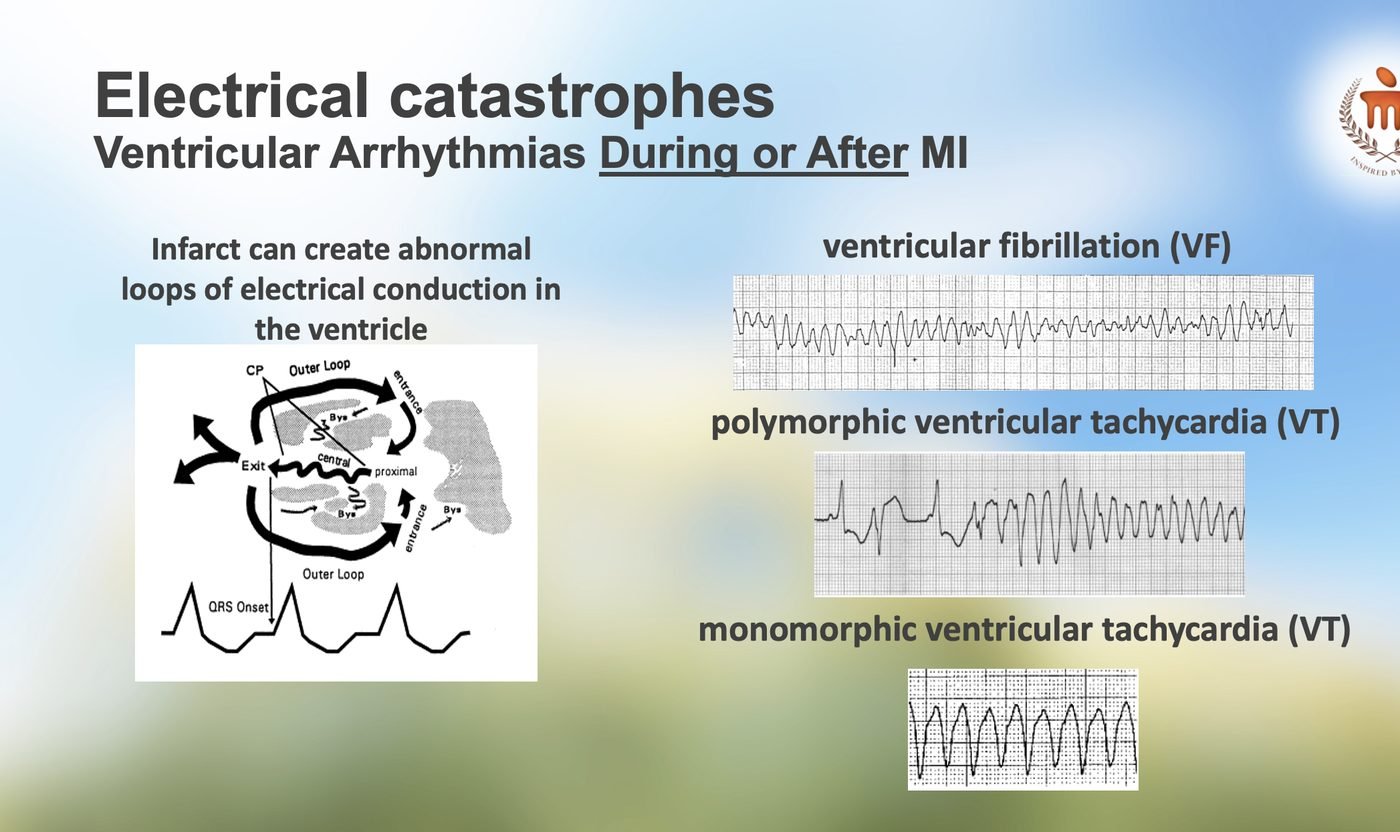
Shock after infarction and the arrhythmias in the picture above are the two ways an infarct kills in the first days. For shock, four trials wrote the plan the tool prints:
| Trial | What it settled |
|---|---|
| SHOCK, 1999 | Emergency revascularisation, rather than stabilisation first, lowered mortality at 6 months |
| IABP-SHOCK II, 2012 | Retired the balloon pump, until then a class I device, by finding no effect on 30-day death at all |
| CULPRIT-SHOCK, 2017 | Opening the non-culprit vessels in the same sitting killed more patients than opening the culprit alone (CULPRIT-SHOCK) |
| DanGer Shock, 2024 | A microaxial flow pump lowered 180-day death in STEMI shock, 58.5 to 45.8 per cent, with a four-fold rise in severe bleeding, limb ischaemia and haemolysis (DanGer Shock) |
Read the table from top to bottom and you have the order of moves: open the artery early, do not reach for the balloon pump, open only the culprit, and keep the newer pump for the centre that has one and the patient who fits the trial.
10. Why the lipid target is lower in India
Indian patients infarct a decade younger than Europeans, at cholesterol levels a Western table would call modest. That is why the Lipid Association of India set a lower goal for secondary prevention than the European and American societies (LAI). The three goals, side by side, stay in the tool.
Back to the farmer
He is three hours from a laboratory and three hours into his pain, so the lytic beats the long drive. His infarct is inferior, so a right-sided lead comes first: a right ventricular infarct changes the fluid and nitrate decisions. He gets tenecteplase by weight, aspirin, clopidogrel and enoxaparin, and the transfer is arranged as the drug is drawn up, because the Tamil Nadu programme showed that the bolus is not the end of the district hospital’s job. He has clear lungs, so he does not need oxygen unless his saturation falls below 90 per cent. Each of those decisions is a line in the tool. Each line has a trial behind it, and now you know which.
Try this
A 72-year-old woman with an anterior STEMI reaches a PCI hospital 40 minutes after her ECG was recorded. She is in cardiogenic shock. Her angiogram shows a blocked left anterior descending artery and a tight right coronary artery. What should be opened tonight, and should a balloon pump go in? Illustrative case.
Answer. The culprit artery only, now. CULPRIT-SHOCK found that opening the non-culprit vessels in the same sitting killed more patients than opening the culprit alone. No routine balloon pump: IABP-SHOCK II found no effect on 30-day death. A microaxial pump is an option only in a centre that has one and in a patient who fits the trial.
Take-home points
- In STEMI, the choice between lysis and PCI is a matter of minutes: if the wire cannot cross within 120 minutes of the ECG, lyse within 10.
- In India, lyse and send. Arrange the transfer when the lytic is drawn up, not when it fails.
- With high-sensitivity troponin, ask how much and whether it is moving, on the cut-offs of your own laboratory’s analyser.
- Use HEART to decide who goes home and GRACE to decide who goes to the laboratory tonight. Neither has been validated in India.
- Oxygen is for a saturation below 90 per cent. In shock, open the culprit artery only, and do not reach for the balloon pump.
Use this at the bedside
Open the tool: Acute Coronary Syndrome Pathway
Get the CDSS app: install the MEDiscuss CDSS on your phone
Declaration: the author built and maintains the tool. It is free to use. The figures in this article are those the tool carried in its Protocols and Evidence tabs on 3 November 2026. DeWood (1980), SHOCK (1999) and IABP-SHOCK II (2012) are named as the tool named them; the tool’s reference list does not carry them.
References
- Byrne RA, Rossello X, Coughlan JJ, et al. 2023 ESC Guidelines for the management of acute coronary syndromes. Eur Heart J. 2023;44(38):3720-3826.
- Armstrong PW, Gershlick AH, Goldstein P, et al. Fibrinolysis or primary PCI in ST-segment elevation myocardial infarction. N Engl J Med. 2013;368(15):1379-1387.
- Xavier D, Pais P, Devereaux PJ, et al. Treatment and outcomes of acute coronary syndromes in India (CREATE): a prospective analysis of registry data. Lancet. 2008;371(9622):1435-1442.
- Alexander T, Mullasari AS, Joseph G, et al. A system of care for patients with ST-segment elevation myocardial infarction in India: the Tamil Nadu-ST-segment elevation myocardial infarction program. JAMA Cardiol. 2017;2(5):498-505.
- Backus BE, Six AJ, Kelder JC, et al. A prospective validation of the HEART score for chest pain patients at the emergency department. Int J Cardiol. 2013;168(3):2153-2158.
- Granger CB, Goldberg RJ, Dabbous O, et al. Predictors of hospital mortality in the global registry of acute coronary events. Arch Intern Med. 2003;163(19):2345-2353.
- Killip T 3rd, Kimball JT. Treatment of myocardial infarction in a coronary care unit. A two year experience with 250 patients. Am J Cardiol. 1967;20(4):457-464.
- Mehta SR, Granger CB, Boden WE, et al. Early versus delayed invasive intervention in acute coronary syndromes. N Engl J Med. 2009;360(21):2165-2175.
- Hofmann R, James SK, Jernberg T, et al. Oxygen therapy in suspected acute myocardial infarction. N Engl J Med. 2017;377(13):1240-1249.
- Yndigegn T, Lindahl B, Mars K, et al. Beta-blockers after myocardial infarction and preserved ejection fraction. N Engl J Med. 2024;390(15):1372-1381.
- Wallentin L, Becker RC, Budaj A, et al. Ticagrelor versus clopidogrel in patients with acute coronary syndromes. N Engl J Med. 2009;361(11):1045-1057.
- Thiele H, Akin I, Sandri M, et al. PCI strategies in patients with acute myocardial infarction and cardiogenic shock. N Engl J Med. 2017;377(25):2419-2432.
- Møller JE, Engstrøm T, Jensen LO, et al. Microaxial flow pump or standard care in infarct-related cardiogenic shock. N Engl J Med. 2024;390(15):1382-1393.
- Puri R, Mehta V, Duell PB, et al. Proposed low-density lipoprotein cholesterol goals for secondary prevention and familial hypercholesterolemia in India with focus on PCSK9 inhibitor monoclonal antibodies: expert consensus statement from Lipid Association of India. J Clin Lipidol. 2020;14(2):e1-e13.


Leave a Reply