





“Doctor, what should I eat?” This is often the very first question after a diagnosis of diabetes. Many people leave the clinic with a printed diet chart full of grams and calories. Within a week, the chart is lost, and the old way of eating is back.
There is a simpler way. You do not need a weighing scale or a calorie app. You need one plate, and a rule for how to fill it. We call it the smart plate. This article explains what it is, why it works, and how to use it with the food we actually eat in India: rice and sambar, roti and sabzi, idli, dosa, ragi mudde, fish curry and all the rest.
A note on the name. Some companies sell “smart plates” with cameras and apps that count calories. That is not what this article is about. Here, the plate is ordinary. The smart part is how you fill it.
The Problem With the Typical Indian Plate
Think of a usual Indian lunch. A big mound of rice or a stack of chapatis takes up most of the plate. There is a small katori of dal, a spoonful of palya or sabzi, some pickle and papad. Maybe a sweet at the end.
Large national data confirm this picture. The ICMR-INDIAB study looked at the diets of over 18,000 adults across India. On average, about 62 per cent of our daily energy comes from carbohydrate, mostly white rice, wheat and sugar. Only about 12 per cent comes from protein. People in the group eating the most carbohydrate had about a 30 per cent higher chance of having newly found diabetes. (Anjana and colleagues, Nature Medicine, 2025)
Carbohydrate is not poison. It is the body’s main fuel. But when most of a meal is rice or roti, the blood sugar climbs quickly after eating. In a person with diabetes, the body cannot bring it down fast enough. Over years, these repeated high sugars damage the eyes, kidneys, nerves, heart and blood vessels.
The answer is not to stop eating. It is to change the proportions on the plate.
What Is the Smart Plate?
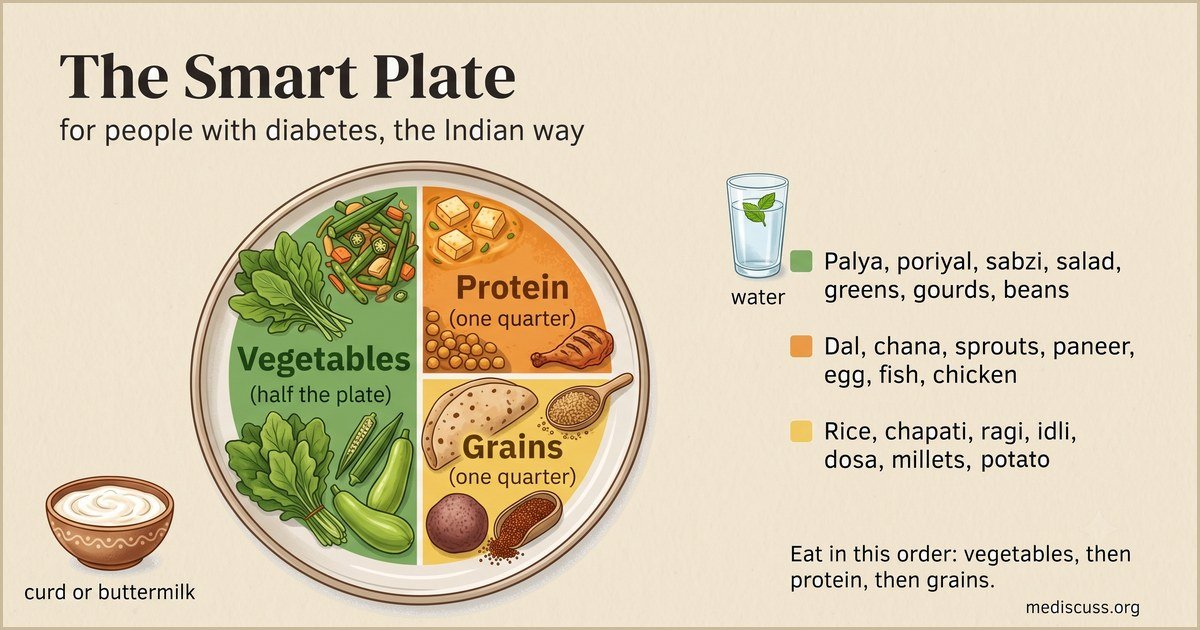
Take a regular dinner plate, about 9 inches (23 cm) across. That is smaller than the large steel thali many homes use. Now imagine a line down the middle, and then divide one side into two. You have three parts.
- Half the plate: vegetables. Cooked vegetables, salad, greens.
- One quarter: protein. Dal, legumes, paneer, curd, egg, fish or chicken.
- One quarter: grains and starchy foods. Rice, chapati, ragi, millets, idli, dosa, potato.
On the side, a glass of water or buttermilk. That is the whole idea.
This is not a new invention. The American Diabetes Association teaches the same layout as its “Diabetes Plate”. In 2024, the Indian Council of Medical Research and the National Institute of Nutrition (ICMR-NIN) released new Dietary Guidelines for Indians with a model called “My Plate for the Day”. In that model, vegetables, fruits and greens make up about half of what we eat in a day, and cereals give only about 42 per cent of the day’s energy. The smart plate simply brings these ideas to each meal, using Indian food.
Why the Smart Plate Works
- Fibre slows the sugar. Vegetables are full of fibre and water. They fill the stomach and slow down how fast sugar from rice or roti enters the blood.
- Protein keeps you full. Dal, curd, eggs and fish keep hunger away for longer, so you are less likely to reach for biscuits an hour later. In the ICMR-INDIAB study, replacing even a small part of carbohydrate with plant, dairy, egg or fish protein was linked to a lower chance of diabetes.
- The grain portion becomes smaller without feeling small. A quarter plate of rice next to a heap of vegetables looks like a full meal. A quarter plate of rice on an empty plate looks like punishment.
- It helps weight. A plate that is half vegetables carries fewer calories. For many people with type 2 diabetes, losing even a few kilos makes the sugars easier to control.
- It needs no counting. You can use it at home, in the office canteen, at a wedding or in a hotel. Your eyes are the only tool.
Half the Plate: Vegetables
This is the most important part, and the part most Indian meals get wrong. The vegetable portion should be the biggest thing on your plate, not a side dish.
Good Choices
These are the “non-starchy” vegetables. Eat them freely:
- Gourds: bottle gourd (lauki, sorekai), ridge gourd, snake gourd, ash gourd, bitter gourd (karela)
- Beans, cluster beans, broad beans, ladies’ finger (bhindi), brinjal, drumstick
- Cabbage, cauliflower, knol-khol, capsicum, tomato, onion, radish, carrot, beetroot in small amounts
- Greens of every kind: spinach (palak), amaranth (dantu soppu, chaulai), methi, drumstick leaves, sabsige, dill
- Cucumber, carrot and onion as salad; kosambari made with soaked moong dal and cucumber
- Mushrooms
Vegetables That Belong in the Grain Quarter
Some vegetables are rich in starch and act much like rice in the body. Count them in the grain quarter, not the vegetable half:
- Potato, sweet potato, yam (suran), colocasia (arbi), tapioca
- Raw banana (plantain), jackfruit when cooked as a dish, sweet corn
- Green peas, in large amounts
So a plate of aloo sabzi with chapati is really a plate of two starches. If you want potato, keep it small and reduce the chapati.
Cooking Tips
- Palya, poriyal, thoran, sabzi and stir-fries with a little oil are all good.
- Avoid deep-frying vegetables as bajji, pakora or chips. Frying turns a light food into a heavy one.
- Coconut is fine in the amounts used for seasoning a palya.
- Add vegetables to everything: carrots and beans in upma, greens in dal, onion and tomato in dosa batter, cucumber in raita.
- Watch the oil. ICMR-NIN suggests about 27 grams of visible fats and oils in a day for an adult eating 2,000 calories. That is roughly five to six teaspoons, for all meals together. Our guide Which Cooking Oil? A Physician’s Guide explains which oils to choose.
One Quarter: Protein
Most Indian meals are low in protein. The smart plate deliberately makes space for it.
| If you are vegetarian | If you eat eggs, fish or meat |
|---|---|
| Thick dal, sambar with more dal than water | Eggs: boiled, omelette, bhurji with vegetables |
| Rajma, chole, chana, lobia, horse gram (huruli) | Fish curry or grilled fish |
| Sprouted moong or chana as usal or salad | Chicken curry or tandoori chicken, without the skin |
| Paneer, tofu, soya chunks | Prawns, crab, in curry rather than fried |
| Curd, hung curd, buttermilk | Limit red meat, and avoid processed meats like sausage and salami |
A few points to note:
- Thin dal is mostly water. One ladle of thin rasam or watery dal gives very little protein. Make the dal thicker, or take two katoris.
- Dal and legumes also contain some carbohydrate. They raise sugar much more slowly than rice, and they bring fibre and protein with them. They are still the best protein base for vegetarians.
- Avoid fried protein. Fish fry, chicken fry, chicken 65 and paneer pakora add a lot of oil. Curry, grill or tandoor is better.
- If you have kidney disease, ask your doctor how much protein is right for you before you increase it.
One Quarter: Grains and Starchy Foods
Rice and roti are not banned. They are simply put in their place: one quarter of the plate.
For most adults, a quarter plate works out to about one cup of cooked rice (a medium katori), or two medium chapatis, or two idlis, or one dosa, or one small ragi ball. Your doctor or dietitian may adjust this depending on your weight, your activity and your medicines.
Rice or Chapati: Which Is Better?
Many people with diabetes switch from rice to chapati and believe the problem is solved. Then they eat five chapatis. Wheat and rice both contain mostly starch. The amount on your plate matters far more than which grain it is. Two chapatis are better than five; one cup of rice is better than three.
Millets, Brown Rice and Whole Grains
Ragi, jowar, bajra, foxtail millet and other millets, along with brown rice and whole wheat, carry more fibre, minerals and vitamins than polished white rice. They are good choices.
But they are not magic. They are still mostly carbohydrate, and they still raise the blood sugar. In the ICMR-INDIAB analysis, simply swapping refined cereals for milled whole grains, without eating less of them, was not linked to a lower risk of diabetes. A big plate of millet is still a big plate of carbohydrate. Choose millets if you like them, but keep them in the quarter.
Foods to Keep Small
- Maida items: parotta, naan, bhatura, white bread, bakery buns
- Fried breakfast items: puri, vada, bonda, mangalore buns
- Poha, upma, sabudana khichdi and pongal when made with little vegetable and lots of grain
- Biscuits and rusks, including those labelled “diabetic” or “sugar-free”. They are still made from flour.
Eat in the Right Order: Vegetables First, Rice Last
The order in which you eat the food on the plate also matters. In a small study published in Diabetes Care in 2015, people with type 2 diabetes ate the same meal on two days. On one day they ate the bread first; on the other, they ate the vegetables and protein first and the bread last. When the carbohydrate came last, the rise in sugar after the meal was clearly smaller, by roughly a third in the first hour. (Shukla and colleagues)
This is easy to do with an Indian meal:
- Start with the salad, kosambari or palya.
- Then eat the dal, curd, egg or fish.
- Finish with the rice or chapati, along with whatever remains.
It costs nothing and changes nothing on the plate. It only changes the order.
Fruit, Milk and Drinks
- Fruit is welcome, but not as a juice. Eat one fruit, or one small bowl, as a snack between meals rather than piled on top of a full lunch. Guava, apple, pear, orange, papaya and jamun are good choices. Banana, mango, chikoo, grapes and custard apple are fine in small portions. ICMR-NIN advises fresh fruit and asks us to avoid juices.
- Curd and buttermilk are an excellent part of an Indian meal. Plain curd can count as part of your protein quarter.
- Tea and coffee: two cups a day with little or no sugar. Each teaspoon of sugar counts.
- Water is the best drink with a meal. Avoid soft drinks, packaged juices and sweetened lassi.
- Jaggery, honey and brown sugar raise your sugar just like white sugar does. We have explained this in Sugar or Jaggery: Which Is Really Healthier?
The Smart Plate for Common Indian Meals
Here is how some everyday meals look before and after. You do not need to change your cuisine. You only need to change the balance.
| Meal | The usual way | The smart plate way |
|---|---|---|
| South Indian lunch | Three cups of rice with sambar and rasam, a spoon of palya, pickle, papad | One cup of rice; a large helping of palya and kosambari; thick sambar or dal; a bowl of curd. Eat the palya first. |
| North Indian lunch or dinner | Four or five chapatis, aloo sabzi, a small katori of dal | Two chapatis; a big bowl of a non-potato sabzi such as lauki, bhindi or palak; a full katori of thick dal or rajma; cucumber raita |
| Idli breakfast | Five or six idlis with coconut chutney | Two or three idlis; a big bowl of vegetable-rich sambar; a boiled egg or a small bowl of sprouts |
| Dosa breakfast | Two masala dosas with potato filling | One plain dosa or pesarattu (green moong dosa); chutney; sambar; a bowl of curd or an egg |
| Poha or upma | A full plate of poha with sev | A smaller portion loaded with peas, carrots, beans and onion; peanuts in place of sev; a side of curd or sprouts |
| Ragi mudde | Two large balls with thin saaru | One small ball; soppina saaru (greens curry) or bassaru with plenty of dal and greens; a side of palya |
| Fish meal (coastal) | Rice heaped high, fish fry, a little curry | One cup of rice; fish curry or tawa fish with little oil; a big helping of vegetable thoran or palya; kokum or plain buttermilk |
| Chicken or mutton meal | Biryani, plus raita | A smaller portion of biryani (count it all as grain); a large bowl of salad and raita; or swap to chicken curry with two chapatis and a large vegetable side |
Festivals, Weddings and Eating Out
Indian life is full of feasts. The smart plate travels with you.
- Banana-leaf meals: ask for less rice at the first serving and a second helping of palya and kosambari. You can refuse the second round of rice.
- Buffets: walk around once before you serve yourself. Fill half the plate with salad and vegetable dishes first. Then add a protein, then a small portion of rice or roti.
- Sweets: a small piece, eaten at the end of a full meal, causes less of a rise than the same sweet eaten alone at teatime. Share it rather than skipping meals to “make room” for it.
- Restaurants: order one extra vegetable dish or salad for the table. Choose tandoori over butter gravies, and phulka over naan.
A Word on Fasting
Fasting days often end up as high-sugar days. Sabudana khichdi, potato, fruit and sweets are all heavy in carbohydrate. Apply the plate even on a fast: makhana, curd, paneer, peanuts and permitted vegetables can fill the protein and vegetable parts.
If you take insulin or tablets such as glimepiride or gliclazide, talk to your doctor before you fast. These medicines can push your sugar too low if you skip meals.
Common Mistakes
- “I have stopped rice, so I can eat as many chapatis as I like.” Both are starch. Watch the amount.
- “Millets and brown rice are safe in any quantity.” They are better grains, not free grains.
- “Diabetic” and “sugar-free” snacks. Sugar-free biscuits, sweets and namkeen are usually made of flour and fat. They still raise the sugar and add calories.
- Skipping dinner or breakfast. A long gap often leads to a large meal later, and can cause low sugar in people on certain medicines. Eat regular, balanced meals.
- Fruit juice in place of fruit. Juice removes the fibre and delivers the sugar fast. Eat the fruit instead.
- Stopping medicines because the diet is good. The smart plate works alongside your medicines, not in place of them. Any change to medicines must be made with your doctor.
Who Should Take Extra Care
The smart plate suits most adults with type 2 diabetes or prediabetes. Some people need advice that fits their own situation:
- People on insulin or on sulphonylurea tablets (glimepiride, gliclazide, glibenclamide). If you cut your rice sharply, your medicine dose may need to come down. Check your sugars and tell your doctor.
- People with kidney disease, who may need limits on protein, potassium or salt.
- Pregnant women with diabetes, and children with type 1 diabetes.
- Older adults who are thin, frail or losing weight. For them, eating enough matters more than eating less.
Your Smart Plate in Five Checks
Before you start eating, look at your plate and ask:
- Is half of it vegetables?
- Is there a real portion of protein: dal, curd, egg, fish or paneer?
- Is the rice, roti or other grain only about a quarter?
- Is there anything deep-fried or sweet that I can make smaller?
- Am I drinking water or buttermilk rather than juice or a soft drink?
Then eat the vegetables first.
How to Start
Do not try to change every meal on the first day. Start with one meal, usually lunch or dinner, and use the smart plate for two weeks. If you check your sugar at home, test two hours after that meal before and after the change. Many people see the difference on the meter, and that is the best encouragement there is.
Show this article to the person who cooks at home. The smart plate works best when the whole family eats the same way, and the rest of the family will benefit too.
For a simple check of your overall health habits, try Swasthya Compass.
References
- Anjana RM, et al. Dietary profiles and associated metabolic risk factors in India from the ICMR–INDIAB survey-21. Nature Medicine. 2025. nature.com/articles/s41591-025-03949-4
- Anjana RM, et al. Macronutrient Recommendations for Remission and Prevention of Diabetes in Asian Indians Based on a Data-Driven Optimization Model: The ICMR-INDIAB National Study. Diabetes Care. 2022;45(12):2883. diabetesjournals.org
- ICMR-National Institute of Nutrition. Dietary Guidelines for Indians, 2024, and Policy Brief: Promotion of “My Plate for the Day”. nin.res.in
- Shukla AP, Iliescu RG, Thomas CE, Aronne LJ. Food Order Has a Significant Impact on Postprandial Glucose and Insulin Levels. Diabetes Care. 2015;38(7):e98-e99. doi:10.2337/dc15-0429
- American Diabetes Association. Diabetes Plate Method: Plan Your Plate 1 2 3. 2025. professional.diabetes.org
This article is for general education. It does not replace advice from your own doctor or dietitian, who knows your full health picture.


Leave a Reply