




A physician’s formula for carrying the load
Pressure vs stress: we use these words as if they mean the same thing. They are not the same. Once you see the difference, both become much easier to handle.
Pressure is the work. It is the amount you have to do: exams, deadlines, a long list of tasks, the ticking clock. Pressure comes from outside you, and most of the time you cannot change it.
Stress is the feeling. It is what you feel inside when the work seems bigger than what you can handle. And here is the good news. That feeling is not fixed. You have more control over it than you think.
So pressure is the load. Stress is what your mind does with that load. The same exam can leave one student calm and ready, and another student shaking with worry. The exam did not change. The mind did.
A little pressure is good for you
It may sound strange, but some pressure actually helps you. If there is no pressure at all, we get bored and lazy and do very little. When there is too much pressure, we feel crushed and freeze up. The sweet spot is in the middle. A fair amount of pressure sharpens your focus and brings out your best. So the goal is not to remove all the pressure. The goal is to handle the pressure well.
The formula
Here is a simple way to remember all of this:
The Three-P Formula

Stress
=
Pressure
−
( Preparation + Perspective + Presence )
Raise the three P’s to meet the pressure, and stress falls toward zero. The pressure that remains stops being a threat and becomes fuel.
Preparation
Build capacity until the same load feels lighter.
Perspective
Control the effort; release the result.
Presence
One task, one moment, full attention.
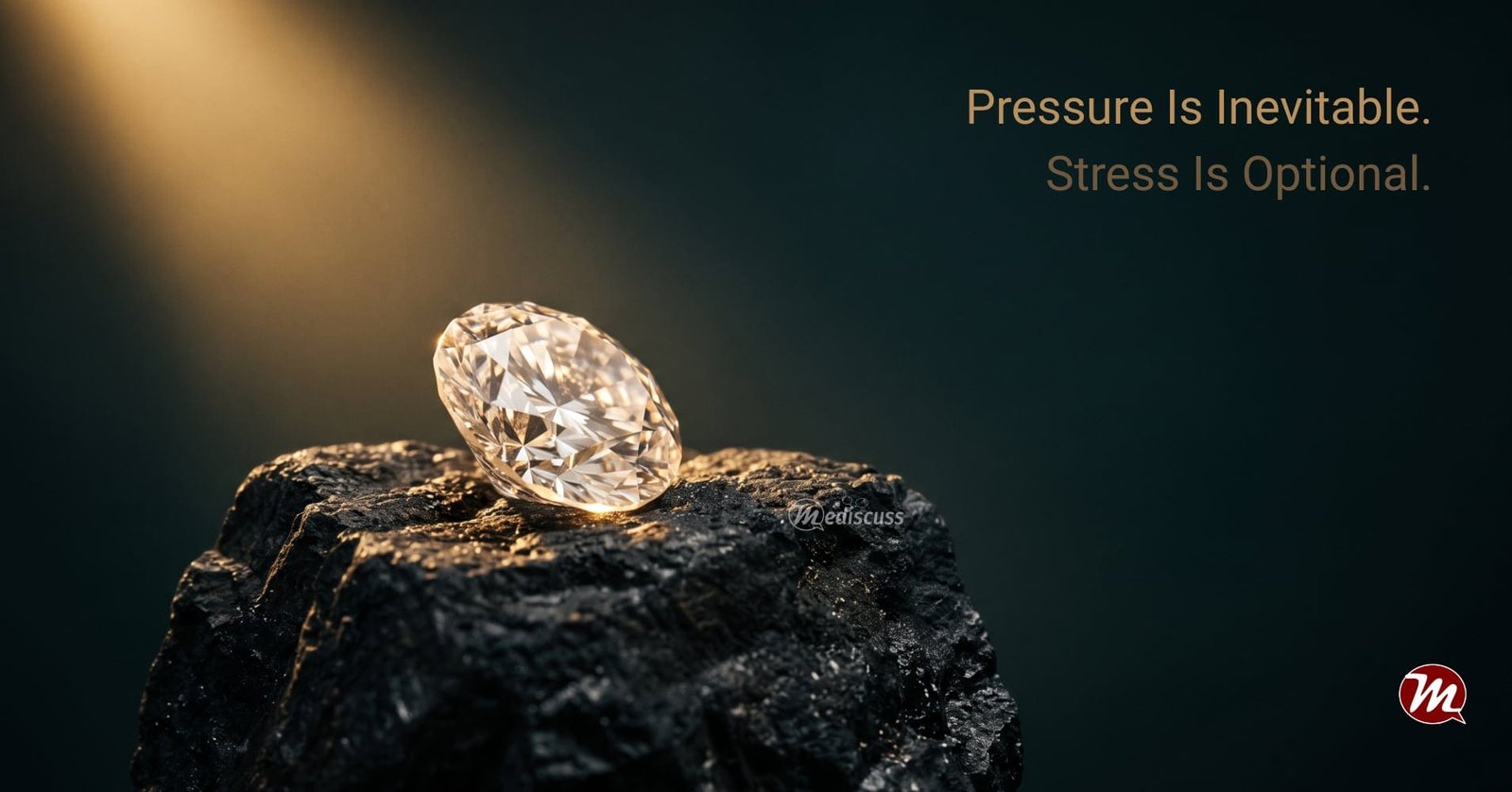
Pressure is inevitable. Stress is optional.
Read it like this. You usually cannot lower the pressure in front of you. The exam is on its date. The work is what it is. But you can always raise the three P’s: Preparation, Perspective, and Presence. When you improve them to match the pressure, the stress you feel drops closer to zero. Even better, the leftover pressure does not feel like a threat anymore and starts working like fuel.
Let us look at each P.
Preparation… get ready
Most of the panic you feel comes from the gap between what you have to do and what you feel you are able to do. Worrying does not close that gap. Practice does. When you study, revise, and prepare well, the same task starts to feel lighter. A prepared mind sees the same workload as smaller and easier.
Perspective… do your best, then let go
A lot of your stress comes from holding on to the result too tightly.
I must come first…
I must not fail…
This has to be perfect…
An old and wise line from the Bhagavad Gita says it aptly… you have a control on your effort, but not on its fruit. In plain words, give your full effort to the part that you have control over, and loosen your desire t on the result that you cannot control.
Importantly, stop comparing yourself with others. Comparison steals your peace faster than almost anything.
Presence… one thing at a time
A mind that keeps jumping between the result, the phone, yesterday, and tomorrow has very little energy left for the task in front of it.
Focus is a skill you can build. Put the phone away. Finish one thing fully before you move to the next. When your attention is gathered in one place, ordinary effort becomes powerful.
I learned this the hard way
I did not get this from a book. During the pandemic, I was in charge of a hospital that was a Dedicated COVID Hospital. For months I lived where life and death met, and the pressure was greater than anything I had ever known.
It never turned into unbearable stress, and the three P’s are the honest reason why I was able to manage. I could not carry all of it at once, so I did not. I took it one patient, one task, and one hour at a time. That is Presence. I gave every patient my complete effort, and still could not save everyone. Doing the work fully and then letting go of the result was the only way to keep going. That is Perspective. And we survived on good systems and a strong team, and I did not try to be a lone hero. That is Preparation.
On the days when I ignored any of this, skipped sleep, and tried to do everything by myself, the pressure turned into stress. The formula is real to me because I have felt what happens when you forget it.
Simple habits that help
The three P’s set the plan. These small daily habits make it work.
- Sleep seven to eight hours. Sleep is not wasted time. It is when your brain saves what you learned and gets you ready for the next day.
- Breathe slowly. A few slow breaths, with a long breath out, calm your body in a minute or two. Use this in the last minute before an exam or any hard moment.
- Do one task at a time. Trying to do many things at once is just fast switching, and it leads to more mistakes.
- Break large work into small pieces. A huge task feels lighter the moment you cut it into small steps.
- Say one line before you start. Something simple like, “I control my effort, not the result.” It settles the mind and gets you moving.
- Talk to someone. Sharing a worry with a friend, a parent, or a teacher makes it lighter. Asking for help is a strength, not a weakness.
The takeaway
Pressure is a normal part of any life worth living. You cannot remove it, and you should not, too.
Stress, on the other hand, is something you shape by the way you meet that pressure.
Raise your Preparation, Perspective, and Presence, and the same pressure will start to feel light. Then it works for you instead of against you.
Stress = Pressure − ( Preparation + Perspective + Presence ) Pressure is inevitable. Stress is optional.
Keep the three P’s high, and the rest takes care of itself.


Leave a Reply